Facts
The petitioner, a Patwari, was charged with financial irregularities regarding crop damage assessments following a 2020 hailstorm
Source reference: p.2A departmental enquiry was conducted where the Enquiry Officer exonerated the petitioner
Source reference: p.2However, the disciplinary authority disagreed with these findings and imposed a punishment of withholding five annual increments with cumulative effect without recording reasons for disagreement or allowing the petitioner to respond to said disagreement
Source reference: p.2, 3The petitioner’s first appeal to the Collector, Bhind, was rejected via a brief, unreasoned order on 12.08.2025
Source reference: p.2A subsequent second appeal to the Commissioner, Chambal Division, was dismissed on jurisdictional grounds
Source reference: p.2The petitioner subsequently challenged these orders under Article 226 of the Constitution of India
Source reference: p.1Issues
1. Whether the disciplinary authority’s order of punishment was legally sustainable given the lack of reasons for disagreeing with the Enquiry Officer’s exoneration
Source reference: p.32. Whether the Appellate Authority acted within its quasi-judicial mandate by passing a non-speaking and unreasoned order
Source reference: p.3, 4Law Applied
The court applied the principles of natural justice and the requirement for "speaking orders" in quasi-judicial proceedings.
Source reference: no citationState of Punjab v. Bandip Singh, holding that administrative decisions must be self-sustaining and impregnated with reasons
Source reference: p.4, 5Kranti Associates Pvt. Ltd. v. Masood Ahmed Khan, which mandates that quasi-judicial authorities must record reasons to ensure transparency, accountability, and to prevent arbitrary exercise of power
Source reference: p.5, 6Oryx Fisheries Pvt. Ltd v. Union of India, affirming that the absence of reasons in an original order cannot be cured by reasons provided in an appellate order
Source reference: p.7-9Reasoning
The court found that the disciplinary authority committed a procedural irregularity by overstepping the Enquiry Officer's exoneration without recording specific reasons for disagreement or providing the petitioner an opportunity to rebut those reasons
Source reference: p.3Regarding the Appellate Authority (Collector), the court observed that the order dated 12.08.2025 was "non-speaking" and failed to demonstrate any application of mind to the grounds raised in the appeal
Source reference: p.3, 4Since the Appellate Authority exercises quasi-judicial powers, it was legally obligated to produce a reasoned order that reflects an objective consideration of facts
Source reference: p.4The court noted that "reason is the soul of justice" and the failure to provide it rendered the impugned orders capricious and arbitrary under the established precedents
Source reference: p.5, 6Holding
The court allowed the petition in part, holding that the impugned appellate orders were unsustainable due to the lack of reasoning
The Court quashed the appeal rejection order dated 12.08.2025 passed by the Collector and the second appeal order dated 23.04.2026. The matter was remanded to the Collector, Bhind, with directions to allow the petitioner to file a fresh appeal within three weeks and for the Collector to decide the same via a reasoned and speaking order within three months.
Source reference: p.10Original Court PDF
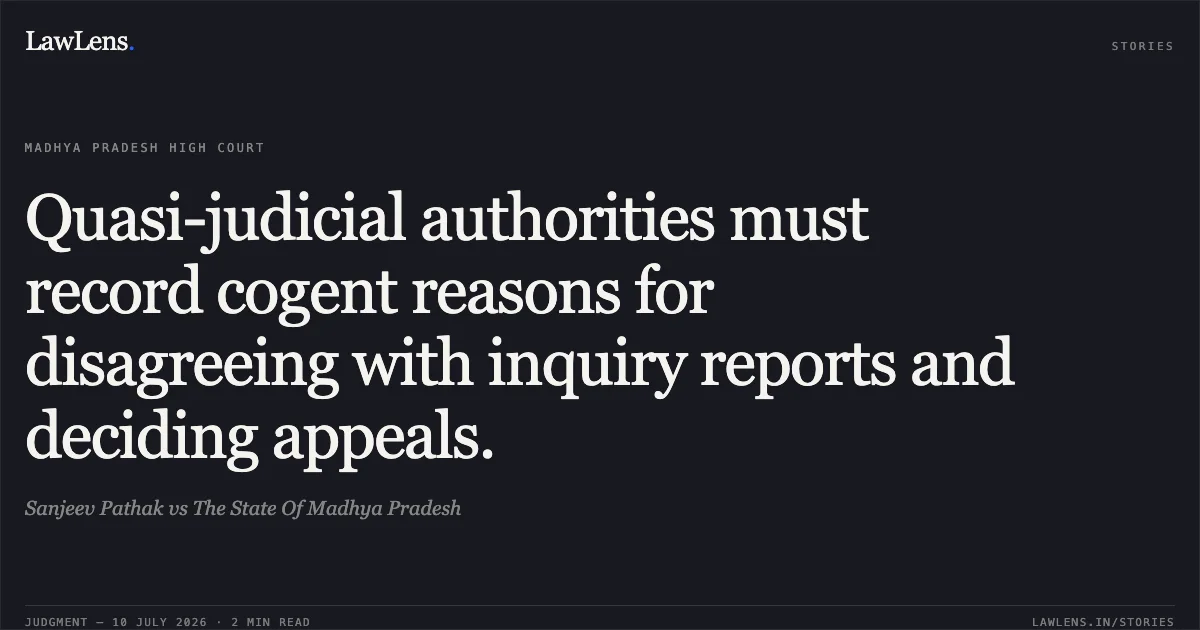
Sanjeev PathakvsThe State Of Madhya Pradesh
Click to open original judgment
Original judgment, available to read, download and summarize on LawLens.in