Facts
The petitioner, a Junior Engineer at the Sheopur Rural Distribution Centre, was served a show-cause notice on September 19, 2009
Source reference: para. 2He submitted his reply on August 21, 2010; however, the Disciplinary Authority had already issued a punishment order on August 17, 2010—three days prior to receiving the reply—withholding two annual increments without cumulative effect
Source reference: para. 2The petitioner appealed to the Appellate Authority, which partially modified the punishment on January 12, 2011, reducing it to the withholding of one annual increment for two years without cumulative effect
Source reference: para. 2, 6The petitioner challenged these orders under Article 226 of the Constitution of India, contending they were non-speaking and failed to consider the grounds raised in his defense
Source reference: para. 1-2Issues
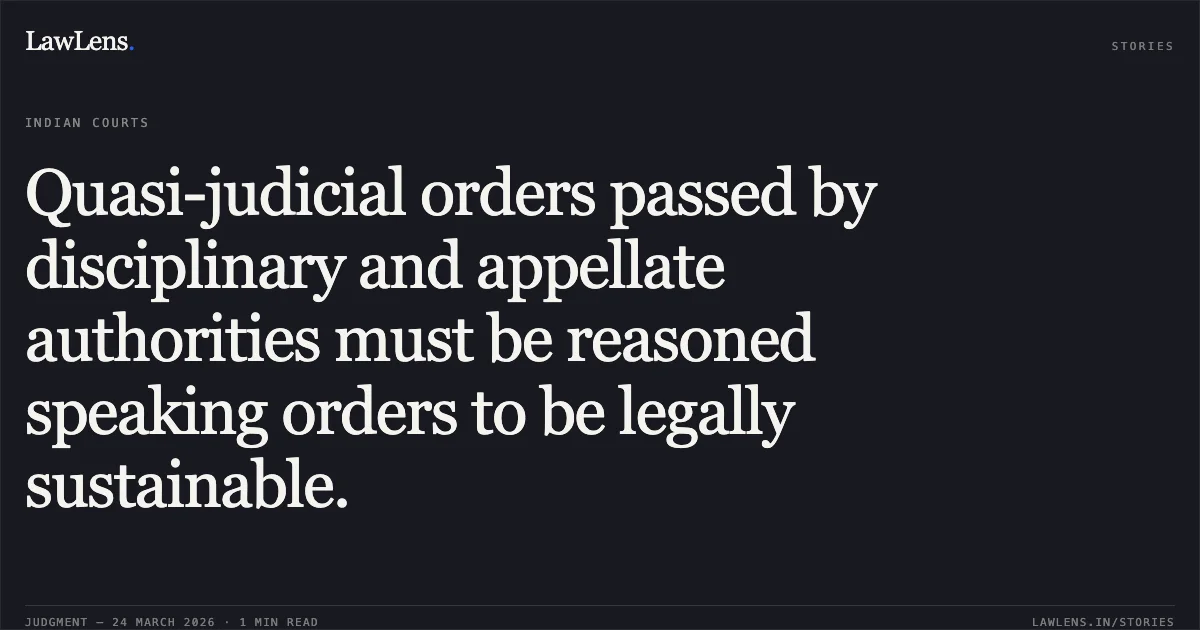
1. Whether the Disciplinary and Appellate Authorities, while exercising quasi-judicial powers, are mandated to pass speaking orders containing valid and justifiable reasons
Source reference: para. 5, 72. Whether the impugned orders, passed without considering the petitioner's reply and grounds of appeal, were legally sustainable
Source reference: para. 8, 12Law Applied
The Court applied the principle that authorities exercising quasi-judicial powers must pass "speaking orders" that demonstrate an objective application of mind to the facts
Source reference: para. 5, 7It relied on State of Punjab v. Bandip Singh (2016) 1 SCC 724, which mandates that administrative or executive decisions must be self-sustaining and disclose all prevailing reasons
Source reference: para. 9-10It further invoked the principles from Kranti Associates Pvt. Ltd. v. Masood Ahmed Khan (2010) 9 SCC 496, which established that recording reasons is an indispensable component of natural justice and the "lifeblood" of judicial decision-making
Source reference: para. 11Reasoning
The Court observed that the Disciplinary Authority issued the punishment order before even receiving the petitioner’s reply, indicating a total lack of application of mind and a failure to exercise due diligence
Source reference: para. 2, 5Upon perusing the appellate order, the Court found it to be non-speaking as it failed to address the specific facts and grounds raised by the petitioner in the appeal
Source reference: para. 7The Court held that for a quasi-judicial order to be valid, the "face of the order must speak," ensuring the affected party understands how their defense was considered
Source reference: para. 8, 11Drawing from Kranti Associates, the Court reasoned that the requirement to record reasons is a component of human rights and fairness, and an order lacking such reasons is arbitrary and capricious
Source reference: para. 10-11Holding
The Court set aside the punishment order dated August 17, 2010, and the appellate order dated January 12, 2011
The Respondents were directed to grant the petitioner all consequential benefits within three months from the receipt of the certified copy of the order
Source reference: para. 13Notably, as the petitioner had already retired, the Court explicitly declined to grant the respondents liberty to initiate any further action against him
Source reference: para. 13The petition was disposed of accordingly
Source reference: para. 14Original Court PDF
Shrimohan SharmavsM.P.Madhya Kshetra Vidyut Vitran Com. Ltd.
Click to open original judgment
Original judgment, available to read, download and summarize on LawLens.in