Facts
The petitioner, an Assistant Manager/Junior Engineer, was served a charge-sheet on April 6, 2016, and a supplementary charge-sheet on September 2, 2010
Source reference: para. 2The petitioner contended that several requested documents necessary for his defense, such as log-sheet registers and specific distribution formats, were not supplied
Source reference: para. 2Following an inquiry, the Disciplinary Authority passed an order on March 30, 2017, imposing a major punishment of withholding one increment with cumulative effect
Source reference: para. 3, 6The petitioner’s subsequent appeal was rejected by the Appellate Authority on July 1, 2017
Source reference: para. 3, 8The petitioner challenged these orders under Article 226 of the Constitution of India, primarily on the grounds that they were non-speaking and unreasoned
Source reference: para. 1, 3During the pendency of the matter, the petitioner retired on June 30, 2025
Source reference: para. 15Issues
1. Whether the orders passed by the Disciplinary and Appellate Authorities were "speaking orders" that demonstrated an objective application of mind to the facts and defense
Source reference: para. 7, 92. Whether the failure of quasi-judicial authorities to record specific reasons for imposing and upholding a punishment vitiates the decision-making process
Source reference: para. 10, 13Law Applied
The court applied the principles of natural justice and the requirement of quasi-judicial authorities to pass "speaking orders"
Source reference: para. 7, 9It relied on State of Punjab v. Bandip Singh (2016), which held that administrative or executive decisions must be self-sustaining and contain all prevailing reasons
Source reference: para. 11The court further cited Ram Kishun v. State of U.P. (2012), establishing that decisions must not be capricious or arbitrary but informed by reasons
Source reference: para. 12Kranti Associates Pvt. Ltd. v. Masood Ahmed Khan (2010), which characterized the recording of reasons as an indispensable component of the decision-making process and human rights
Source reference: para. 13Reasoning
The Court reviewed the text of the Disciplinary Authority’s order and found it merely stated that the petitioner’s reply contained no facts and concluded the punishment was "justifiable" without addressing the merits of the defense or the specifics of the evidence
Source reference: para. 6, 7Similarly, the Appellate Authority’s order was found to be a summary rejection that failed to consider the specific grounds raised in the appeal, relying instead on a vague assertion of "sympathetic consideration"
Source reference: para. 8, 9The Court reasoned that since these authorities exercise quasi-judicial powers, they are legally obligated to record justifiable grounds to ensure the affected party knows how their case was considered
Source reference: para. 7, 10Relying on the Kranti Associates doctrine, the Court noted that an order must not be like the "inscrutable face of a sphinx" but must demonstrate through reasoning that all relevant factors were objectively considered
Source reference: para. 13Holding
The Court held that both the punishment order dated March 30, 2017, and the appellate order dated July 1, 2017, were non-speaking and lacked legal sustainability
The Court set aside both orders and directed the respondents to provide all consequential benefits to the petitioner within three months
Source reference: para. 14Noting the petitioner’s age (64) and retirement on June 30, 2025, the Court expressly denied the respondents any liberty to take fresh action against the petitioner
Source reference: para. 15The petition was disposed of with these directions
Source reference: para. 16Original Court PDF
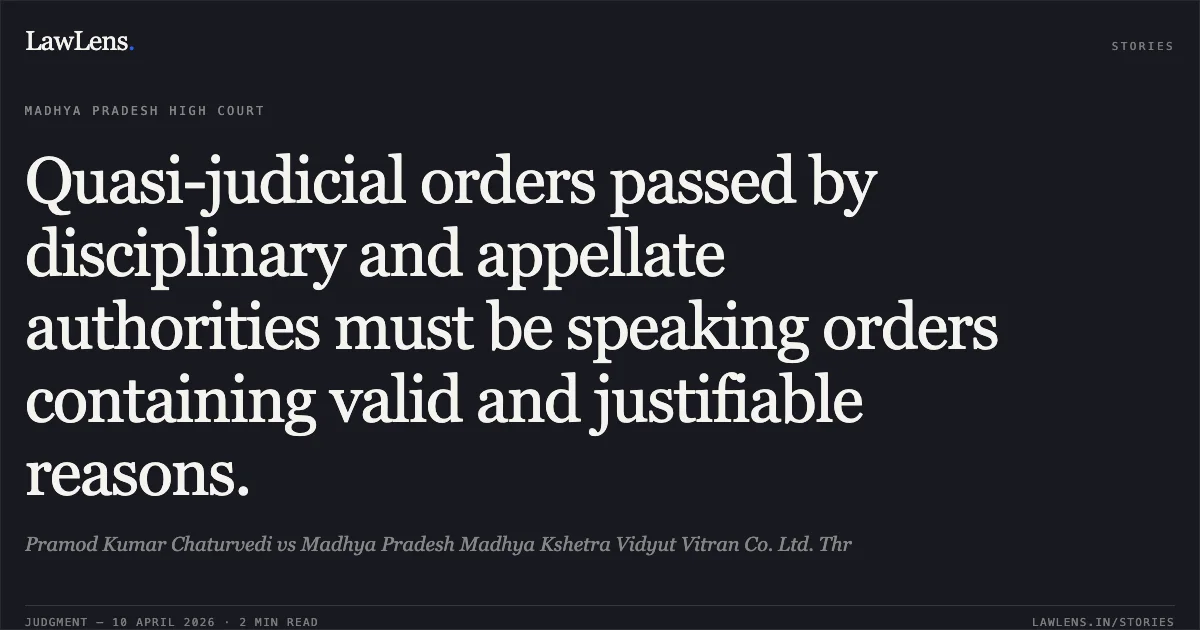
Pramod Kumar ChaturvedivsMadhya Pradesh Madhya Kshetra Vidyut Vitran Co. Ltd. Thr
Click to open original judgment
Original judgment, available to read, download and summarize on LawLens.in