Facts
The petitioner, a Constable in the Special Armed Force (Gwalior), was served a show-cause notice on 14.02.2011 alleging misconduct.
Source reference: para. 2Despite submitting a detailed reply on 22.02.2011 denying the allegations of verbal abuse and disputes with the Guard Commander, the Disciplinary Authority passed an order on 03.08.2011.
Source reference: p. 1-2The order imposed a punishment of withholding one annual increment without cumulative effect.
Source reference: para. 2The petitioner’s subsequent appeal was dismissed by the Appellate Authority on 03.04.2012.
Source reference: para. 2The petitioner challenged both orders under Article 226 of the Constitution, contending they were non-speaking and unreasoned.
Source reference: para. 2Issues
1. Whether the punishment order dated 03.08.2011 and the appellate order dated 03.04.2012 are legally sustainable as "speaking orders".
Source reference: para. 6, 82. Whether an administrative or quasi-judicial authority is mandated to record valid and justifiable reasons in support of its conclusions when affecting the rights of a party.
Source reference: para. 9Law Applied
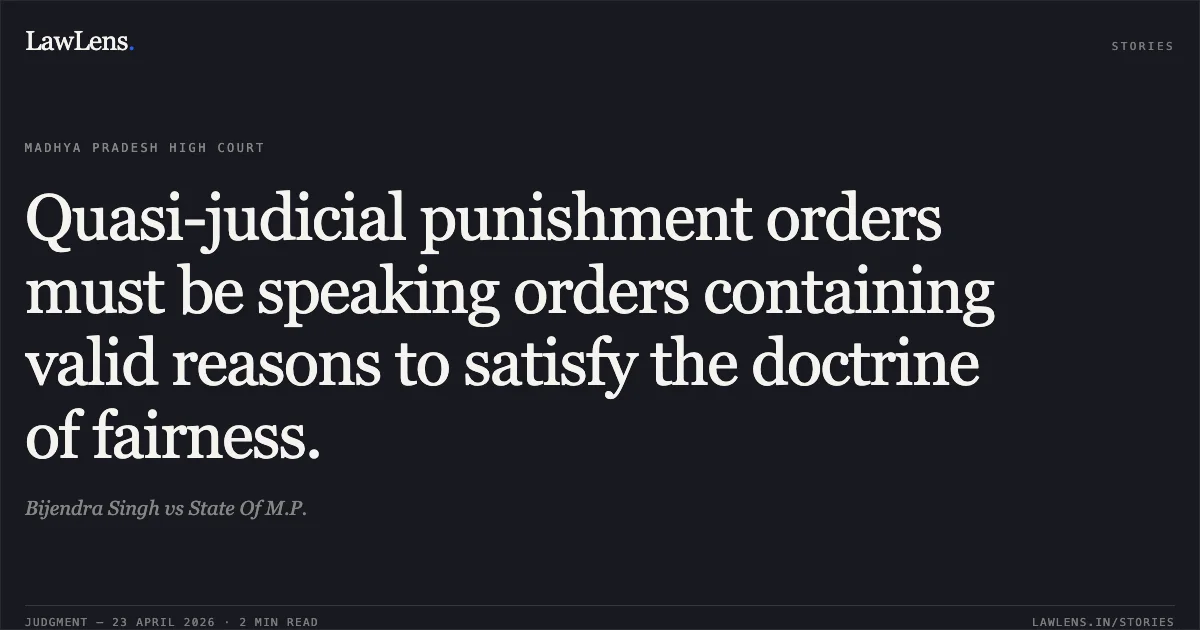
The court primarily applied the principle that quasi-judicial and administrative authorities must pass reasoned "speaking orders" to satisfy the doctrine of fairness and natural justice.
Source reference: para. 6, 12State of Punjab v. Bandip Singh, which held that executive decisions must be self-sustaining and impregnated with reasons.
Source reference: para. 10-11Kranti Associates Pvt. Ltd. v. Masood Ahmed Khan, establishing that recorded reasons are the "lifeblood of judicial decision-making" and a component of human rights under the rule of law.
Source reference: para. 12Reasoning
The Court observed that the Disciplinary Authority, while exercising quasi-judicial powers, failed to apply its mind to the specific facts and grounds raised in the petitioner's reply.
Source reference: para. 6Upon perusing the impugned order dated 03.08.2011, the Court found it to be non-speaking and lacking justifiable reasoning.
Source reference: para. 6Similarly, the Appellate Authority's order dated 03.04.2012 was found deficient as it did not objectively consider the merits of the appeal, with the State’s counsel candidly admitting that no specific reasoning had been assigned while concurring with the initial findings.
Source reference: para. 3, 8The Court reasoned that since the rights of the petitioner were prejudicially affected, the authorities did not have carte blanche to take arbitrary or capricious decisions without demonstrating how the defense was considered.
Source reference: para. 9-11Holding
The Court answered in the negative, holding that both the disciplinary and appellate orders were unsustainable due to a lack of reasoning.
Consequently, the High Court set aside the punishment order dated 03.08.2011 and the appeal rejection order dated 03.04.2012. The respondents were directed to grant all consequential benefits to the petitioner within three months from the receipt of the certified copy of the order.
Source reference: para. 13(i), 13(ii)Original Court PDF
Bijendra SinghvsState Of M.P.
Click to open original judgment
Original judgment, available to read, download and summarize on LawLens.in