Facts
The appellant was convicted by the Xth Additional District and Sessions Judge, Moradabad, in Sessions Trial No. 136 of 1986 for offences under Sections 366 and 376 IPC, and sentenced to three years’ rigorous imprisonment under Section 366 IPC and seven years’ rigorous imprisonment with a fine of ₹2,000 under Section 376 IPC.
Source reference: para. 2The prosecution alleged that, on 12 November 1985, the appellant abducted the complainant’s daughter from Moradabad after alluring her, and took cash and jewellery with her.
Source reference: para. 3–4The victim testified that the appellant represented that her mother had met with an accident, took her first by rickshaw and thereafter by matador to Sambhal, threatened her with a knife, kept her there for approximately eight days, and subjected her to forcible sexual intercourse.
Source reference: para. 5The defence disputed the allegations and asserted that the victim had voluntarily accompanied the appellant.
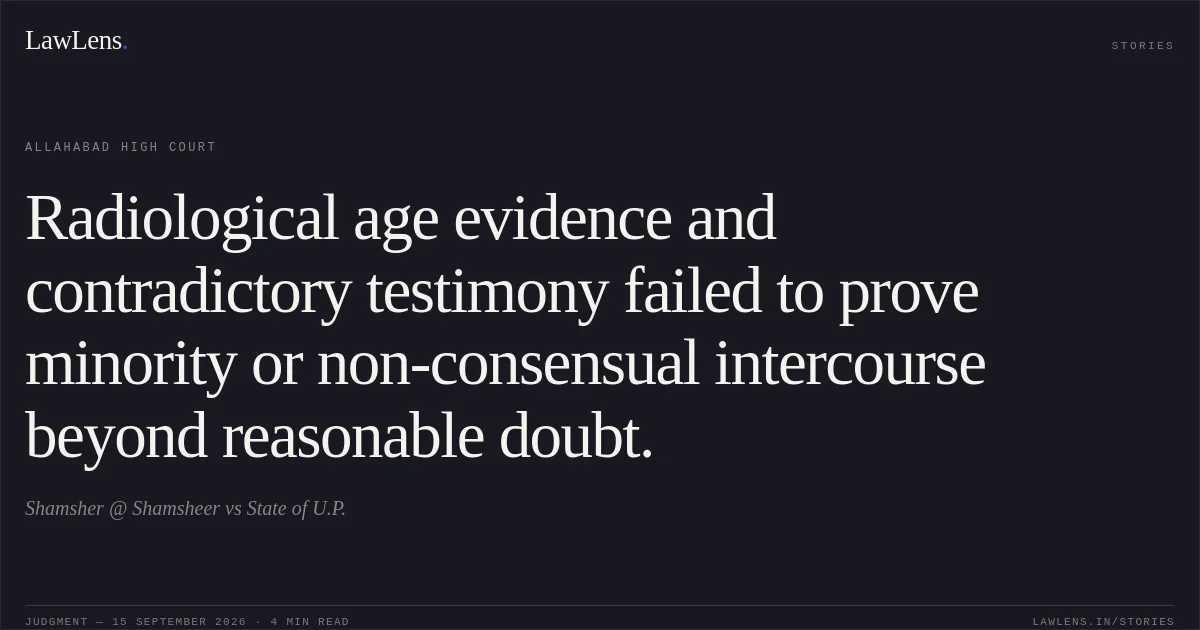
Source reference: no citationThe victim’s age was determined principally through medical and radiological evidence as approximately 17 years, with the medical evidence acknowledging a possible variation of about six months.
Source reference: para. 22, 28, 30The High Court noted material inconsistencies between the evidence of the victim, her father, the recovery witnesses, the medical evidence and the investigation, including the absence of injuries or bloodstains and the failure of the victim to raise an alarm during her alleged confinement and transit.
Source reference: para. 18, 22, 25–27, 31, 35The appellant preferred the present appeal against his conviction.
Source reference: no citationIssues
1. Whether the prosecution proved beyond reasonable doubt that the victim was a minor on the date of the alleged occurrence, so as to negate the relevance of consent under the applicable law.
Source reference: paras. 30, 32–33, 362. Whether the prosecution established that the appellant abducted or induced the victim and committed rape against her will and without her consent.
Source reference: paras. 5, 31, 35–373. Whether the contradictions in the prosecution evidence and the uncertainty in the medical determination of age entitled the appellant to the benefit of doubt.
Source reference: paras. 31–37Law Applied
The court applied Sections 366 and 376 IPC concerning kidnapping/abduction of a woman for illicit purposes and rape, respectively, and required the prosecution to establish the essential ingredients of those offences beyond reasonable doubt.
Source reference: para. 2It applied the principle that the prosecution bears the burden of proving the victim’s minority through reliable evidence, and that radiological age estimation is approximate and must be assessed with an appropriate margin of error.
Source reference: paras. 22, 28, 30, 33, 36The court relied on Rajak Mohammad v. State of Himachal Pradesh, 2018 (9) SCC 248, for the principles that radiological evidence may not conclusively establish minority; that the accused must receive the benefit of reasonable doubt concerning age; and that, where the prosecutrix remained with the accused and had opportunities to complain but did not do so, the possibility of consensual conduct may not be wholly excluded.
Source reference: paras. 32–34, 37The general criminal law principle that reasonable doubt must operate in favour of the accused was also applied.
Source reference: paras. 33, 37Reasoning
The court found that the prosecution evidence was materially inconsistent. The victim alleged forcible transportation, threats, physical injuries and bleeding, but the medical officer found no incised wounds, abrasions or bleeding, and no bloodstains on her clothes were recorded by the father or the investigating officer.
Source reference: paras. 18, 22, 27, 35Her account was also inconsistent with her father’s version regarding the manner and place of recovery, and the recovery witness could not identify the person who allegedly fled from the rickshaw.
Source reference: paras. 16, 20–21The court further considered it significant that the victim allegedly travelled through public places, remained in Sambhal for eight days among several persons, and did not raise an alarm or complain to anyone.
Source reference: paras. 10–14, 31, 35Since the only substantial age evidence was radiological and placed her age at approximately 17 years, subject to a possible variation, the court held that minority was not proved with certainty.
Source reference: paras. 22, 28, 30, 36Applying Rajak Mohammad, the court concluded that the possibility of voluntary accompaniment and consensual conduct could not be ruled out, and that the cumulative inconsistencies created reasonable doubt regarding abduction and rape.
Source reference: paras. 32–37Holding
The High Court held that the prosecution failed to prove beyond reasonable doubt that the victim was a minor or that the appellant had abducted and raped her.
The conviction and sentences imposed by the trial court under Sections 366 and 376 IPC were therefore set aside, and the appellant was acquitted of all charges on the benefit of doubt.
Source reference: para. 38As the appellant was already on bail, he was not required to surrender; his bail bonds were cancelled and the sureties were discharged.
Source reference: para. 38The appeal was accordingly allowed.
Source reference: para. 39Acts & Sections Cited
4 provisions across 2 statutes referred to in this judgment. Each provision opens on LawLens.
Indian Penal Code, 18603
Code of Criminal Procedure, 19731
Original Court PDF
Shamsher @ ShamsheervsState of U.P.
Click to open original judgment
Original judgment, available to read, download and summarize on LawLens.in