Facts
The petitioner and her husband, Iliyas Tamboli, claimed compensation before the Railway Claims Tribunal for the death of their unmarried son in an alleged untoward railway incident.
Source reference: pp. 1–3, paras. 2–7Iliyas died while the claim was pending, but the Tribunal was not informed.
Source reference: pp. 1–3, paras. 2–7On 14 August 2024, the Tribunal awarded ₹8,00,000, allocating equal shares to the petitioner and Iliyas.
Source reference: pp. 1–3, paras. 2–7The petitioner later sought release of Iliyas’s share to her; the Tribunal rejected the application, holding that it could not modify its final judgment.
Source reference: pp. 1–3, paras. 2–7The petitioner challenged that order under Article 227 of the Constitution.
Source reference: pp. 1–3, paras. 2–7Issues
Whether the Railway Claims Tribunal could modify its final compensation order to release the deceased co-applicant’s allocated share to the petitioner
Source reference: pp. 3–5, paras. 10–16Whether, as the surviving parent and dependent of the deceased passenger, the petitioner could receive the entire compensation
Source reference: pp. 3–5, paras. 11, 16Law Applied
Section 123(b) of the Railways Act, 1989 identifies a passenger’s parent or parents as dependants where the deceased passenger was unmarried; compensation under Section 124-A was therefore payable to the petitioner in her capacity as a dependent.
Source reference: p. 3, para. 11Under Section 18 of the Railway Claims Tribunal Act, 1987, the Tribunal is guided by natural justice and may regulate its procedure; Section 18(3), including clause (f), confers specified civil-court powers, including review of its decisions.
Source reference: p. 4, paras. 12, 16The Tribunal could also exercise power analogous to Section 152 of the Code of Civil Procedure, 1908, which permits correction of accidental slips or omissions.
Source reference: pp. 4–5, paras. 13–15In Niyamat Ali Molla v. Sonargaon Cooperative Housing Society, AIR 2008 SC 225, the Supreme Court explained that this power reflects the principle actus curiae neminem gravabit and supports correction of the record to reflect the true state of affairs;
Source reference: pp. 4–5, paras. 13–15Lakshmi Ram Bhuyan v. Hari Prasad Bhuyan, (2003) 1 SCC 197, recognizes that Section 152 enables a court to give effect to the meaning and intention of its judgment.
Source reference: pp. 4–5, paras. 13–15Reasoning
The Tribunal had found both parents to be dependants and divided the award equally.
Source reference: pp. 3–5, paras. 10–11, 16But because the deceased passenger was unmarried, the petitioner could have pursued the claim alone as his dependent had the father’s death been brought to the Tribunal’s attention; she would then have been entitled to the full ₹8,00,000.
Source reference: pp. 3–5, paras. 10–11, 16The Tribunal’s refusal rested on an unduly narrow view that it lacked power to alter a final order.
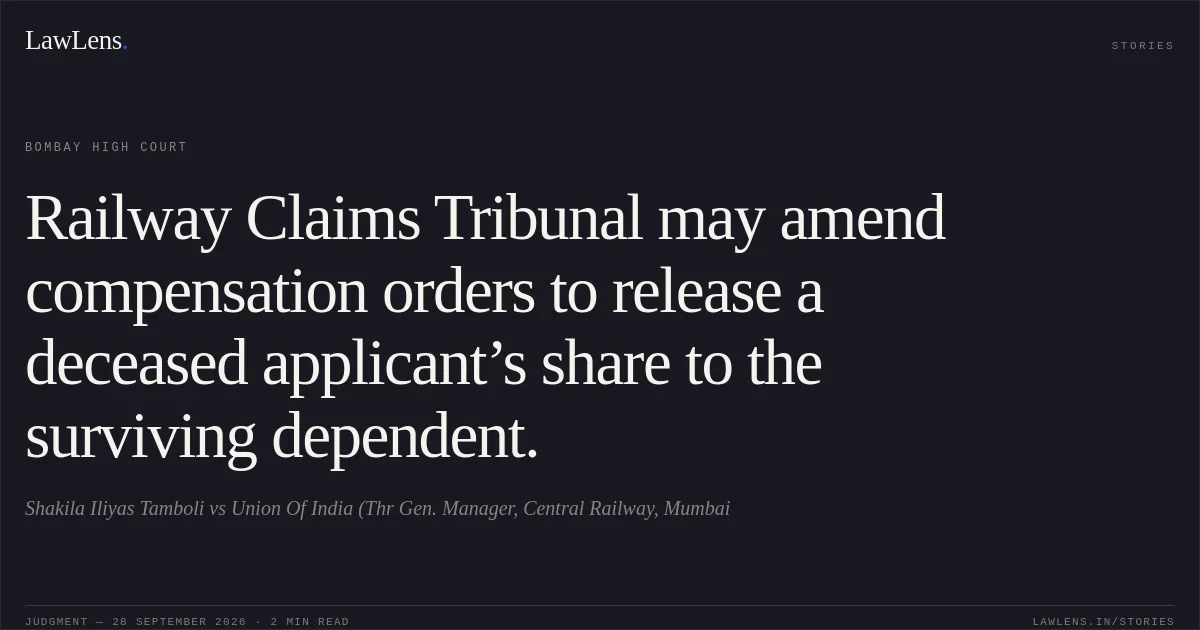
Source reference: pp. 4–5, paras. 12–16In light of its statutory powers and the principles underlying Section 152 CPC, it could make the necessary correction and release the share allocated to the deceased co-applicant to the petitioner.
Source reference: pp. 4–5, paras. 12–16Holding
The Court allowed the petition and quashed the Tribunal’s order dated 31 January 2025.
It allowed the petitioner’s miscellaneous application and directed the Tribunal to amend its judgment of 14 August 2024 to release to her the compensation share allocated to the deceased applicant, within 30 days of communication of the order.
Source reference: p. 6, para. 18Rule was made absolute, with no order as to costs.
Source reference: p. 6, para. 18Acts & Sections Cited
4 provisions across 3 statutes referred to in this judgment. Each provision opens on LawLens.
Railway Claims Tribunal Act, 19872
Railways Act, 19891
Code of Civil Procedure, 19081
Original Court PDF
Shakila Iliyas TambolivsUnion Of India (Thr Gen. Manager, Central Railway, Mumbai
Click to open original judgment
Original judgment, available to read, download and summarize on LawLens.in