Facts
Shri K.V. Damodaran, a Railway employee, was issued a charge sheet in 2004 for gross negligence and stock shortages
Source reference: para. 1After several rounds of litigation regarding medical retirement and his dues, he was permitted to retire but the disciplinary authority imposed a penalty of withholding 100% of his Death-cum-Retirement Gratuity (DCRG) and ordered recovery of Rs. 50,60,416/-
Source reference: paras. 2-7While a revision petition was pending, Damodaran passed away on 17.08.2008
Source reference: para. 8The revisional authority subsequently reduced the penalty to 50% withholding of DCRG
Source reference: para. 9Thereafter, on 19.11.2012, the Railways directed that the remaining outstanding amount be recovered from the family pension of his widow, Respondent No. 1
Source reference: para. 10The Central Administrative Tribunal (CAT) set aside this recovery order, leading the Railways to challenge the CAT's decision before the High Court
Source reference: paras. 11-12Issues
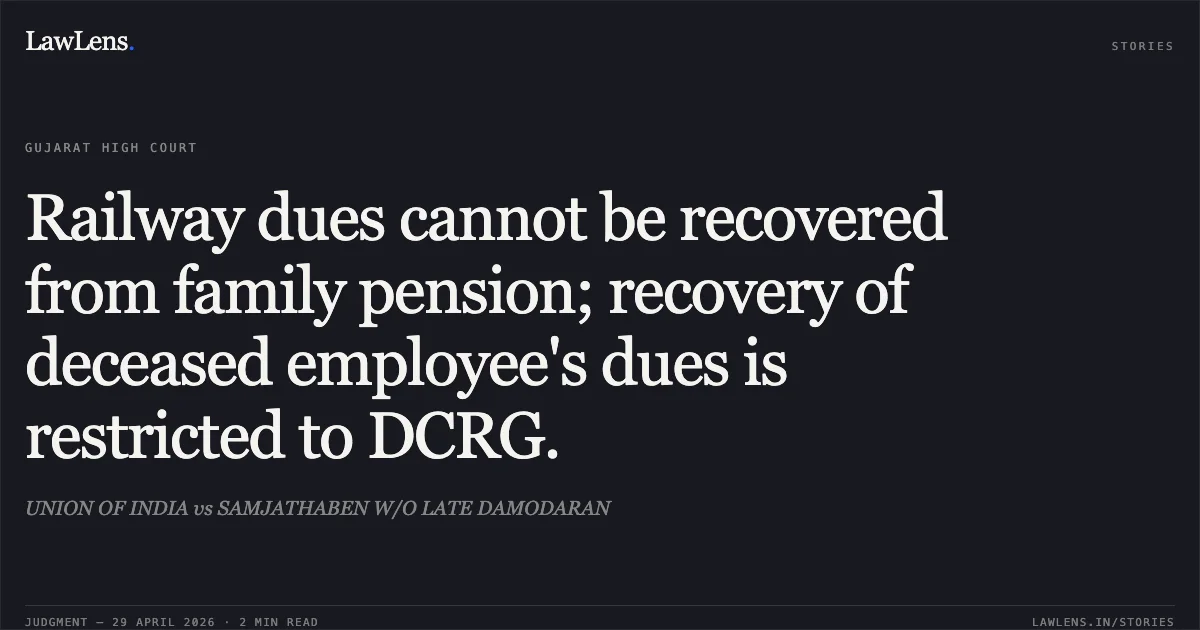
Whether the Railways is legally entitled under the Railway Services (Pension) Rules, 1993, to recover the dues/losses caused by a deceased employee from the family pension payable to his widow.
Source reference: para. 14Law Applied
Rule 15 of the Railway Services (Pension) Rules, 1993, which authorizes recovery of railway dues only from the dues of the pensionary benefits of the employee themselves
Source reference: para. 15Rule 98(2) of the same Rules, which stipulates that in the event of a railway servant's death, any recoverable dues under Rule 15 and Rule 16(6) shall be recovered solely from the amount of Death-cum-Retirement Gratuity (DCRG) becoming payable to the family
Source reference: para. 16The court also applied the legal principle that family pension is a separate entitlement for the survival of legal heirs and does not constitute an "estate" left behind by the deceased employee
Source reference: para. 20Reasoning
The Court reasoned that Rule 15 is restricted to proceedings against the "railway servant" and cannot be extended to a third party receiving a family pension
Source reference: para. 15The Court observed that Rule 98(2) explicitly limits the scope of recovery after an employee's death to the DCRG payable to the family; the Pension Manual lacks any provision for recovery from the family pension itself
Source reference: paras. 16-17The Bench emphasized that this omission is intentional, as legal heirs cannot be held personally liable for the service-related debts of the deceased
Source reference: para. 18Since family pension is granted to enable survivors to sustain themselves, it is immune from recovery of the deceased’s dues, regardless of whether the recovery is sought from the basic pension or the dearness relief
Source reference: paras. 19-20Holding
The Court held that the Railways cannot recover modern or outstanding dues of a deceased employee from the family pension of the widow.
The Tribunal’s decision was upheld, and the writ petition filed by the Union of India was dismissed. The Court ordered that any amounts recovered by virtue of the interim relief during the pendency of the petition must be returned to the respondent widow.
Source reference: paras. 21-22Acts & Sections Cited
3 provisions across 1 statute referred to in this judgment. Linked provisions open on LawLens.
Company Law Board (Qualifications, Experience and Other Conditions Of Service of Members) Rules, 19933
Original Court PDF
UNION OF INDIAvsSAMJATHABEN W/O LATE DAMODARAN
Click to open original judgment
Original judgment, available to read, download and summarize on LawLens.in