Facts
On 11 November 2023, Raguraman, a season-ticket holder travelling from Kancheepuram, alighted at Guindy Railway Station. While climbing the foot overbridge steps, he was pushed amid heavy crowding, fell, sustained a head injury and later died in hospital.
Source reference: paras. 8–10His wife and minor children sought compensation under Sections 123, 124A and 125 of the Railways Act, 1989.
Source reference: paras. 2(b)–(e), 12The Railway Claims Tribunal awarded them ₹8,00,000, with interest, but incorrectly described the incident as an accidental fall from a train.
Source reference: paras. 2(b)–(e), 12The Union of India appealed, arguing that the incident was not an “untoward incident” and that the death was natural.
Source reference: paras. 4, 7Issues
Whether a passenger’s fatal fall on a station foot overbridge, caused by crowding and pushing, constitutes an “untoward incident” under the Railways Act, 1989.
Source reference: para. 15Whether the Railway Administration was exempt from compensation under any exception in the proviso to Section 124A.
Source reference: paras. 7, 14Law Applied
Section 123(c) of the Railways Act defines “untoward incident” to include specified violent acts within railway premises and the accidental falling of a passenger from a train; Section 124A imposes liability for death or injury resulting from an untoward incident, subject to its enumerated exceptions; and Sections 2(29) and 125 address passenger status and applications by dependants.
Source reference: pp. 4–6; para. 5The Court applied the principle that beneficial welfare legislation should receive a liberal, purposive interpretation, relying on Union of India v. Prabhakaran Vijayakumar.
Source reference: para. 24It also referred to Article 38(1) of the Constitution and the principle of strict liability under Section 124A.
Source reference: paras. 6, 22, 26Reasoning
The Court accepted the Tribunal’s findings that Raguraman was a bona fide passenger and that he fell on the foot overbridge steps within the station premises, but set aside the Tribunal’s finding that he fell from a train as a clerical error.
Source reference: paras. 8–12The post-mortem report attributed death to the head injury, and the Railway did not establish any exception under Section 124A.
Source reference: paras. 13–14In light of the crowding and pushing, the Court treated the incident as a stampede and, invoking Section 123(c)(1)(ii), characterised the pushing by other passengers as a violent attack within the station precincts.
Source reference: paras. 19–23, 31It concluded that the incident fell within Section 124A and that the Railway’s strict liability applied.
Source reference: para. 22Holding
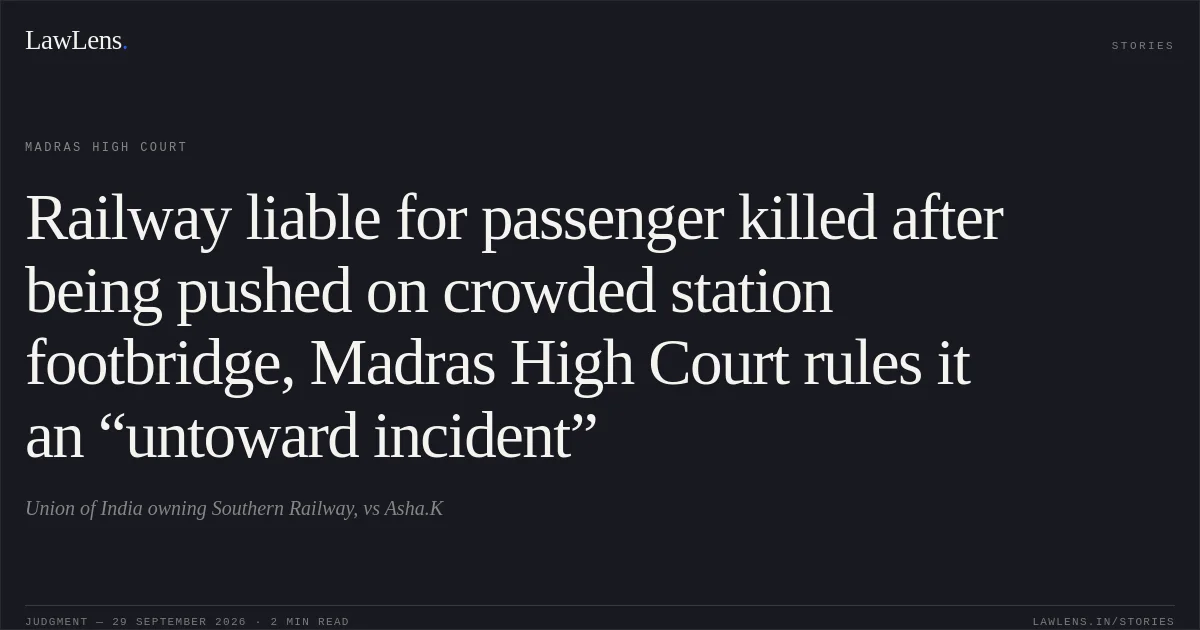
The Court held that the fatal fall on the foot overbridge amid heavy crowding and pushing amounted to an “untoward incident,” and that no Section 124A exception had been proved.
It dismissed the appeal, confirmed the Tribunal’s award of ₹8,00,000 with accrued interest and the existing apportionment, and directed the Railway to comply within six weeks of receiving the order.
Source reference: paras. 32–33Acts & Sections Cited
5 provisions across 2 statutes referred to in this judgment. Each provision opens on LawLens.
Railway Claims Tribunal Act, 19871
Railways Act, 19894
Original Court PDF
Union of India owning Southern Railway,vsAsha.K
Click to open original judgment
Original judgment, available to read, download and summarize on LawLens.in