Facts
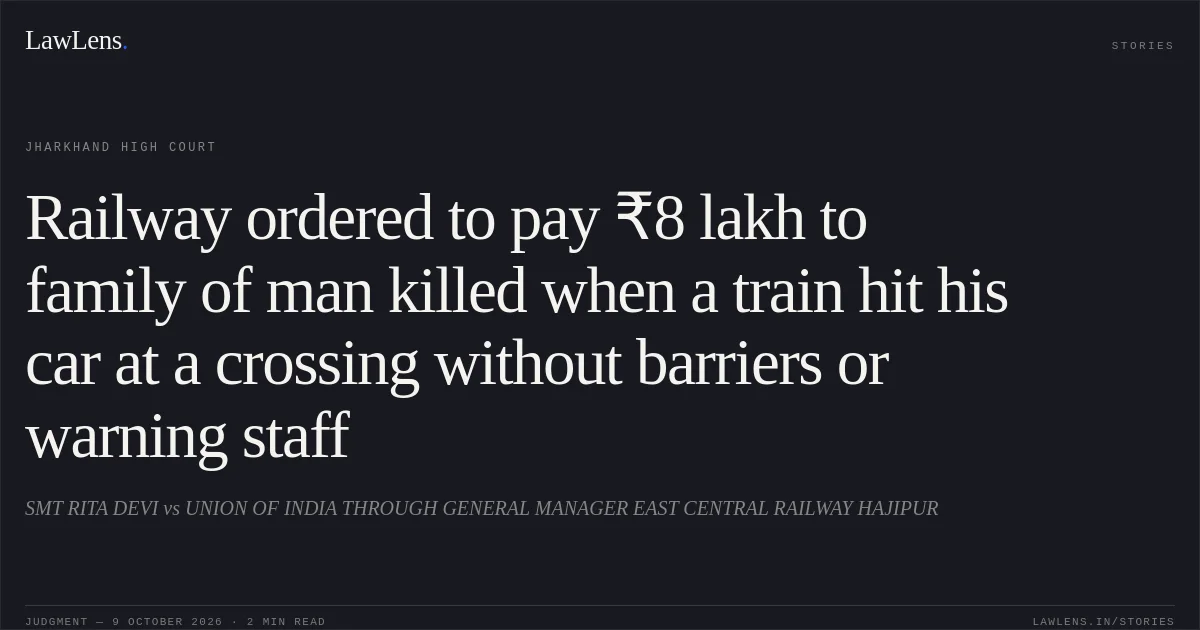
The appellants, the widow and children of Akhileshwar Ram, sought compensation after he died on 26 January 2014 when a car in which he was travelling was struck by the Tata–Jammu Tawi Express at the Parhua railway crossing.
Source reference: p. 2, para. 3They alleged that the crossing was inadequately guarded and that no railway staff or effective obstruction was present
Source reference: p. 2, para. 3The Railway Claims Tribunal first dismissed the claim for want of jurisdiction; the High Court set that decision aside and remanded the matter.
Source reference: p. 2, para. 3On reconsideration, the Tribunal again dismissed the claim, finding that the deceased was not a bona fide passenger and that the incident did not fall within Sections 124 and 124-A of the Railways Act.
Source reference: pp. 2–4, paras. 3, 5, 7The appellants challenged that dismissal under Section 23 of the Railway Claims Tribunal Act, 1987
Source reference: p. 1, para. 2Issues
1. Whether the death of a person travelling in a car struck by a train at a level crossing, where the crossing was allegedly inadequately protected, could entitle his dependants to compensation under the Railways Act
Source reference: pp. 4–5, paras. 7–92. Whether the Tribunal’s dismissal of the claim should be set aside and compensation awarded to the appellants
Source reference: pp. 4, 7–10, paras. 7, 14–16Law Applied
The Court considered Section 18 of the Railways Act, 1989, concerning the provision of gates, chains or barriers at level crossings, together with Sections 123 and 124-A concerning untoward incidents and compensation
Source reference: pp. 3, 5, paras. 3, 9It applied the principle that beneficial or welfare legislation should receive a liberal, purposive interpretation, relying on Union of India v. Nand Lal Ghaley and the authorities discussed there
Source reference: pp. 5–7, para. 10It also relied on Dharam Bidyas Kujur v. Union of India and Laxmi Priya Sahu v. Divisional Railway Manager as decisions involving railway-crossing accidents, and on Swarnalata Barua v. Union of India for the Railway Administration’s duty to provide adequate warning or obstruction at a crossing
Source reference: pp. 8–9, paras. 11–13For the amount and interest, the Court referred to Union of India v. Rina Devi, applying Rule 3 and Schedule II of the Railway Accident and Untoward Incidents (Compensation) Rules, 1990
Source reference: pp. 9–10, paras. 15–16Reasoning
The Tribunal had dismissed the claim because the deceased was not travelling by train and therefore was not a bona fide passenger for the purposes of Sections 124 and 124-A
Source reference: p. 4, para. 7The High Court, however, considered the alleged absence of a gatekeeper, signalman or effective barrier at the crossing, and treated the Railway’s failure to safeguard the crossing as material under Section 18
Source reference: pp. 2–3, para. 3; p. 5, para. 9Applying a liberal approach to the beneficial statutory scheme, and relying on precedent concerning railway-crossing accidents and the Railway’s duty to warn or obstruct road users, the Court held that the appellants had established entitlement to compensation and that the claim did not fall within any exception in the proviso to Section 124-A
Source reference: pp. 5–9, paras. 9–14Holding
The High Court allowed the appeal, set aside the Tribunal’s dismissal and held the appellants entitled to compensation of ₹8,00,000 under the applicable compensation rules
It awarded no interest, disposed of the appeal without costs, and directed that the Tribunal’s record be returned
Source reference: p. 10, paras. 16–17Acts & Sections Cited
7 provisions across 2 statutes referred to in this judgment. Each provision opens on LawLens.
Railway Claims Tribunal Act, 19872
Railways Act, 19895
Original Court PDF
SMT RITA DEVIvsUNION OF INDIA THROUGH GENERAL MANAGER EAST CENTRAL RAILWAY HAJIPUR
Click to open original judgment
Original judgment, available to read, download and summarize on LawLens.in