Facts
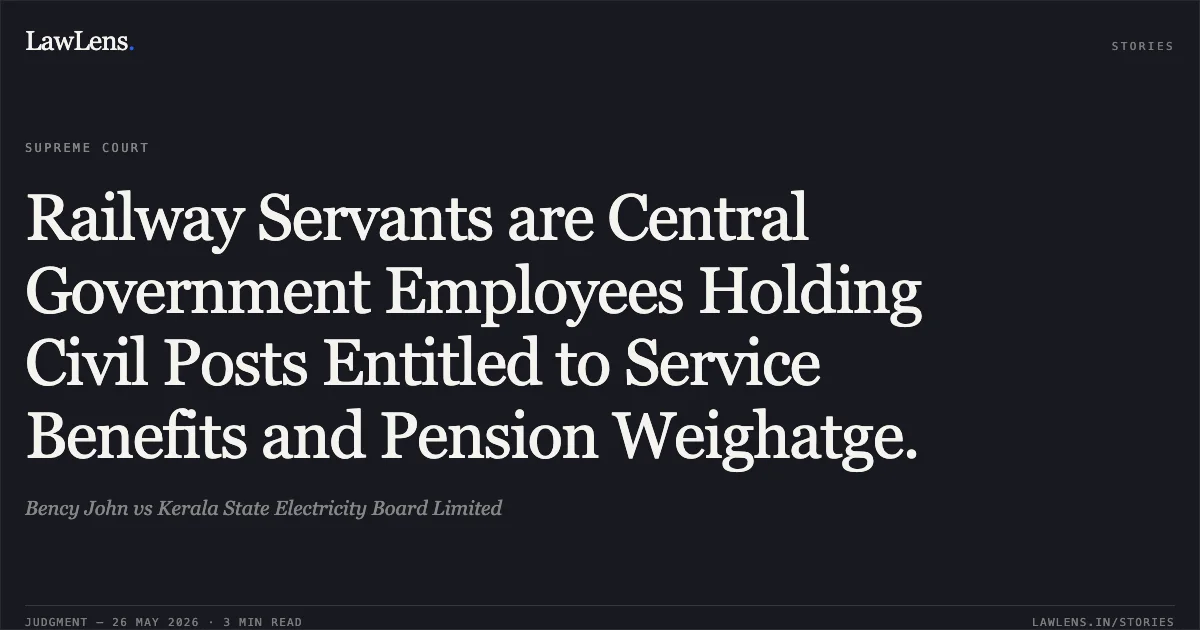
The appellant served in the Indian Railways for over 10 years before joining the Kerala State Electricity Board (the Board) in 2001.
Source reference: para. 6Upon joining, the Railways remitted pro-rata pension liability to the Board, and the Board's own orders and settlements (1996, 2000, 2007) provided that "regular pensionable Central Government Service" would count toward "weightage" for pay fixation.
Source reference: paras. 7-9In 2012, the Board's Internal Auditor objected, claiming "Railway Service" is not "Central Government Service" because railway servants are governed by separate conduct and pension rules.
Source reference: para. 11, 13A Single Judge of the Kerala High Court ruled in favor of the appellant, but the Division Bench reversed this, holding that the exclusion of railway servants from the Central Civil Services (CCS) Rules meant they were not Central Government employees for this benefit.
Source reference: para. 12-13Issues
1. Whether a railway servant ceases to be a member of the civil service of the Union merely because separate rules govern their service conditions, such as recruitment, conduct, and pension.
Source reference: para. 19/422. Whether the Board, having accepted pro-rata pension contributions and acted upon its own orders for years, is estopped from unilaterally withdrawing the benefit of weightage.
Source reference: para. 19/44Law Applied
Article 309 of the Constitution of India regarding the power of the President to regulate recruitment and service conditions for the Union.
Source reference: para. 24Article 311, which protects members of the "civil service of the Union" or "civil posts under the Union".
Source reference: para. 31Section 2(34) of the Railways Act, 1989, which defines a "railway servant" as a person employed by the Central Government.
Source reference: para. 28Precedent Moti Ram Deka v. North East Frontier Railway, establishing that railway employees hold civil posts under the Union.
Source reference: para. 38Precedent State of Assam v. Kanak Chandra Dutta, defining "civil post" as employment in a civil capacity under the administrative control of the Union.
Source reference: para. 39Rule 1(3) of the CCS (Conduct) Rules to show that the Law recognizes railway servants as Government servants even when exempted from specific CCS rules.
Source reference: para. 40Reasoning
The Court reasoned that the Railways is an integral department of the Government of India, not a separate legal entity or PSU.
Source reference: para. 15.1The creation of the Railway Board under the Railways Act, 1989, is an arrangement for administrative convenience and does not alter the status of its employees as Central Government servants.
Source reference: para. 22, 42The Court found the High Court's Division Bench erred by conflating "applicability of specific rules" with "employment status"; the fact that the CCS Rules exclude railway servants actually confirms their status as Government servants, as the exclusion is only to allow the specific Railway Rules to apply.
Source reference: para. 40-41Because the appellant's service was "regular and pensionable" and the Board had accepted the financial liability (pro-rata pension) from the Railways, the Board's attempt to deny "weightage" was arbitrary and violated the principle of promissory estoppel.
Source reference: para. 15.2, 45Holding
The Supreme Court answered the first issue in the negative and the second in the affirmative, holding that a railway servant remains a member of the civil service of the Union under the administrative control of the Central Government.
The Court set aside the Division Bench orders, restored the Single Judge’s judgment, and directed that the appellant be granted all benefits and weightage for his railway service.
Source reference: para. 48-49The Board was ordered to extend all flowing benefits within three months and cautioned not to discriminate against other similarly situated employees.
Source reference: para. 50-51Acts & Sections Cited
9 provisions across 5 statutes referred to in this judgment. Each provision opens on LawLens.
Railways Act, 19891
Code of Civil Procedure, 19081
Administrative Tribunals Act, 19853
Railway Protection Force Act, 19571
Indian Penal Code, 18603
Original Court PDF
Bency JohnvsKerala State Electricity Board Limited
Click to open original judgment
Original judgment, available to read, download and summarize on LawLens.in