01Facts
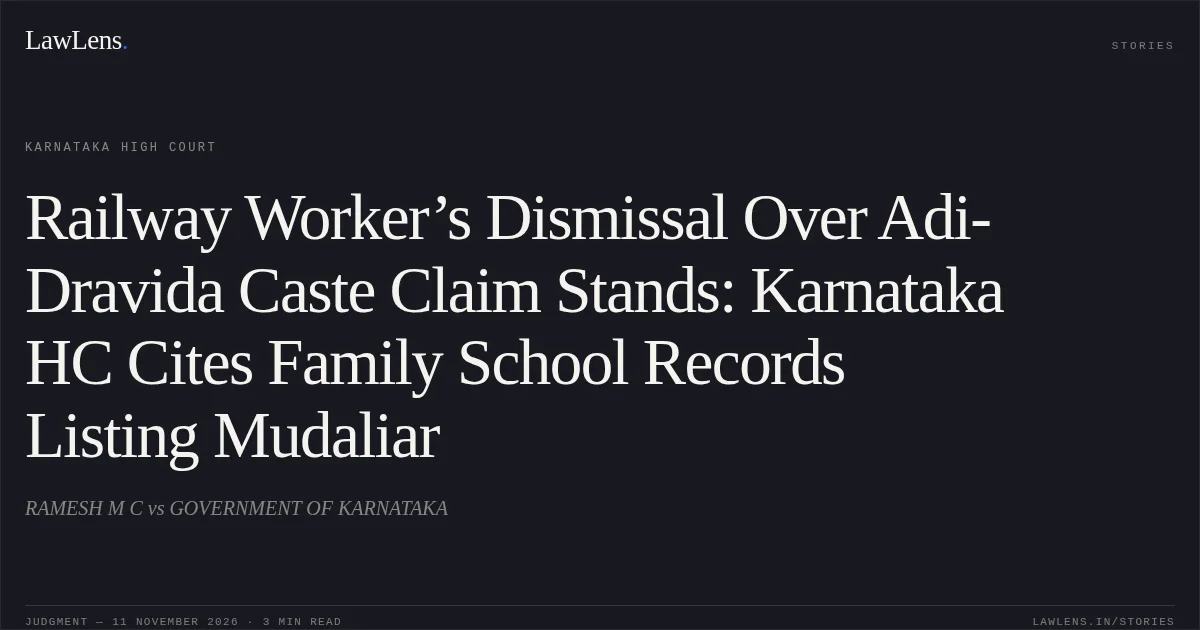
The petitioner, a South Western Railway employee appointed in 1979, claimed Scheduled Caste status as Adi-Dravida.
¶ 2.1, 7 · pp. 5, 8–9Following a complaint, the Civil Rights Enforcement Directorate reported that the petitioner’s family belonged to the Mudaliar caste; school records for the petitioner and his siblings also recorded that caste.
¶ 2.1, 7 · pp. 5, 8–9In 2019, the District Caste Verification Committee found the petitioner had obtained his caste certificate on false information and directed its cancellation.
¶ 2.2, 3 · pp. 6–7The Tahsildar cancelled the certificate, and the Railway dismissed the petitioner from service on 26 August 2019.
¶ 2.2, 3 · pp. 6–7The Commissioner dismissed the petitioner’s appeal in 2023.
¶ 1–4 · pp. 3–7The petitioner sought to quash those orders and obtain restoration of his caste certificate and consequential service benefits.
¶ 1–4 · pp. 3–702Issues
i.Whether the caste-verification authorities’ finding that the petitioner was Mudaliar, and their consequent cancellation of his Adi-Dravida certificate, were unsupported by evidence or otherwise liable to be set aside
¶ 10–11, 15–18 · pp. 11–12, 24–28ii.Whether the petitioner was entitled to have his dismissal from Railway service quashed and to receive consequential service benefits after the caste certificate supporting his claimed Scheduled Caste status was cancelled
¶ 2.2, 4, 14, 18–19 · pp. 6–7, 27–2803Law Applied
Under Sections 4A(5), 4C and 4-D of the Karnataka Scheduled Castes, Scheduled Tribes and Other Backward Classes (Reservation of Appointments etc.) Act, 1990, the claimant bears the burden of proving the claimed caste status; the caste-verification process may examine the validity of a certificate issued by the competent authority, and an adverse decision is appealable.
¶ 3, 17–18 · pp. 6, 26–28The Court relied on State of Maharashtra v. Milind for the principle that the constitutionally specified Scheduled Caste or Scheduled Tribe lists cannot be altered by State authorities or courts.
¶ 12.2 · pp. 14–15It also applied the principles that a certificate held to have been obtained by fraud cannot sustain a reserved appointment or the resulting service benefits (R. Vishwanatha Pillai v. State of Kerala), and that a relative’s caste certificate is not conclusive if relevant evidence was overlooked (Raju Ramsing Vasave v. Mahesh Deorao Bhivapurkar).
¶ 12.4, 12.7 · pp. 17, 19–22The Court further noted that a caste recognised as Scheduled in one State does not, by migration alone, confer that status in another State.
¶ 13 · pp. 23–24Provisions in the judgment · 3
Karnataka Scheduled Castes, Scheduled Tribes and other Backward Classes (Reservation of Appointments, etc.,) Act, 1990 Section 4DSection 4ASection 4C
04Reasoning
The Court found that the official school records consistently identified the petitioner and his siblings as Mudaliar, and that the investigation report and the authorities’ decisions were based on those records and the family history.
¶ 7, 15 · pp. 8–9, 24–25The caste certificates issued to relatives did not establish the petitioner’s claim conclusively; nor did the typed copies of the 1976 affidavit and 1925 mortgage deed provide conclusive proof.
¶ 11, 16 · pp. 11–12, 25–26The latter document also related to the petitioner’s maternal grandfather in Tamil Nadu, and could not establish entitlement to Scheduled Caste status in Karnataka.
¶ 11, 16 · pp. 11–12, 25–26Applying the statutory burden of proof, the Court held that the petitioner had not produced cogent, legally acceptable evidence to displace the authorities’ findings.
¶ 17–18 · pp. 26–28It therefore found no basis to interfere with the certificate cancellation or the consequential dismissal.
¶ 17–18 · pp. 26–2805Holding
The Court answered the issues against the petitioner, holding that he had failed to establish his claim to Adi-Dravida status and had shown no ground for setting aside the impugned orders.
¶ 18–19 · pp. 27–28The writ petition was dismissed as devoid of merit; the requested relief, including restoration of the caste certificate and consequential service benefits, was refused.
¶ 18–19 · pp. 27–28Original Court PDF
RAMESH M CvsGOVERNMENT OF KARNATAKA
Click to open original judgment
Original judgment, available to read, download and summarize on LawLens.in