Facts
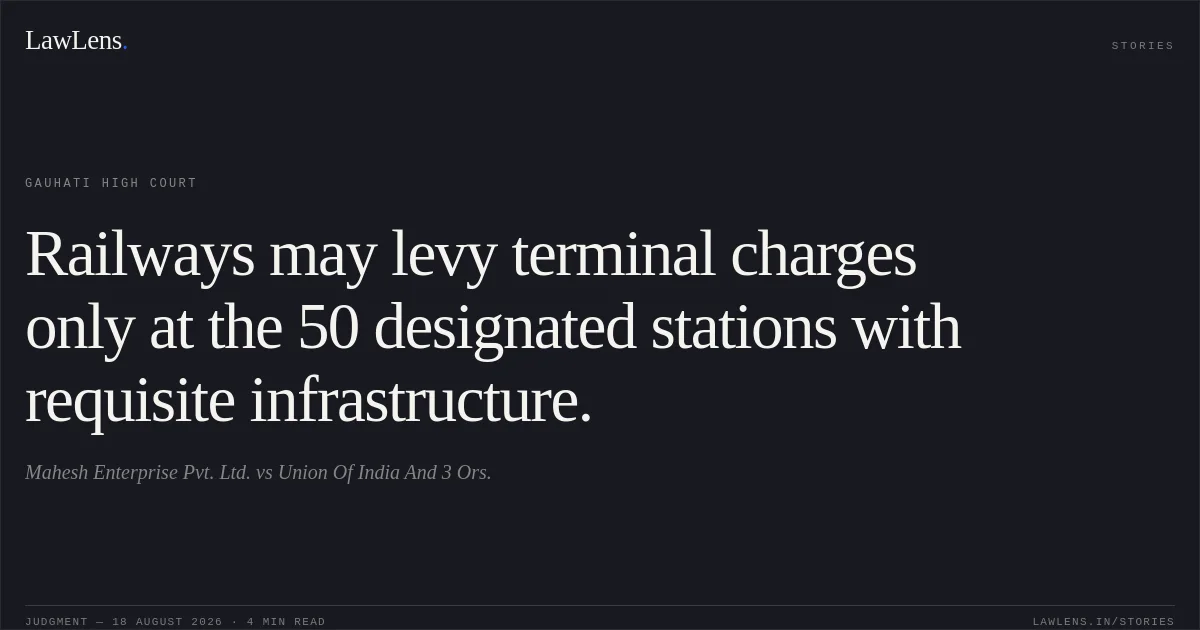
Mahesh Enterprise Pvt. Ltd. booked a consignment of nine coal rakes from Jogighopa to Hardoi and claimed that, in addition to the railway freight, the Railways collected terminal charges and punitive/penal freight charges from it.
Source reference: p.5–6The appellant sought refund of the terminal charges amounting to ₹9,56,248 and penal charges of approximately ₹65,785 under Section 16 of the Railway Claims Tribunal Act, 1987.
Source reference: p.5–6The Railway Claims Tribunal, Guwahati Bench, partly allowed the original application by directing refund of the penal charges with 9% interest but rejected the claim for refund of terminal charges.
Source reference: p.5–6, para.18The appellant challenged that decision under Section 23 of the Railway Claims Tribunal Act, 1987.
Source reference: p.2, para.2The Tribunal had disposed of 39 original applications by a common judgment.
Source reference: p.2–3, para.3The present appeal, however, was examined only in relation to OA No. III-268/2012.
Source reference: p.2–3, para.3Issues
Whether the Railways could levy terminal charges when neither the originating station, Jogighopa, nor the destination station, Hardoi, was included among the 50 stations identified in the Railway Board’s Circular dated 5 June 2007?
Source reference: p.11–13, paras.19–21Whether the Railway Claims Tribunal erred in treating the decisions in MFA No. 42/2017 and MFA No. 105/2017 as per incuriam in view of the earlier decision in MFA No. 100/2011?
Source reference: p.11–15, paras.19–25Whether the Railway Board’s circulars prescribing terminal charges were invalid for want of placement before Parliament under Section 199 of the Railways Act, 1989?
Source reference: p.8, para.11; p.10–11, para.16Law Applied
The Court applied Section 23 of the Railway Claims Tribunal Act, 1987, governing appeals to the High Court, and Section 16 concerning claims before the Tribunal.
Source reference: p.2, para.2; p.5–6Rule 24 of the Railway Claims Tribunal (Procedure) Rules, 1989 permits simultaneous hearing only where applications arise from the same facts and involve common issues; similar facts alone do not satisfy the rule.
Source reference: p.3–5, paras.4–5The Court relied on the Railway Board’s Circular dated 5 June 2007 and held, following the coordinate-bench decisions in Union of India v. M/s SSD Eastern Bhutan Coals Company Ltd., MFA No. 42/2017, and Union of India v. M/s Fuel Sources India Pvt. Ltd., MFA No. 105/2017, that terminal charges could be levied only at the 50 specified stations having the requisite loading and unloading infrastructure; charges could not be imposed at other stations.
Source reference: p.6–8, paras.7–10; p.13–16, paras.21, 24–25The Court distinguished Union of India v. M/s Meghalaya Cement Ltd., MFA No. 100/2011, as that case concerned whether the specified facilities were mandatory at a station already included in the circular, not whether charges could be levied at stations outside the specified list.
Source reference: p.12–13, para.20; p.15, para.24Under Kunhayammed v. State of Kerala, dismissal of an SLP by a non-speaking order does not amount to Supreme Court approval of the impugned judgment; nevertheless, the coordinate-bench decisions remained binding on the High Court under judicial discipline unless referred to a larger Bench.
Source reference: p.13–15, paras.22–25Reasoning
The Court found that both Jogighopa and Hardoi were absent from the list of 50 stations annexed to the Circular dated 5 June 2007.
Source reference: p.12, para.20It distinguished MFA No. 100/2011 because that decision involved Changsari, a station included in the circular, and addressed only the necessity of having specified facilities before imposing charges; it did not decide whether charges could be levied at stations outside the list.
Source reference: p.12–13, para.20In contrast, MFA Nos. 42/2017 and 105/2017 directly held that terminal charges could be imposed only at the 50 identified stations and not elsewhere.
Source reference: p.13–16, paras.21, 24–25Although dismissal of the Railways’ SLP did not constitute an adjudication on the merits under Kunhayammed, the coordinate-bench rulings continued to bind the Court.
Source reference: p.14–16, paras.23–25The Tribunal therefore erred in declaring those decisions per incuriam and in refusing refund merely because the 5 June 2007 circular was viewed as an infrastructure-development circular rather than a levy-limiting instrument.
Source reference: p.14–16, paras.23–25Since neither station involved in the appellant’s consignment was among the 50 specified stations, the terminal charges were not lawfully recoverable.
Source reference: p.16, para.26Holding
The High Court allowed the appeal and set aside the Tribunal’s refusal to refund the terminal charges.
The Court held that terminal charges could be levied only at the 50 stations identified in the Circular dated 5 June 2007 and that no such charges could be imposed for the appellant’s consignment involving Jogighopa and Hardoi.
Source reference: p.16–17, paras.26–27It directed the respondents to refund ₹9,56,248 to the appellant, together with interest at 9% per annum.
Source reference: p.16–17, paras.26–27The records of the connected original application were directed to be returned to the Railway Claims Tribunal, Guwahati Bench, along with a copy of the judgment.
Source reference: p.17, para.28Acts & Sections Cited
5 provisions across 2 statutes referred to in this judgment. Each provision opens on LawLens.
Railway Claims Tribunal Act, 19872
Railways Act, 19893
Original Court PDF
Mahesh Enterprise Pvt. Ltd.vsUnion Of India And 3 Ors.
Click to open original judgment
Original judgment, available to read, download and summarize on LawLens.in