Facts
The appellant, a contractor engaged under four Railway contracts, claimed that substantial work had been completed and that bills, security deposits and performance guarantees remained unpaid.
Source reference: pp. 3–5After the Railway rejected its representation seeking release of amounts, the appellant challenged that endorsement in a writ petition. The Single Judge declined to entertain the petition, noting that the dispute arose from contracts containing arbitration clauses and that any excepted matter could be taken to the jurisdictional civil court.
Source reference: pp. 3–5, 7The Railway had referred to Articles 18(1) and 18(2) of the General Conditions of Contract (GCC), which concern illegal gratification and related consequences; the CBI had filed a charge sheet alleging bribery, and the case was pending trial.
Source reference: pp. 4–6Issues
1. Whether the Single Judge was justified in declining to entertain the writ petition on the ground that the dispute arose from contractual agreements and the appellant could pursue appropriate remedies.
Source reference: pp. 5, 7–82. Whether the Railway’s refusal to release the amounts could stand when no decision under Articles 18(1) or 18(2) of the GCC, and no specific CBI direction to withhold payment, had been identified.
Source reference: pp. 7–8Law Applied
Articles 18(1) and 18(2) of the GCC governed the consequences of alleged bribery or monetary dealings with Railway employees.
Source reference: pp. 5–6Article 18(1) permits recovery from a contractor’s bills, security deposit or other dues of loss or damage resulting from a decision concerning rescission; Article 18(2) provides for the General Manager to decide disputes concerning commission of the specified offence or compensation payable, with that decision stated to be final and conclusive.
Source reference: pp. 5–6The judgment did not apply or discuss any statutory rule or precedent governing the merits of the alleged offence or the contractual payment dispute.
Source reference: pp. 5–8Reasoning
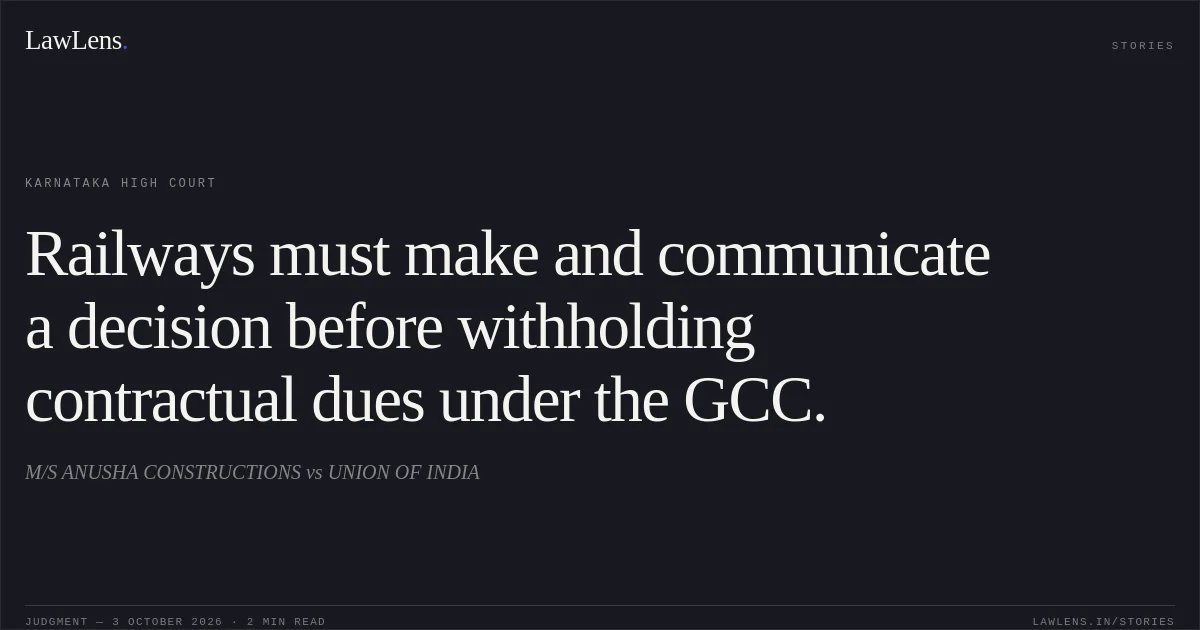
The Court noted that the impugned endorsement relied on the GCC, but no decision by the General Manager under Article 18 had yet been made, and no specific CBI order directing the withholding of the amounts had been identified.
Source reference: pp. 6–7The appellant was therefore not yet in a position to challenge such a decision or direction. The Court also accepted the Railway’s statement that it would reconsider the matter and communicate any decision to invoke Articles 18(1) or 18(2).
Source reference: pp. 7–8In those circumstances, the Court found no basis to fault the Single Judge’s decision not to entertain the contractual dispute in writ proceedings, while leaving the appellant free to pursue appropriate remedies if a decision or direction were made.
Source reference: pp. 7–8Holding
The appeal was disposed of without further orders. The Single Judge’s refusal to entertain the writ petition was not faulted.
The Railway stated that it would consider the matter afresh and communicate any decision to invoke Articles 18(1) or 18(2) of the GCC; the appellant may avail itself of appropriate remedies in relation to any such decision or any CBI direction to withhold funds.
Source reference: pp. 7–8Acts & Sections Cited
1 provisions across 1 statute referred to in this judgment. Each provision opens on LawLens.
KARNATAKA HIGH COURT ACT, 19611
Original Court PDF
M/S ANUSHA CONSTRUCTIONSvsUNION OF INDIA
Click to open original judgment
Original judgment, available to read, download and summarize on LawLens.in