01Facts
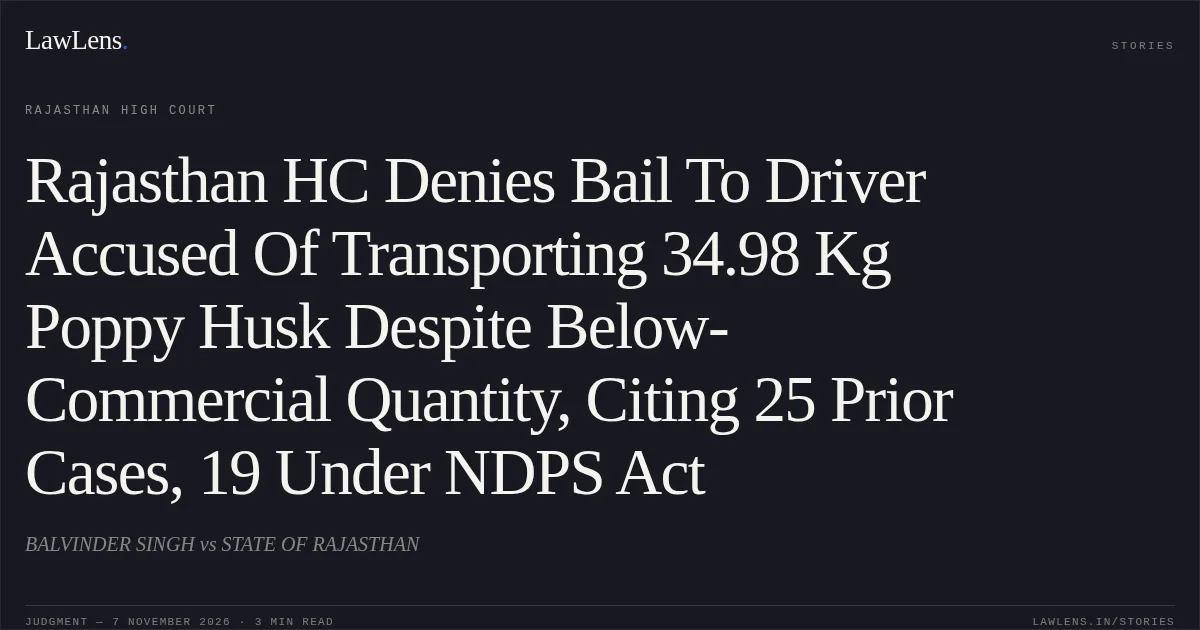
The petitioner sought bail under Section 483 of the BNSS in connection with an FIR alleging offences under Sections 8/15 and 25 of the NDPS Act. Police allegedly recovered 34.980 kg of poppy straw from two bags in a car driven by the petitioner; the alleged quantity was below the notified commercial quantity.
¶ 1–2, 6, 8The charge-sheet had been filed, and the petitioner had been in custody since 26 February 2026. He relied on the grant of bail to a co-accused and alleged non-compliance with Section 52A of the NDPS Act.
¶ 3, 25–26The State opposed bail, relying in particular on the petitioner’s antecedents: 25 registered cases, including 19 under the NDPS Act, with convictions recorded in 11 of those cases and in five of the six other cases.
¶ 4, 602Issues
i.Whether the petitioner should be granted bail where the alleged recovery was below commercial quantity, but the material indicated his involvement and his antecedents included multiple NDPS cases and convictions.
¶ 8, 16–19, 21, 27ii.Whether the petitioner was entitled to bail on parity with the co-accused, or on the basis of alleged non-compliance with Section 52A of the NDPS Act.
¶ 23–2503Law Applied
Section 37(1)(b) of the NDPS Act imposes restrictions on bail in specified cases involving commercial quantity; those restrictions were not attracted on the alleged quantity here, but that fact did not, by itself, entitle the petitioner to bail.
¶ 8Bail remains a discretionary, fact-specific assessment, including consideration of the accusation, the accused’s role, criminal antecedents, and the likelihood of repetition [*Prasanta Kumar Sarkar v. Ashis Chatterjee*, (2010) 14 SCC 496; *Ajwar v. Waseem*, 2024 SCC OnLine SC 974].
¶ 9–16Antecedents are relevant but cannot alone justify refusal; they gain significance where the record prima facie indicates involvement in the alleged offence.
¶ 16Under *Madan Lal v. State of H.P.*, (2003) 7 SCC 465, possession may be constructive, and the question of conscious possession depends on the facts and statutory presumptions.
¶ 17Under *Narcotics Control Bureau v. Kashif*, 2024 INSC 1045, a lapse or delay in complying with Section 52A does not, by itself, entitle an accused to bail or vitiate the trial.
¶ 23–24Parity is not automatic where the co-accused’s circumstances, including antecedents, materially differ.
¶ 25Provisions in the judgment · 8 · Linked ones open on LawLens
Bharatiya Nagarik Suraksha Sanhita, 2023 Section 483
Narcotic Drugs and Psychotropic Substances Act, 1985 Section 8Section 15Section 25Section 37Section 20Section 35Section 54
04Reasoning
The Court considered the petitioner’s alleged role as the driver of the car carrying the contraband to be prima facie relevant to his involvement, while leaving the ultimate issue of conscious possession to the trial.
¶ 17–18Although Section 37’s commercial-quantity restrictions did not apply, the petitioner’s record of repeated NDPS cases and convictions supported an apprehension of further similar offending if released.
¶ 19, 21, 27The co-accused was distinguishable because he was 19 years old and had no prior antecedents; parity therefore did not assist the petitioner.
¶ 25The alleged Section 52A lapse was not, standing alone, a sufficient ground for bail, and the completed investigation and period of custody were weighed against the petitioner’s alleged role and antecedents.
¶ 24, 26–2705Holding
The Court dismissed the bail application, holding that the below-commercial quantity, completion of the investigation, custody, alleged Section 52A lapse, and co-accused’s release did not outweigh the petitioner’s prima facie role and criminal antecedents.
¶ 27–28The Court clarified that its observations were confined to the bail application and would not affect the trial court’s independent assessment of the evidence.
¶ 29Original Court PDF
BALVINDER SINGHvsSTATE OF RAJASTHAN
Click to open original judgment
Original judgment, available to read, download and summarize on LawLens.in