01Facts
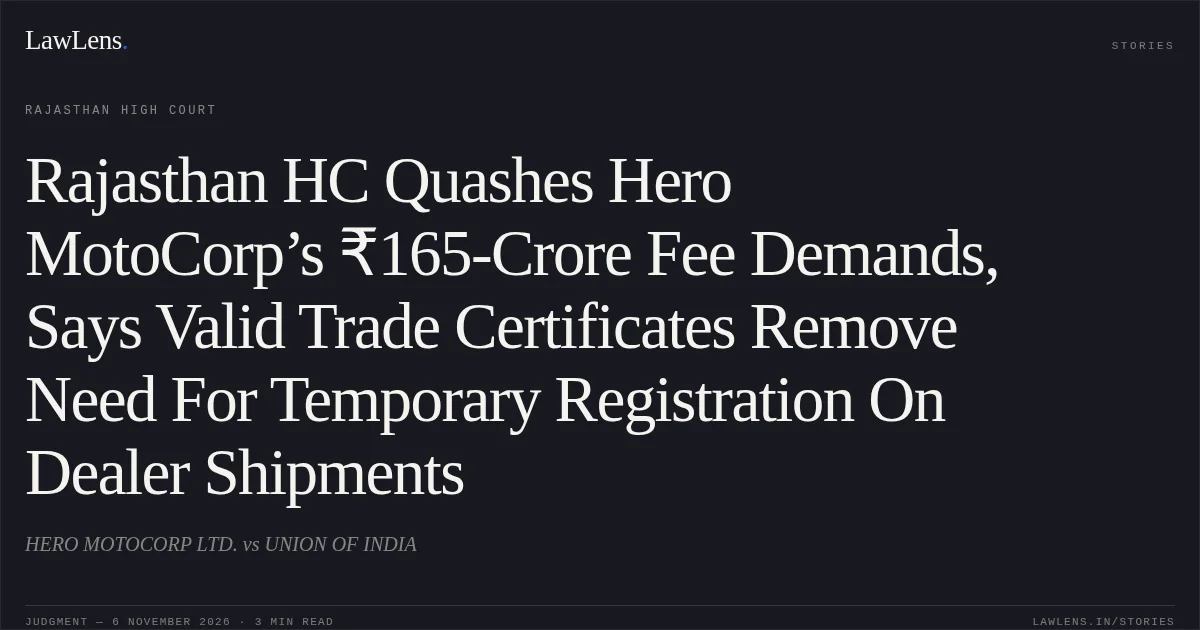
Hero Motocorp, a motor-vehicle manufacturer with a plant in Rajasthan, challenged demands for temporary-registration fees relating to vehicles sent from its factory to dealers for resale.
¶ 5–10, 22–27It contended that the vehicles were transported by truck and that, as a manufacturer holding trade certificates under Rule 33 of the Central Motor Vehicles Rules, 1989 (“CMVR”), it was exempt from registration.
¶ 5–10, 22–27The State maintained that the certificates had lapsed, but Hero produced evidence of renewals in its sur-rejoinder; the State did not controvert that evidence.
¶ 5–10, 22–27The State also stated that it had not demanded temporary-registration fees from Honda because Honda held valid trade certificates.
¶ 5–10, 22–2702Issues
i.1. Whether a manufacturer holding a valid trade certificate under Rule 33 CMVR must obtain temporary registration under Rule 4.2(1)(a) of the Rajasthan Rules for vehicles sold or distributed to dealers, sub-dealers, or branches, and pay the prescribed fee
¶ 45–46ii.2. Whether Hero held valid trade certificates during the relevant period and was entitled to be treated at par with Honda
¶ 47, 64–7103Law Applied
Section 39 of the Motor Vehicles Act, 1988 (“MV Act”) prohibits driving an unregistered vehicle, subject to its proviso for vehicles in a dealer’s possession; Rule 33 CMVR provides that a dealer or manufacturer possessing a valid trade certificate is exempt from the necessity of registration.
¶ 49–62Section 43 provides for temporary registration, while Section 65 authorises State rules on specified matters, subject to the limits of that rule-making power.
¶ 49–62Rules 41 and 42 CMVR govern permitted use under a trade certificate and delivery to a purchaser, respectively; Rules 4.2(1)(a) and 4.28 of the Rajasthan Rules concern temporary registration and its fee.
¶ 49–62In Tata Motors Ltd. v. State of Jharkhand, (2020) 15 SCC 438, the Supreme Court treated temporary registration and a trade certificate as alternative routes for a manufacturer or dealer’s use of a vehicle.
¶ 49–62K.T.C. Automobiles v. Commissioner of Commercial Taxes, (2016) 4 SCC 82, supports the principle that registration is a post-sale event.
¶ 49–62The Court also applied the principles that delegated legislation cannot impose a fee without authority and must remain within the parent statute, as stated in Ahmedabad Urban Development Authority v. Sharadkumar Jayantikumar Pasawalla, (1992) 3 SCC 285, and Bimal Chandra Banerjee v. State of Madhya Pradesh, (1970) 2 SCC 467
¶ 49–62Provisions in the judgment · 8 · Linked ones open on LawLens
Motor Vehicles Act, 1988 Section 39Section 40Section 41Section 43Section 64Section 65Section 177
rajasthan motor vehicles taxation act, 1951 Section 4
04Reasoning
The Court read Rule 33’s unqualified exemption from the “necessity of registration” as covering both temporary and permanent registration while the vehicle remained in the manufacturer’s possession in the course of business.
¶ 50–58Applying Tata Motors, it held that temporary registration and a trade certificate are alternatives, not cumulative requirements.
¶ 50–58The journey to a dealer for resale was covered by the trade-certificate scheme; Rule 42’s restriction on delivery to a purchaser did not apply to a dealer receiving stock for resale
¶ 50–58Rule 4.2(1)(a) could therefore be read consistently with the Central rules as applying where the manufacturer lacked a valid trade certificate, and not as imposing a further registration requirement or fee on a certificate-holder
¶ 59–63On the second issue, Hero’s evidence of renewed certificates was uncontroverted, and the State’s stated basis for not charging Honda—its valid trade certificate—applied equally to Hero.
¶ 64–71Treating the two manufacturers differently would also offend Article 14
¶ 64–71The Court accordingly did not decide the challenge to the rule’s vires or its application to vehicles sold outside Rajasthan
¶ 7205Holding
The Court held that a manufacturer holding a valid Rule 33 trade certificate need not obtain temporary registration under Rule 4.2(1)(a) for vehicles sold or distributed to dealers, sub-dealers, or branches, and owes no fee under Rule 4.28 for those vehicles.
¶ 63, 71, 74–76It found that Hero held valid certificates during the relevant period and was entitled to treatment at par with Honda
¶ 63, 71, 74–76The writ petitions were allowed; the impugned demands were quashed, any recovered amounts were ordered to be refunded within eight weeks, and the State was barred from raising such demands for periods in which Hero held a valid trade certificate.
¶ 78Proceedings concerning tax under the Rajasthan Motor Vehicles Taxation Act, 1951, were left unaffected
¶ 78Original Court PDF
HERO MOTOCORP LTD.vsUNION OF INDIA
Click to open original judgment
Original judgment, available to read, download and summarize on LawLens.in