Facts
The parties were married on 23.10.2015.
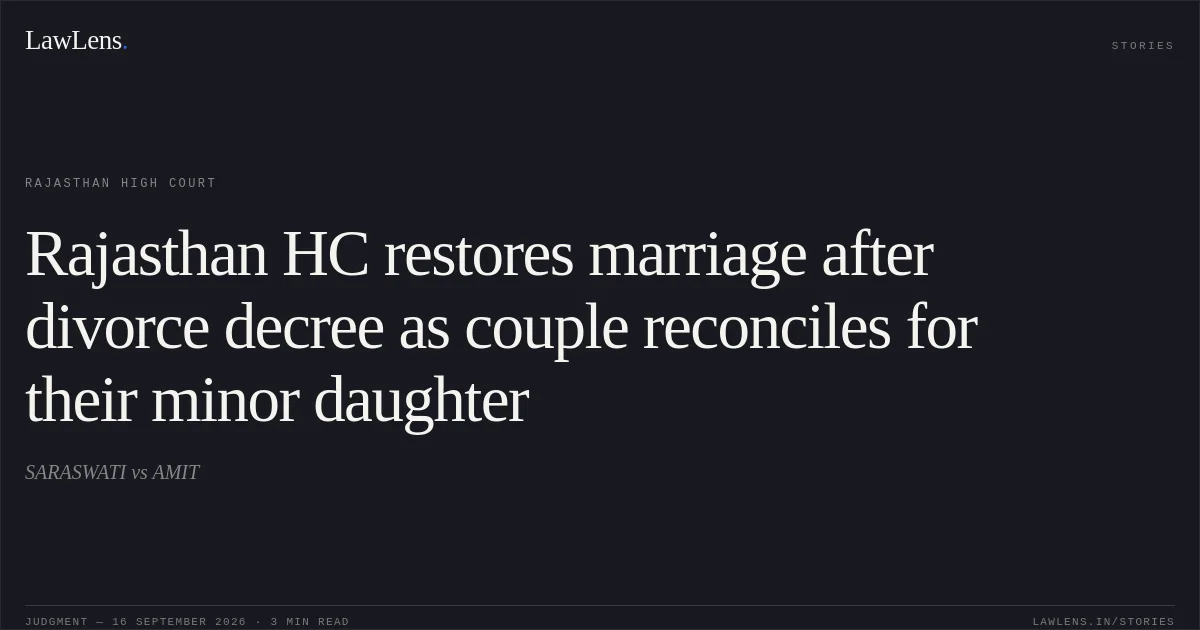
Source reference: no citationOn the husband’s petition under Section 13(1)(ia) of the Hindu Marriage Act, 1955, the Family Court, Hanumangarh, dissolved the marriage by judgment and decree dated 30.11.2024 in Civil Regular Case No. 237/2020.
Source reference: para. 2The wife preferred an appeal under Section 28 of the Hindu Marriage Act read with Section 19 of the Family Courts Act, 1984.
Source reference: para. 2During the appeal, mediation was unsuccessful; however, during the Court proceedings, the parties voluntarily reconciled, entered into a settlement, and expressed their desire to resume matrimonial life, particularly in the welfare of their minor daughter.
Source reference: paras. 3–4Both parties personally appeared before the Court, were identified by counsel, and stated that their consent was free and uninfluenced.
Source reference: paras. 1, 4, 13Issues
Whether, in light of the parties’ subsequent voluntary settlement and unequivocal decision to resume cohabitation, the appellate court could set aside the decree of divorce and restore the matrimonial relationship.
Source reference: paras. 8–18Whether the welfare of the parties’ minor daughter and the parties’ mutual desire for reconciliation justified allowing the appeal and giving effect to the settlement.
Source reference: paras. 4, 7–14Law Applied
The Court applied Section 28 of the Hindu Marriage Act, 1955, governing appeals from matrimonial decrees, read with Section 19 of the Family Courts Act, 1984.
Source reference: para. 2The original decree had been passed under Section 13(1)(ia) of the Hindu Marriage Act on the ground of cruelty.
Source reference: para. 2The Court relied on the principle that appellate courts may consider material subsequent events affecting the relief claimed, particularly where the matrimonial dispute is personal, no third-party rights or public interests are involved, and the parties have voluntarily reconciled.
Source reference: paras. 9–12It relied principally on Kamlesh Devi v. Vijay Kumar Soni, D.B. Civil Misc. Appeal No. 2534/2019, decided on 28.09.2020, and also referred to Prabhu Vaippan v. Akshita Pande, 2020 SCC OnLine Kar 4358, in support of restoring a matrimonial relationship following a subsequent settlement and mutual consent.
Source reference: para. 15The Court further treated the welfare of the minor child as a significant consideration in facilitating reconciliation.
Source reference: paras. 7, 13–14Reasoning
The Court found that the circumstances existing after the divorce decree materially altered the basis for continuing the litigation: both parties had personally appeared, freely consented to reconciliation, and jointly sought restoration of their marriage.
Source reference: paras. 3–4, 13Since the dispute was purely matrimonial and no third-party rights or overriding public interest was implicated, continuation of adjudication would serve little purpose when the parties no longer wished to pursue the underlying conflict.
Source reference: paras. 9–10Applying the principles in Kamlesh Devi and Prabhu Vaippan, the Court held that the subsequent settlement could be given effect in appellate jurisdiction.
Source reference: no citationThe parties’ common intention to provide their minor daughter the care, affection, companionship and emotional security of both parents further supported restoration of the family relationship.
Source reference: paras. 7–14The Court emphasised that it was not compelling reconciliation but was facilitating a voluntary and informed decision made by the parties themselves.
Source reference: para. 13Holding
The appeal was allowed.
The judgment and decree dated 30.11.2024 passed by the Family Court, Hanumangarh, dissolving the marriage, was set aside.
Source reference: paras. 17, 22The marriage solemnized between the parties on 23.10.2015 was restored as if the decree of divorce had not intervened.
Source reference: para. 18The notarised settlement deed was taken on record, pending applications were disposed of, and the Registrar (Judicial) was directed to transmit the judgment to the concerned Family Court for consequential formalities.
Source reference: paras. 21–23Acts & Sections Cited
3 provisions across 2 statutes referred to in this judgment. Each provision opens on LawLens.
Hindu Marriage Act, 19552
Family Courts Act, 19841
Original Court PDF
SARASWATIvsAMIT
Click to open original judgment
Original judgment, available to read, download and summarize on LawLens.in