Facts
The petitioners were selected for appointment as Post Graduate Teachers but were initially excluded because they possessed their educational qualifications through distance education.
Source reference: pp. 14–16, paras. 8–11Their exclusion was set aside by the High Court in Gurmail Kaur v. State of Haryana, decided on 27.05.2015, which directed the State to issue appointment letters; the decision was upheld in appeal, and the contempt proceedings were later closed after compliance.
Source reference: pp. 14–16, paras. 8–11The petitioners were eventually appointed in 2021 with ante-dated appointment dates corresponding to the dates on which their juniors had been appointed—05.03.2014 for PGT (English), 16.05.2012 and 05.03.2014 for PGT (Economics), and 14.12.2013 for PGT (Mathematics and History).
Source reference: pp. 15–17, para. 11Their appointment orders granted ante-dated benefits only for notional pay fixation and seniority, while actual financial benefits were made payable from the date of joining duty.
Source reference: pp. 15–17, para. 11Under the Teacher Transfer Policy, 2026, “Experience in Cadre” was calculated by the formula: “Number of Days (Qualifying Date – Date of Joining in Cadre) ÷ 365,” subject to a maximum of 30 points.
Source reference: pp. 17–19, para. 12The respondents calculated the petitioners’ experience from their actual dates of joining in 2021 rather than from their ante-dated appointment dates.
Source reference: pp. 2–7, paras. 2–3.7Issues
Whether the petitioners’ ante-dated/notional service should be counted for determining their merit under the head “Experience in Cadre” under the Teacher Transfer Policy, 2026?
Source reference: p. 11, para. 5Whether “Date of Joining in Cadre” in Clause 4, Table B, of the Policy means the actual date of physical joining or the ante-dated appointment date recognised for seniority in the cadre?
Source reference: pp. 19–21, paras. 13–17Whether the respondents’ refusal to count the ante-dated period was arbitrary and violative of Articles 14 and 16 of the Constitution?
Source reference: pp. 11–14, paras. 6–7; pp. 32–34, paras. 20–22Law Applied
The Court applied Articles 14 and 16 of the Constitution, under which State action affecting public employment must be based on relevant, uniformly applicable principles and must not be arbitrary.
Source reference: pp. 11–14, paras. 6–7It interpreted Clause 3(ii) and Clause 4, Table B, of the Teacher Transfer Policy, 2026, particularly the formula defining “Experience in Cadre” by reference to the “Date of Joining in Cadre”.
Source reference: pp. 16–19, paras. 12–13The Court relied on G.S. Lamba v. Union of India and Delhi Water Supply and Sewage Disposal Committee v. R.K. Kashyap for the principle that cadre membership and seniority are matters of legal status and that length of service in the cadre ordinarily determines seniority.
Source reference: p. 20, para. 16The Court distinguished Union of India v. M. Bhaskar, Union of India v. Dr. S. Baliar Singh, Baldev Singh v. Union of India, and Sanjeev Kumar v. State of Haryana on the ground that those cases involved express requirements of actual service, actual posting, or service at a particular station.
Source reference: pp. 27–31, paras. 19.3–19.9The Court also applied the principle that an authority cannot take advantage of its own wrongful act, relying on High Court of Judicature for Rajasthan v. Abhay Jain.
Source reference: pp. 32–34, paras. 20–22Reasoning
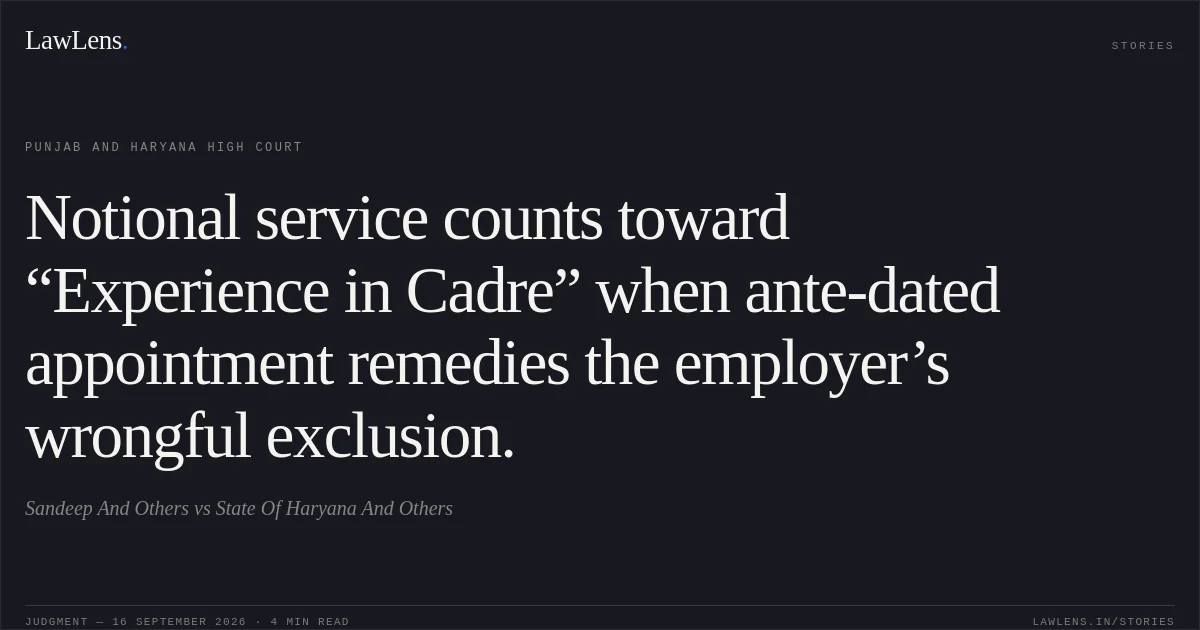
The Court held that the Policy itself defines “Experience in Cadre” through an arithmetical formula based on a single date—the “Date of Joining in Cadre”—and does not use the words “actual,” “physical,” or “date of actual joining”.
Source reference: pp. 19–20, paras. 13–15The respondents therefore could not insert an actual-service requirement into the formula, particularly when the Policy expressly referred to duty actually performed in its provisions concerning minimum and prescribed tenure but did not impose the same requirement for “Experience in Cadre”.
Source reference: p. 20, para. 15Since the respondents’ appointment orders recognised the petitioners’ earlier dates for purposes of seniority, those dates established when the petitioners were treated as members of the PGT cadre.
Source reference: pp. 20–22, paras. 16–18Treating the same petitioners as having joined the cadre on one date for seniority but on a later date for experience would apply two inconsistent dates to the same service record.
Source reference: pp. 20–22, paras. 16–18The Court further reasoned that the petitioners had been kept out of service due to the respondents’ unlawful refusal to appoint them; denying them experience points for that period would make the respondents’ own wrong the basis for reducing the petitioners’ merit and would place them below their juniors.
Source reference: pp. 32–34, paras. 20–22This result lacked a rational nexus with the Policy’s object and was arbitrary under Articles 14 and 16.
Source reference: pp. 32–34, paras. 20–22Holding
The Court allowed both writ petitions.
It quashed the respondents’ action of calculating the petitioners’ “Experience in Cadre” from their actual dates of joining and directed the competent authority to recompute their merit under Clause 4, Table B, Serial No. 2, by treating the ante-dated appointment dates recorded in their appointment orders as their “Date of Joining in Cadre”.
Source reference: p. 35, para. 25(a)–(b)The respondents were directed to reassess the petitioners’ merit and inter se position in the Teacher Transfer Drive, 2026 within four weeks of receiving the certified order.
Source reference: pp. 35–36, para. 25(c)The Court clarified that the judgment did not confer any right to arrears, salary, or other actual financial benefits for the ante-dated period, nor any right to posting at a particular station.
Source reference: pp. 35–36, para. 25(c)Original Court PDF
Sandeep And OthersvsState Of Haryana And Others
Click to open original judgment
Original judgment, available to read, download and summarize on LawLens.in