Facts
The respondent-concessionaire was awarded a Build, Operate and Transfer/Design-Build-Finance-Operate-Transfer project for constructing, operating and maintaining an alternate route to Ghat Ki Guni through a tunnel in the Jhalana Hills, under a Tripartite Concession Agreement dated 27.11.2009.
Source reference: paras. 2–3The project was awarded at an estimated cost of ₹150 crores, with a concession period of 13 years, 5 months and 20 days.
Source reference: paras. 2–3Before the arbitral tribunal, the respondent claimed ₹175.67 crores towards increased project cost, ₹188.02 crores towards loss of toll revenue, ₹40.71 crores for delayed achievement of the Commercial Operations Date, and ₹8.49 crores for loss of advertising revenue.
Source reference: para. 4The sole arbitrator allowed the increase-in-project-cost claim, partly allowed the toll-loss claim, rejected the delayed-COD claim, and allowed the advertising claim, awarding a total of ₹198.04 crores together with IRR at 20.33% and post-award interest at 12%.
Source reference: para. 5A corrigendum dated 31.07.2023 deleted the words “amounting to Rs. 198.04 Crores” from the award, thereby permitting IRR to accrue without the stated ceiling.
Source reference: paras. 6, 25.1The appellants’ objections under Section 34 of the Arbitration and Conciliation Act, 1996 were dismissed by the Commercial Court on 27.01.2025.
Source reference: para. 1Issues
1. Whether the respondent’s claims were barred by limitation?
Source reference: para. 31(i); paras. 41–432. Whether the arbitral award suffered from patent illegality or conflicted with the public policy of India?
Source reference: para. 31(ii); paras. 44–593. Whether the arbitrator travelled beyond the Concession Agreement by awarding cash compensation, treating the DPR as binding, and granting relief contrary to the contractual risk-allocation scheme?
Source reference: para. 31(iii); paras. 60–754. Whether the corrigendum award exceeded the limited correctional jurisdiction under Section 33 of the Arbitration and Conciliation Act, 1996?
Source reference: para. 31(iv); paras. 76–775. Whether the Commercial Court failed to exercise its jurisdiction under Section 34 by declining to examine the specific grounds of challenge?
Source reference: para. 31(v); para. 78Law Applied
Section 28(3) requires an arbitral tribunal to decide disputes in accordance with the terms of the contract; Sections 34(2)(b)(ii) and 34(2A) permit interference where an award conflicts with the fundamental policy of Indian law or contains patent illegality appearing on its face; and Section 33 permits only correction of clerical, typographical or computational errors.
Source reference: paras. 33, 37–38, 76–77The Court relied on Associate Builders v. DDA, Ssangyong Engineering & Construction Co. Ltd. v. NHAI, Delhi Airport Metro Express (P) Ltd. v. DMRC, and Konkan Railway Corporation Ltd. v. Chenab Bridge Project Undertaking for the limited scope of Sections 34 and 37, while recognising that judicial restraint does not permit an award that rewrites the contract or ignores vital evidence.
Source reference: paras. 37–38It relied on Ramnath International Construction (P) Ltd. v. Union of India for the rule that where the contract limits the remedy to extension of time, compensation for delay cannot be awarded contrary to that contractual allocation.
Source reference: para. 50Kailash Nath Associates v. DDA was applied for the principle that damages under Section 73 of the Contract Act presuppose a breach of an identifiable contractual obligation.
Source reference: para. 54Geo Miller & Co. (P) Ltd. v. Rajasthan Vidyut Utpadan Nigam Ltd. informed the limitation analysis concerning the accrual of cause of action after failure of contractually mandated negotiations.
Source reference: para. 42.3The Court further relied on State of Haryana v. S.L. Arora & Co. and Vedanta Ltd. v. Shenzen Shandong Nuclear Power Construction Co. Ltd. against awarding unsupported compound interest or treating a projected IRR as a contractual interest rate.
Source reference: paras. 55–56Reasoning
The Court rejected the limitation objection because it had not been raised before the arbitrator and, in any event, limitation depended on factual questions concerning accrual, demands, rejection and continuing loss; the arbitration notice dated 18.09.2017 was within three years of the Empowered Committee’s decision rejecting monetary compensation.
Source reference: paras. 42–43On merits, the Court held that the Concession Agreement allocated investigation, design, engineering and drawing responsibility to the concessionaire through Clauses 2.1, 5.1, 7.1 and 16.2.
Source reference: paras. 50–53The DPR was a reference document, while IRC and MoRTH standards governed the project; the pre-bid response to Query No. 99 expressly stated that the DPR need not be followed and that deviation would not affect cost or concession period.
Source reference: paras. 61–63The arbitrator therefore impermissibly shifted design risk to the appellants and awarded compensation without identifying any breached contractual obligation.
Source reference: paras. 54, 65–67The Court further found that the contractual scheme contemplated restoration of the concessionaire’s financial position principally through extension of the concession period, not cash compensation, and that 484 days had already been granted for the relevant alignment and site-related causes.
Source reference: paras. 44–48, 68The award consequently resulted in impermissible double compensation.
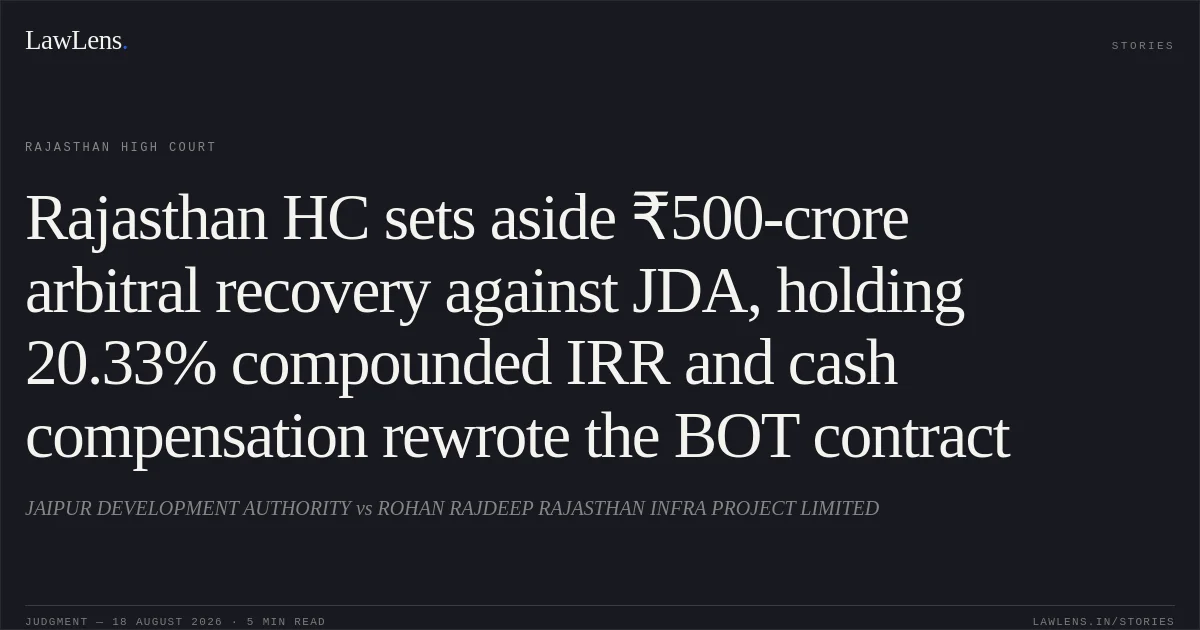
Source reference: paras. 44–48, 68The award of IRR at 20.33% was also invalid because IRR was an estimated project-appraisal metric, not a contractual promise or interest rate; its compounding application lacked contractual and legal foundation and produced a disproportionate liability exceeding ₹500 crores against an asserted cost escalation of approximately ₹57.87 crores.
Source reference: paras. 55–56.1, 79–81The toll-leakage claim enlarged the appellants’ obligation beyond the undertaking to restrict heavy vehicles, the demonetisation claim bypassed the mandatory certification and verification mechanism under Clause 11.6(d), and the advertising claim ignored the contractual priority accorded to road-user safety and lacked adequate proof of quantum.
Source reference: paras. 57–59, 72–75Finally, deletion of the ₹198.04-crore ceiling under Section 33 was substantive, not clerical, and therefore beyond the arbitrator’s jurisdiction.
Source reference: paras. 76–77The Commercial Court’s reliance on the limited scope of Section 34 without applying those tests to the pleaded objections amounted to a failure to exercise jurisdiction.
Source reference: para. 78Holding
The Court answered the limitation issue against the appellants but accepted the remaining challenges.
It held that the award was patently illegal, contrary to the contractual scheme, internally contradictory, unsupported by an established breach, disproportionate, and in conflict with the fundamental policy of Indian law.
Source reference: paras. 85–89The corrigendum independently exceeded Section 33 by substantively enlarging the award.
Source reference: paras. 76–77The appeal was accordingly allowed; the Commercial Court’s order dated 27.01.2025, the arbitral award dated 25.06.2023, and the corrigendum award dated 31.07.2023 were all set aside.
Source reference: para. 90Any amounts deposited or recovered pursuant to the award, including sums realised through invocation of the bank guarantee, were directed to abide by restitution in accordance with law.
Source reference: para. 90The parties were left to bear their own costs.
Source reference: para. 90Acts & Sections Cited
12 provisions across 2 statutes referred to in this judgment. Each provision opens on LawLens.
Arbitration and Conciliation Act, 1996
Indian Contract Act, 18723
Original Court PDF
JAIPUR DEVELOPMENT AUTHORITYvsROHAN RAJDEEP RAJASTHAN INFRA PROJECT LIMITED
Click to open original judgment
Original judgment, available to read, download and summarize on LawLens.in