Facts
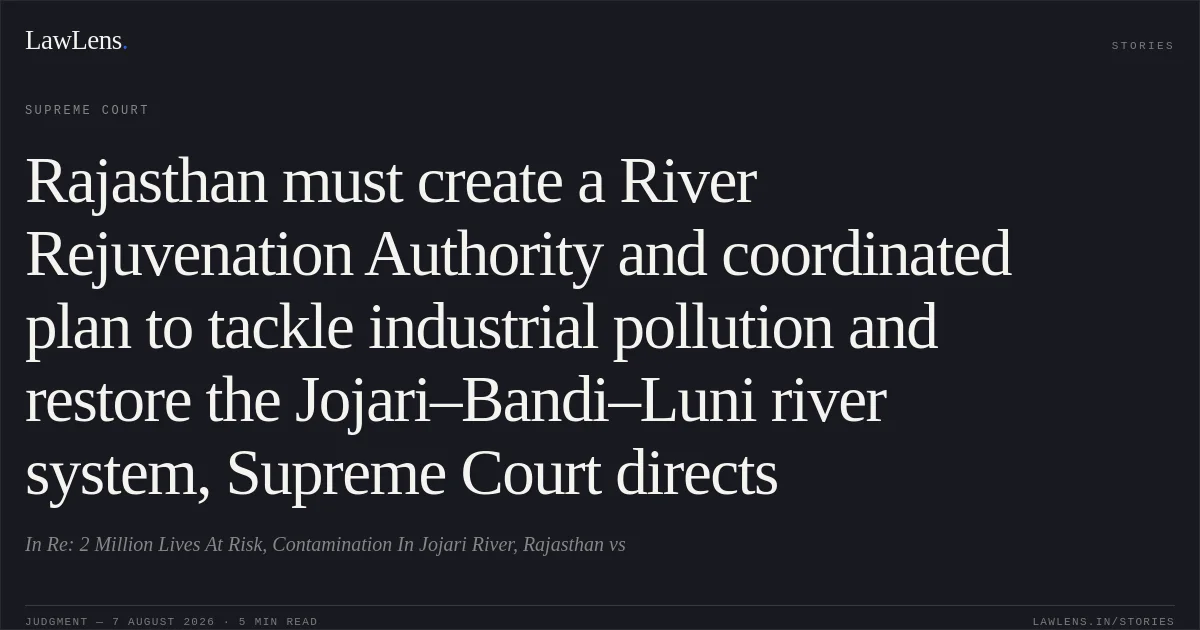
The Supreme Court was monitoring widespread industrial pollution and ecological degradation affecting the Jojari–Bandi–Luni river ecosystem in Rajasthan.
Source reference: para. 1Earlier proceedings had resulted in the constitution of a High-Level Ecosystem Oversight Committee (“Committee”) and a Special Investigation Team (“SIT”).
Source reference: para. 1On 21 July 2026, the Court considered the Committee’s Second Status Report, the SIT’s First Status Report and newspaper reports alleging contamination of water bodies, discharge of untreated industrial effluents, groundwater degradation, encroachments on riverbeds and floodplains, and regulatory failures.
Source reference: para. 1The Court had consequently directed investigation into environmental offences, remedial treatment of accumulated effluents at various Common Effluent Treatment Plants (“CETPs”), transfer of identified lands to the Forest Department, and submission of comprehensive compliance reports by the State of Rajasthan.
Source reference: para. 2In response, the State filed a further SIT report and a compliance report.
Source reference: para. 3The SIT reviewed 16 criminal cases concerning riverine pollution in Jodhpur, Pali and Balotra, registered four FIRs pursuant to its constitution, invoked aggravated penal provisions where prima facie warranted, and reported possible connivance between CETP officials and industrial units in bypassing treatment processes.
Source reference: paras. 3–5The State also reported remedial measures concerning the pink-coloured pond near the Jojari River at Tanawada, pollution in the Sanganer–Dravyavati–Nevta region, alleged contamination of Morel Dam, treatment and removal of accumulated wastewater at Ambey Valley and Khed, and proposed restoration of the Jojari, Bandi and Luni rivers.
Source reference: paras. 7–15The Committee’s reports further disclosed concerns regarding the proposed RIICO Industrial Area at Kakani and the Ambey Valley Industrial Park, including possible development within high-flood areas, inadequate ecological buffers, irregular land-use conversions and deficient official records.
Source reference: paras. 25–27After hearing the State, the Committee, the SIT and affected stakeholders, the Court concluded that the environmental issues were interconnected, involved multiple State departments and required an integrated institutional response.
Source reference: paras. 16–19Issues
Whether the State of Rajasthan was required to establish an integrated, inter-departmental mechanism for coordinating pollution control, ecological restoration and implementation of the Court’s directions?
Source reference: paras. 18–19, 31–33Whether the State should scientifically determine and demarcate the High Flood Line and ecological buffer zones for river systems, and restrict new development within the identified river corridors pending that exercise?
Source reference: para. 20; Direction C, para. 33Whether the accumulated industrial wastewater at the Ambey Valley and Khed HRTS facilities required time-bound treatment, removal, dismantling of storage infrastructure and ecological restoration of the sites?
Source reference: para. 21Whether Rajasthan required an independent and adequately empowered River Commission or River Rejuvenation Authority for integrated river-basin governance?
Source reference: para. 22; Direction G, para. 33Whether the SIT was required to undertake a deeper and impartial investigation into the possible involvement of industrial units, CETPs and public officials in the illegal discharge of untreated effluents?
Source reference: paras. 4–6; Direction H, para. 33Whether the State was required to review industrial development and land-use permissions in environmentally sensitive areas, including Kakani and Ambey Valley, and regulate groundwater extraction and water-intensive industries in over-exploited zones?
Source reference: paras. 25–30Whether further institutional measures, including a comprehensive resolution plan and a public environmental grievance-reporting mechanism, were necessary for effective monitoring and enforcement?
Source reference: paras. 31–32; Directions A–F and J–M, para. 33Law Applied
The Court applied the regulatory framework governing environmental pollution and criminal accountability, including Section 33A of the Water (Prevention and Control of Pollution) Act, 1974, which empowers the Pollution Control Board to issue binding directions, including closure directions, against polluting industries.
Source reference: para. 8It directed consideration of aggravated offences under Sections 272, 326(a) and 326(c) of the Bharatiya Nyaya Sanhita, 2023, and offences under the Prevention of Damage to Public Property Act, 1984, where supported by the evidence.
Source reference: paras. 2, 4–6The Court also applied the principles of scientific environmental assessment, prevention of untreated discharge, ecological restoration, protection of river corridors and floodplains, sustainable groundwater management, inter-departmental accountability and institutional monitoring.
Source reference: paras. 20–24, 28–32No specific judicial precedent was relied upon in the order.
Source reference: no citationReasoning
The Court found that the material before it demonstrated systemic, rather than isolated, environmental violations: untreated industrial effluents were allegedly being discharged through bypass mechanisms, CETPs were overloaded or incompletely connected, temporary wastewater storage facilities had accumulated hazardous waste, and industrial development had occurred close to or potentially within riverbeds and high-flood areas.
Source reference: paras. 5, 8–12, 20–27Because these problems involved the Environment, Forest, Water Resources, Industries, Urban Development, Revenue, Agriculture and local-government authorities, fragmented departmental action was considered inadequate.
Source reference: paras. 18–19The Court therefore required scientific determination of High Flood Lines and ecological buffers before permitting further development, directed time-bound treatment and ecological restoration of contaminated sites, and ordered review of potentially unlawful industrial layouts and land-use conversions.
Source reference: paras. 20–27It also held that the SIT’s reported progress did not eliminate the need for a deeper investigation, particularly into the alleged institutional and financial mechanisms and the role of public servants.
Source reference: para. 6To ensure sustained implementation, the Court mandated an Integrated Coordination Group, a Comprehensive Resolution Plan, a River Commission or River Rejuvenation Authority, continuing Committee supervision, and a digital public-reporting mechanism for environmental violations.
Source reference: para. 33Holding
The Court held that the environmental degradation of the Jojari–Bandi–Luni river ecosystem required coordinated, multidisciplinary and continuing institutional intervention.
It directed Rajasthan, within seven days, to constitute an Integrated Coordination Group headed by the Chief Secretary.
Source reference: Direction A, para. 33The Group, in consultation with the Committee, must prepare and submit a Comprehensive Resolution Plan within three weeks, specifying action points, responsible authorities, milestones, timelines and monitoring mechanisms.
Source reference: Directions B–F, para. 33The State was further directed to constitute an independent and adequately empowered River Commission/River Rejuvenation Authority, scientifically determine High Flood Lines and ecological buffers, and place its organisational framework and powers before the Court.
Source reference: Direction G, para. 33The SIT was ordered to intensify and complete its investigation against all persons implicated by credible evidence, including public servants, industrial units and CETP officials.
Source reference: Direction H, para. 33The Committee was directed to decide pending representations of White Category industries preferably within seven days, while continuing to monitor compliance.
Source reference: Directions I and K, para. 33The Court also directed creation of a QR-code-based public environmental grievance mechanism, continued cooperation by all State departments and authorities, and personal monitoring by the Chief Secretary.
Source reference: Directions J–M, para. 33Details of action against responsible Rajasthan State Pollution Control Board officers were ordered to be placed before the Committee within three days.
Source reference: Direction N, para. 33The matters were directed to be listed on 22 September 2026 for consideration of the Comprehensive Resolution Plan.
Source reference: para. 36Acts & Sections Cited
2 provisions across 1 statute referred to in this judgment. Each provision opens on LawLens.
Bharatiya Nyaya Sanhita, 20232
Original Court PDF
In Re: 2 Million Lives At Risk, Contamination In Jojari River, Rajasthan vs
Click to open original judgment
Original judgment, available to read, download and summarize on LawLens.in