Facts
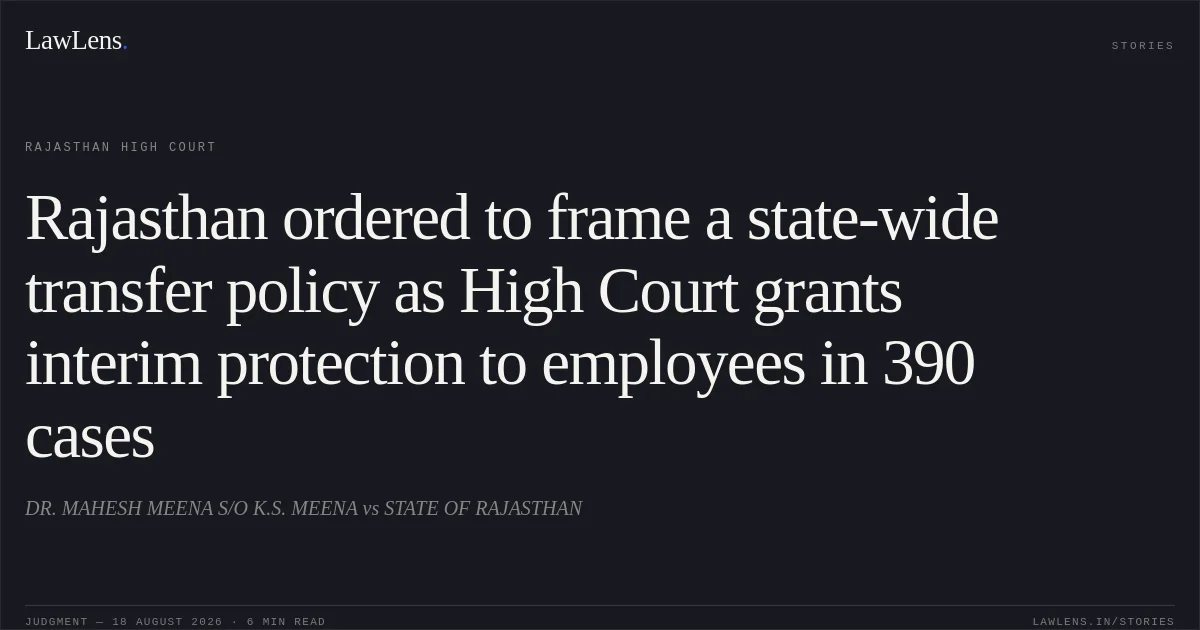
The lead petition challenged the petitioner’s transfer order dated 10 July 2026 and consequential relieving order, seeking quashing of the transfer and continuation as Senior Veterinary Officer at the First Class Veterinary Hospital, Sultanpura, Kota.
Source reference: para. 2The connected petitions involved employees of various State departments, Boards, Corporations, Discoms, local authorities, financial institutions, non-governmental educational institutions and other instrumentalities, who challenged transfer orders on grounds including arbitrariness, premature or repeated transfers, violation of statutory provisions and departmental policies, non-consideration of medical, spouse, disability, retirement and family circumstances, lack of sanctioned posts, incompetence of the transferring authority, political interference and mala fides.
Source reference: paras. 1, 5–9The Court treated the lead petition as the representative case because the batch involved common questions of law and fact, while clarifying that factual discrepancies would be considered on a mutatis mutandis basis.
Source reference: para. 1The Court was also apprised that the Rajasthan Civil Services Appellate Tribunal (“RCSAT”) was not functioning effectively because of vacancies and non-availability or non-sitting of requisite Members, resulting in delays in service matters.
Source reference: paras. 3, 25, 32Issues
Whether transfer orders issued by the State and its instrumentalities were liable to judicial interference on the grounds of arbitrariness, mala fides, extraneous considerations, non-application of mind, violation of statutory provisions, incompetence of the authority or disregard of relevant personal and administrative circumstances.
Source reference: paras. 4–5, 25, 29, 35, 38Whether an employee possesses an enforceable right to remain posted at a particular place on the basis of spouse grounds, medical hardship, disability, proximity to retirement, family circumstances, tenure expectations or departmental transfer guidelines.
Source reference: paras. 21, 31, 38Whether violation of executive transfer guidelines or a draft transfer policy, as distinct from a statutory rule or binding policy, independently invalidates a transfer order.
Source reference: paras. 14–17, 30, 36Whether the Court should issue institutional directions for the creation of a grievance-redressal mechanism, formulation of a State-wide transfer policy and improvement of the functioning of the RCSAT.
Source reference: paras. 32–34, 39–40, 52–56Whether disciplinary proceedings initiated solely for non-joining at the transferred place should proceed before the legality and propriety of the transfer grievance were considered.
Source reference: paras. 8–9, 57Law Applied
The Court applied the settled rule that transfer is an ordinary incident of service and that an employee holding a transferable post has no vested right to remain posted at a particular station, relying on Gujarat Electricity Board v. Atmaram Sungomal Poshani, (1989) 2 SCC 602; Shilpi Bose v. State of Bihar, 1991 Supp (2) SCC 659; Union of India v. S.L. Abbas, (1993) 4 SCC 357; State of U.P. v. Gobardhan Lal, (2004) 11 SCC 402; and Rajendra Singh v. State of U.P., (2009) 15 SCC 178.
Source reference: paras. 4, 11–12, 19–20, 27Judicial review is, however, available where a transfer is made by an incompetent authority, violates a mandatory statutory provision, is mala fide, colourable, discriminatory, based on extraneous considerations or is patently arbitrary.
Source reference: paras. 4, 29, 35, 38Rule 20 of the Rajasthan Service Rules, 1951 prohibits substantive transfer to a lower-paid post except on account of inefficiency, misbehaviour or the employee’s written request, and treats such transfer as reduction in rank requiring disciplinary procedure.
Source reference: paras. 7.7, 7.10, 35Section 89(8)(ii) of the Rajasthan Panchayati Raj Act, 1994 requires consultation with the concerned Pradhan or Pramukh before transfers covered by that provision.
Source reference: para. 7.9Executive guidelines ordinarily do not create enforceable rights, but a duly formulated and operational policy binds the Government unless lawfully amended or withdrawn, as recognised in Bhika Ram v. State of Rajasthan, (2025) SCC OnLine SC 2891.
Source reference: paras. 30, 36Personal hardships and spouse or medical grounds require fair administrative consideration but do not ordinarily confer a right to a particular posting.
Source reference: paras. 21, 31The Court also relied on L. Chandra Kumar v. Union of India, AIR 1997 SC 1125 and Madras Bar Association v. Union of India, (2022) 12 SCC 455 regarding the importance of an effective tribunal and the continued availability of constitutional judicial review.
Source reference: paras. 7.12, 33, 55Reasoning
The Court reconciled the employer’s broad administrative power to transfer employees with the requirement that such power be exercised lawfully and fairly.
Source reference: no citationIt declined to examine the comparative desirability of individual postings or to treat personal inconvenience, premature transfer or breach of non-statutory instructions as automatic grounds for quashing a transfer.
Source reference: paras. 27–28, 31, 35–36At the same time, the Court held that the expression “administrative exigency” cannot provide immunity from judicial review where the transfer is shown to contravene a mandatory statutory provision, originate from an incompetent authority, operate as a disguised punishment, reflect mala fides or disregard relevant and compelling circumstances so as to become arbitrary.
Source reference: paras. 29, 35, 38Because the batch contained distinct factual situations and the Court could not adjudicate every individual transfer on the common record, it adopted a transitional and institutionally oriented remedy rather than quashing all orders.
Source reference: no citationEach petitioner was permitted to submit a detailed representation identifying the factual and legal defects in the concerned transfer.
Source reference: paras. 42–46The competent authority was directed to assess authority, statutory compliance, tenure, sanctioned-post availability, protected circumstances, repeated transfers, mala fides and applicable policies, and to pass a reasoned decision.
Source reference: paras. 42–46The Court further considered the large-scale recurrence of transfer litigation and the ineffective functioning of the RCSAT, directing administrative measures to provide an efficacious alternative remedy.
Source reference: paras. 32–34, 39, 52–56Holding
The Court held that transfer is an incident of service and that no employee has an indefeasible right to remain at a chosen station.
Nevertheless, transfer power is not unfettered and remains subject to statutory limitations, competence, fairness, non-arbitrariness and absence of mala fides or extraneous considerations.
Source reference: paras. 35–38The writ petitions were not allowed by quashing the transfer orders; instead, the entire batch was disposed of with the following directions:
Source reference: paras. 42–61Each petitioner could file a comprehensive representation before the competent authority within 15 days of the judgment.
Source reference: paras. 43–44The competent authority or departmental committee had to decide the representation within a further 15 days, by a reasoned and non-mechanical order.
Source reference: paras. 45–46The impugned transfer orders were kept in abeyance for the petitioners until disposal of the representation or for 30 days from the judgment, whichever was earlier; if a representation was filed within time, protection continued until its decision. Petitioners who had already joined remained subject to the outcome of the representation.
Source reference: para. 47Each concerned department, Board, Nigam, Discom or establishment was directed to constitute a Departmental Transfer Grievance Committee within seven working days.
Source reference: paras. 49–51A State-Level Committee comprising a former High Court Judge, the Advocate General and the Chief Secretary was directed to formulate and place before the Government a comprehensive transfer policy within two months, addressing tenure, premature transfers, counselling, protected categories, competent authorities, transparency and grievance redressal.
Source reference: paras. 52–54The State was directed to take steps, subject to law, for strengthening the RCSAT, including appointment or nomination of a retired High Court Judge in a supervisory role and filling requisite vacancies.
Source reference: paras. 55–56Where disciplinary proceedings had been initiated solely for non-joining pursuant to the impugned transfer, the disciplinary authority was required to consider the employee’s representation and its outcome before proceeding further.
Source reference: para. 57Pending applications were also disposed of, and the entire batch stood concluded.
Source reference: para. 61Acts & Sections Cited
2 provisions across 2 statutes referred to in this judgment. Each provision opens on LawLens.
Rajasthan Panchayati Raj Act, 19941
RAJASTHAN MUNICIPALITIES ACT,20091
Original Court PDF
DR. MAHESH MEENA S/O K.S. MEENAvsSTATE OF RAJASTHAN
Click to open original judgment
Original judgment, available to read, download and summarize on LawLens.in