01Facts
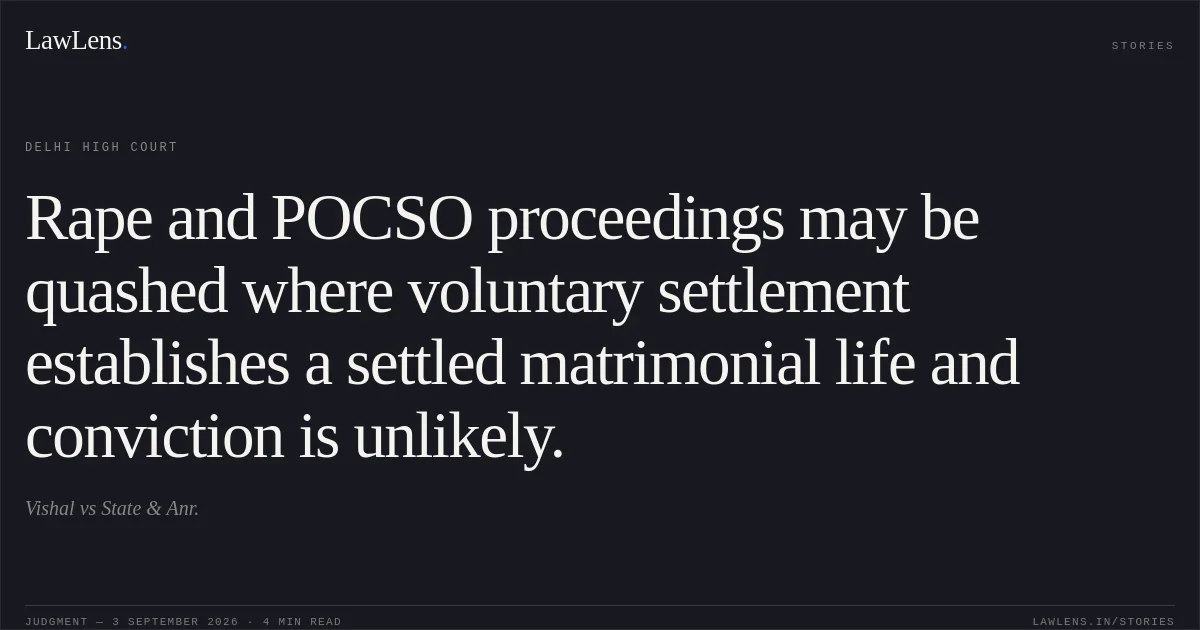
The petitioner sought quashing of FIR No. 0277/2023, registered at Police Station Tilak Nagar under Section 363 IPC, along with consequential proceedings, on the basis of a settlement between the parties.
p. 1 · ¶ 1The FIR originated from a missing-person report lodged by the mother of respondent no. 2, who stated that her 17-year-old daughter had gone missing on 24 March 2023 while returning to Delhi.
pp. 1–2 · ¶ 2–3During investigation, respondent no. 2 was recovered and, in her statement under Section 164 CrPC recorded on 3 July 2023, stated that she had voluntarily eloped with the petitioner, married him on 24 April 2023, and wished to live with him.
p. 2 · ¶ 4–5The charge-sheet was subsequently filed with Sections 376 IPC and 6 of the POCSO Act added; her testimony had not yet been recorded.
p. 2 · ¶ 7By the time of the petition, respondent no. 2 had attained majority, and the parties had been living together since 24 April 2023 and had two children.
p. 2 · ¶ 8Respondent no. 2 appeared before the Court, confirmed the relationship and settlement, denied coercion or influence, and stated that continuation of the proceedings was causing distress to their settled family life.
pp. 2–3 · ¶ 9–10Her mother also conveyed no objection to quashing of the FIR.
p. 3 · ¶ 1102Issues
i.Whether the High Court could exercise its inherent jurisdiction under Section 528 of the Bharatiya Nagarik Suraksha Sanhita, 2023, to quash proceedings involving Sections 376 IPC and 6 of the POCSO Act on the basis of a settlement between the parties?
pp. 3–4 · ¶ 12–14, 16ii.Whether, in the facts of the case—including the victim’s present majority, continued matrimonial relationship, two children, voluntary statement, and the complainant’s no-objection—the continuation of the criminal proceedings would serve any meaningful purpose?
pp. 3–4 · ¶ 10–1503Law Applied
The Court applied the inherent-power jurisdiction under Section 528 of the Bharatiya Nagarik Suraksha Sanhita, 2023, permitting quashing to secure the ends of justice.
Relying on Gian Singh v. State of Punjab & Anr., (2012) 10 SCC [citation incomplete in the judgment] and Narinder Singh & Ors. v. State of Punjab & Anr., (2014) 6 SCC 466, the Court held that even proceedings involving non-compoundable offences may be quashed where the continuation of the prosecution would serve no meaningful purpose and the likelihood of conviction is remote.
p. 3 · ¶ 12The Court further relied on Madhukar & Anr. v. State of Maharashtra, 2025 SCC OnLine SC 1415, which recognizes that although offences under Section 376 IPC are grave and ordinarily should not be quashed merely on settlement, the inherent jurisdiction is fact-sensitive and may be exercised where continuation of the proceedings would cause continuing distress without a productive outcome.
pp. 3–4 · ¶ 13–14The Court also referred to Mohd. Parwej v. State, 2026 SCC OnLine Del 1030; Harmeet Singh v. State of GNCT Delhi & Ors., 2026 SCC OnLine Del 1707; Suman Kumar v. State Govt. of NCT of Delhi & Anr., 2026 SCC OnLine Del 2209; and Mohd. Amzad & Ors. v. State of Delhi & Anr., 2026 SCC OnLine Del 2341.
p. 3 · ¶ 12Provisions in the judgment · 6 · Linked ones open on LawLens
Indian Penal Code, 1860 Section 363Section 376
Protection of Children from Sexual Offences Act, 2012 Section 6
Code of Criminal Procedure, 1973 Section 164Section 482
Bharatiya Nagarik Suraksha Sanhita, 2023 Section 528
04Reasoning
The Court treated the matter as an exceptional, fact-specific case rather than permitting quashing solely because of a compromise.
Respondent no. 2 had voluntarily stated under Section 164 CrPC that she had eloped with and married the petitioner, and, after attaining majority, personally reaffirmed that position before the Court without coercion or influence.
pp. 2–3 · ¶ 4–5, 9–10The parties had continued living together since 2023 and had two children, while the mother of respondent no. 2 also expressed no objection.
pp. 2–3 · ¶ 8, 11In light of these circumstances, the Court assessed the prospect of conviction as “very bleak” and found that continuation of the trial would serve no useful purpose, would disturb the parties’ settled family life, and would not implicate any overriding public interest.
p. 4 · ¶ 15Applying the principles in Narinder Singh, Gian Singh, and Madhukar, the Court concluded that exercise of inherent jurisdiction was necessary to secure the ends of justice despite the addition of the grave offences under Section 376 IPC and Section 6 of the POCSO Act.
pp. 3–4 · ¶ 12–1605Holding
The Court answered the issues in favour of the petitioner and held that, on the exceptional facts of the case, continuation of the criminal proceedings would be purposeless and that the FIR could be quashed in exercise of the Court’s inherent jurisdiction under Section 528 BNSS.
p. 4 · ¶ 16Accordingly, FIR No. 0277/2023 dated 30 May 2023, registered at Police Station Tilak Nagar, and all consequential proceedings were quashed.
pp. 4–5 · ¶ 17The parties’ original affidavits and the Memorandum of Understanding were directed to be submitted before the learned Trial Court within six weeks, and the petition and pending application were disposed of.
p. 5 · ¶ 17–19Original Court PDF
VishalvsState & Anr.
Click to open original judgment
Original judgment, available to read, download and summarize on LawLens.in