Facts
The prosecution alleged that Om Parkash @ Kallu raped the complainant in her jhuggi on the night of 29 May 2006.
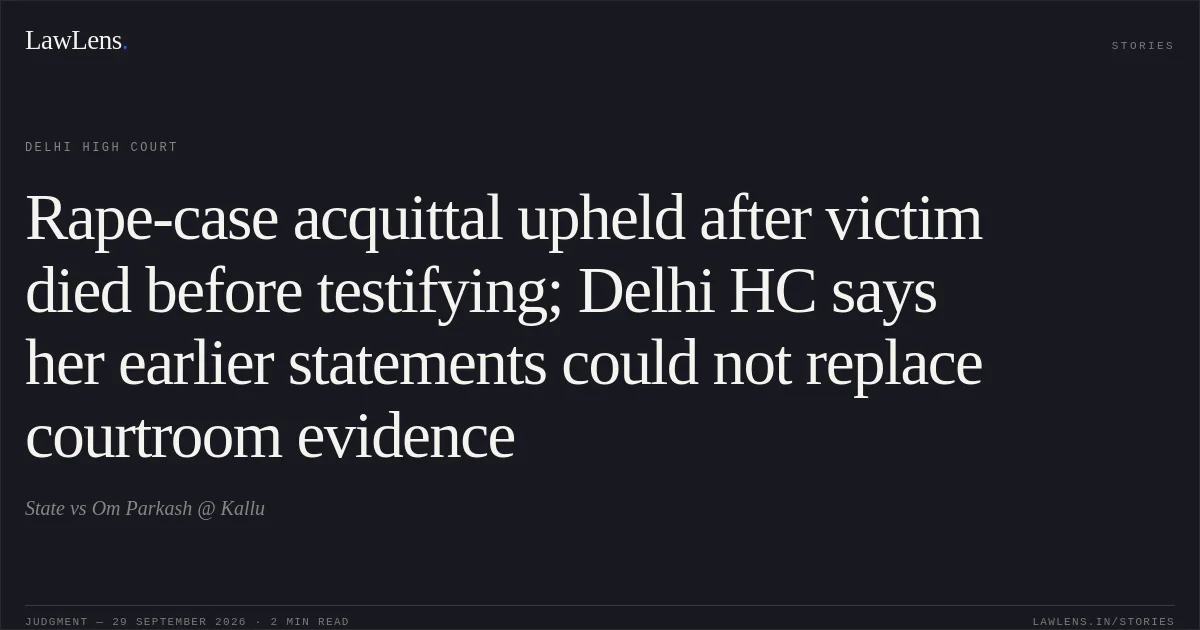
Source reference: pp. 2–6The complainant made statements to the police and under Section 164 CrPC, but died by suicide about three months after the incident, before she could testify at trial.
Source reference: pp. 2–6The State relied on those statements, the suicide note, medical evidence and testimony from the complainant’s family.
Source reference: pp. 2–6The Trial Court acquitted the respondent, and the State appealed.
Source reference: pp. 2–6Issues
Whether the complainant’s statements to the police and under Section 164 CrPC, in the absence of her testimony at trial, could be relied on as substantive evidence to establish the alleged offence.
Source reference: pp. 7–9Whether the Trial Court’s acquittal was unreasonable or perverse so as to justify interference in the State’s appeal.
Source reference: pp. 5–8Law Applied
Section 3 of the Indian Evidence Act, 1872 defines evidence to include oral statements made before the Court and documents produced for its inspection.
Source reference: p. 8The Court held that a statement under Section 164 CrPC, or a statement made to the police, has a limited role in corroborating or contradicting a witness and cannot substitute for that witness’s substantive testimony.
Source reference: pp. 8–9It also considered Sections 6 and 32 of the Evidence Act and held that neither provision rendered the statements admissible to establish the prosecution case in these circumstances.
Source reference: p. 9In an appeal against acquittal, the appellate court must carefully examine the evidence and the reasons for acquittal; it may interfere where the acquittal is perverse, based on a misreading or omission of material evidence, or where only the conclusion of guilt is reasonably possible. A merely alternative view does not justify reversal (Surender Singh v. State of Uttarakhand, (2025) 5 SCC 433; Bhupatbhai Bachubhai Chanda v. State of Gujarat, 2024 SCC OnLine SC 523; Shivaji Sahabrao Bobade v. State of Maharashtra, (1973) 2 SCC 793).
Source reference: pp. 5–7Reasoning
The complainant did not testify and was therefore not available for cross-examination.
Source reference: pp. 8–9The Court concluded that her police statement and Section 164 statement could not, by themselves, prove the charge as substantive evidence.
Source reference: pp. 8–9The medical examination, including abrasions and a torn hymen, could have corroborated her testimony, but could not replace it; the forensic result was inconclusive.
Source reference: pp. 5, 8–9Although the suicide note and other circumstances indicated a strong possibility that the complainant had been raped by the respondent, the Court held that suspicion, even a strong possibility, could not take the place of proof beyond reasonable doubt.
Source reference: p. 9It found no basis under the applicable appellate principles to disturb the Trial Court’s acquittal.
Source reference: pp. 7, 9Holding
The High Court held that the complainant’s untested statements, without substantive testimony, were insufficient to establish the respondent’s guilt beyond reasonable doubt, and that the acquittal did not warrant appellate interference.
The State’s appeal was dismissed; any accompanying applications were dismissed or disposed of, and the respondent’s bail bonds were discharged.
Source reference: p. 9Acts & Sections Cited
3 provisions across 2 statutes referred to in this judgment. Each provision opens on LawLens.
Indian Penal Code, 18601
Code of Criminal Procedure, 19732
Original Court PDF
StatevsOm Parkash @ Kallu
Click to open original judgment
Original judgment, available to read, download and summarize on LawLens.in