Facts
The appellant was prosecuted under Sections 376, 379 and 506 IPC on the allegation that, on 13.07.2013, he called the prosecutrix to his house, threatened her with a knife, forcibly undressed her, committed rape, took her gold chain, recorded the incident on his mobile phone, and subsequently threatened to disclose the recording.
Source reference: p.2The FIR was lodged approximately 147 days after the alleged occurrence, after the prosecutrix, her husband (PW-2) and another person allegedly went to the appellant’s house to obtain his mobile phone.
Source reference: pp.6, 11During investigation, the mobile phones of the appellant, the prosecutrix and her husband were seized and sent for forensic examination, but the FSL report was neither collected nor produced at trial.
Source reference: pp.12–14The Trial Court convicted the appellant under Sections 376 and 506 IPC and sentenced him to ten years’ rigorous imprisonment under Section 376 IPC and one year’s simple imprisonment under Section 506 IPC, with concurrent sentences.
Source reference: p.2The appellant challenged the conviction in appeal under Section 415(2) BNSS, 2023.
Source reference: p.2Issues
1. Whether the testimony of the prosecutrix, considered with the other evidence, established the essential ingredients of rape under Section 375 IPC so as to sustain the conviction under Section 376 IPC?
Source reference: pp.7–10, 14–172. Whether the material contradictions in the prosecutrix’s testimony, the delay in lodging the FIR, and the failure to produce the FSL report created reasonable doubt regarding the prosecution case?
Source reference: pp.10, 13–153. Whether the prosecution proved the ingredients of criminal intimidation under Section 506 IPC beyond reasonable doubt?
Source reference: pp.16–174. Whether the appellant’s defence, including the allegation concerning obscene messages and the mobile-phone evidence, was sufficiently probable to reinforce the benefit of doubt?
Source reference: pp.13–15Law Applied
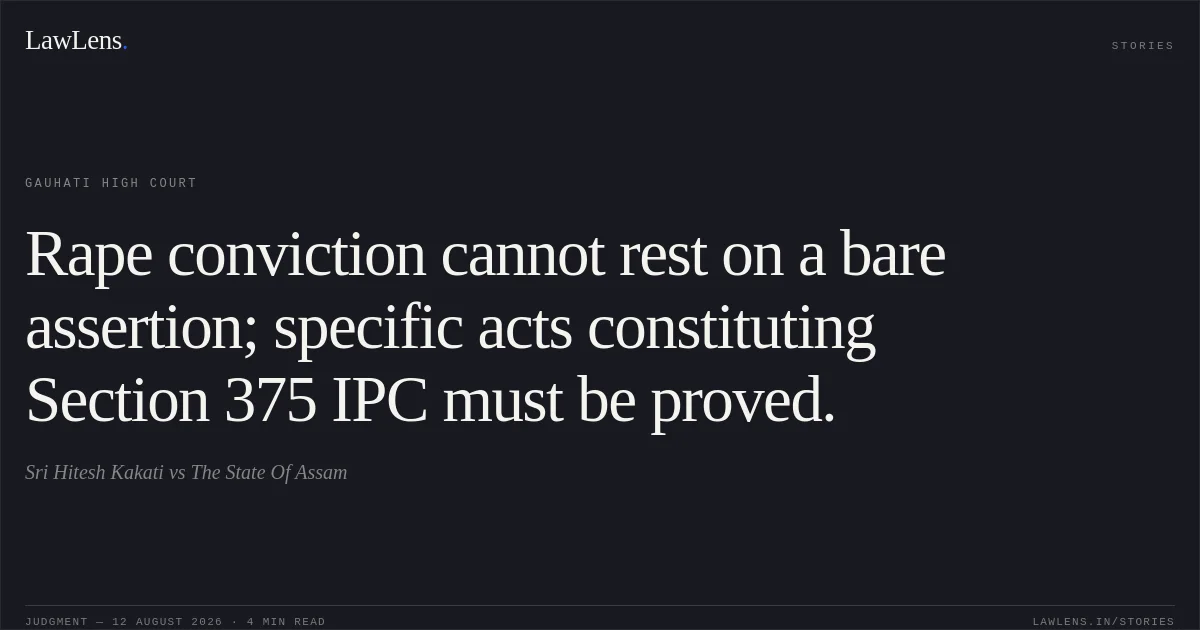
The Court applied Sections 375 and 376 IPC, holding that conviction for rape requires evidence of a specific sexual act falling within Section 375(a)–(d), such as penetration, insertion, manipulation causing penetration, or application of the mouth; merely using the word “rape” is insufficient.
Source reference: pp.7–10It relied on State of Himachal Pradesh v. Raghubir Singh, (1993) 2 SCC 622, for the principle that conviction may rest on the sole testimony of the prosecutrix where it inspires confidence and is free from circumstances affecting credibility.
Source reference: p.5It relied on State of Madhya Pradesh v. Mahendra @ Golu, (2022) 12 SCC 442, for the rule that even slight or partial penetration is sufficient, but such penetration must nevertheless be established by evidence.
Source reference: pp.9–10Under Tomaso Bruno v. State of Uttar Pradesh, (2015) 7 SCC 178, withholding the best available evidence may justify an adverse inference against the prosecution.
Source reference: pp.14–15The Court further held, relying on State of Delhi v. Shri Ram Lohia, AIR 1960 SC 490, that a statement under Section 164 CrPC is not substantive evidence and may be used only for corroboration or contradiction.
Source reference: pp.15–16Finally, under Reena Hazarika v. State of Assam, (2019) 13 SCC 289, the accused need only establish the defence on a preponderance of probabilities, not beyond reasonable doubt.
Source reference: p.15Reasoning
The Court found that the prosecutrix’s evidence merely stated that the appellant “committed rape” after making her undress, without describing penetration or any other act within Section 375(a)–(d).
Source reference: pp.7–10Her initial police statement referred only to a “bad act,” while her Section 164 CrPC statement and trial testimony did not cure the absence of evidence regarding the specific sexual act constituting rape.
Source reference: pp.9, 15–16Her credibility was further impaired by the material contradiction between her assertion in examination-in-chief that she had gone to the appellant’s house on 13.07.2013 and her later denial in cross-examination that she had gone there on that date.
Source reference: p.10The delayed FIR, the failure of PW-4 to support the alleged visit to the appellant’s house, and the non-production of the FSL report concerning the alleged video and obscene messages created additional doubt.
Source reference: pp.11–15The appellant’s consistent defence, supported to some extent by DW-1 and maintained throughout the proceedings, was sufficient to probabilize his version.
Source reference: pp.13–15Since the allegation of intimidation also substantially depended on the unreliable testimony of the prosecutrix and lacked independent corroboration, the conviction under Section 506 IPC was likewise held unsustainable.
Source reference: pp.16–17Holding
The High Court held that the prosecution failed to prove beyond reasonable doubt the essential ingredients of rape under Section 375 IPC or criminal intimidation under Section 506 IPC.
The conviction and sentence imposed by the Additional Sessions Judge (FTC), Rangia, in Sessions Case No. 22/2019 by judgment dated 09.07.2025 were set aside and quashed.
Source reference: p.17The appeal was allowed and the appellant was acquitted of all charges.
Source reference: p.18The Court directed his immediate release if he had not already been released pursuant to the Registry’s release order and directed that the trial court record be returned.
Source reference: p.18Acts & Sections Cited
8 provisions across 3 statutes referred to in this judgment. Each provision opens on LawLens.
Bharatiya Nagarik Suraksha Sanhita, 20231
Indian Penal Code, 18604
Code of Criminal Procedure, 19733
Original Court PDF
Sri Hitesh KakativsThe State Of Assam
Click to open original judgment
Original judgment, available to read, download and summarize on LawLens.in