Facts
The appellant was convicted by the Third Additional Sessions Judge, Ambikapur, on 10.08.2007 for offences under Sections 376(1), 450, 342, and 323 of the IPC.
Source reference: para 1The prosecution alleged that on 15.03.2006, during Holi, the appellant entered the prosecutrix’s house while she was alone, locked the door from inside, and committed forcible sexual intercourse while causing physical injuries by biting her.
Source reference: para 2The prosecutrix claimed she subsequently informed her sister, husband, and the village Sarpanch.
Source reference: para 2, 12The appellant challenged the conviction, arguing that the prosecutrix was a consenting party, as she failed to raise an alarm despite neighbors being present, and that the medical evidence contradicted her claims.
Source reference: para 7Issues
1. Whether the testimony of the prosecutrix is of "sterling quality" to sustain a conviction solely on her solitary evidence.
Source reference: para 17-182. Whether the prosecution proved its case beyond reasonable doubt in the absence of medical corroboration, FSL reports, and the examination of key witnesses.
Source reference: para 15, 18Law Applied
The court primarily applied Sections 376(1), 450, 342, and 323 of the IPC.
Source reference: para 1The court relied on the "sterling witness" doctrine as defined in Rai Sandeep Alias Deepu v. State (NCT of Delhi), which requires a witness to be of such high quality that their version is unassailable and consistent from the initial statement through cross-examination.
Source reference: para 16It further applied the principles from Santosh Prasad Alias Santosh Kumar v. State of Bihar and Krishan Kumar Malik v. State of Haryana, which establish that if a prosecutrix's evidence lacks trustworthiness or shows material lacunae, independent corroboration is necessary for conviction.
Source reference: para 16-17Reasoning
The High Court found the prosecutrix’s testimony unreliable and untrustworthy. The court noted significant discrepancies: the prosecutrix admitted she did not raise an alarm despite her brother-in-law living in the adjacent house.
Source reference: para 12Medical evidence from PW-02 contradicted the prosecutrix's claims of biting and physical struggle, as no external or internal injuries were found.
Source reference: para 14-15Additionally, the prosecution failed to examine vital witnesses—the prosecutrix's husband and sister—to whom the incident was allegedly reported immediately.
Source reference: para 15The Sarpanch (PW-01) turned hostile, testifying that the prosecutrix had only mentioned a scuffle, not rape.
Source reference: para 13Furthermore, no FSL report was produced to confirm the presence of spermatozoa on seized items.
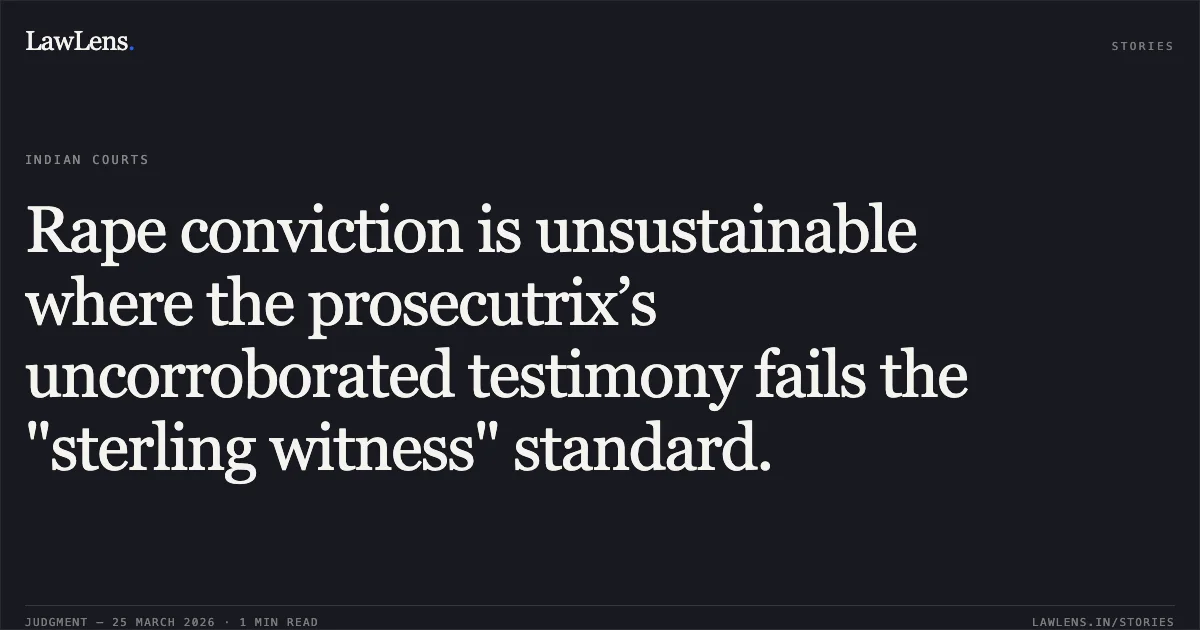
Source reference: para 14, 18Applying the Rai Sandeep standard, the court determined the prosecutrix was not a "sterling witness" due to these evidentiary gaps and the lack of independent corroboration.
Source reference: para 18Holding
The High Court allowed the appeal and set aside the impugned judgment of conviction and sentence.
The court held that the evidence was insufficient to sustain the conviction as the prosecutrix's testimony failed to inspire confidence and was not corroborated by medical or scientific evidence.
Source reference: para 18-19The appellant was acquitted of all charges under Sections 376(1), 450, 342, and 323 of the IPC.
Source reference: para 19Under Section 481 of the BNSS 2023, the appellant was directed to furnish a personal bond of Rs. 25,000 for six months to ensure appearance before the Supreme Court if required.
Source reference: para 20Acts & Sections Cited
9 provisions across 3 statutes referred to in this judgment. Each provision opens on LawLens.
Indian Penal Code, 18604
Code of Criminal Procedure, 19734
Bharatiya Nagarik Suraksha Sanhita, 20231
Original Court PDF
SUKHNATHvsSTATE OF CHHATTISGARH
Click to open original judgment
Original judgment, available to read, download and summarize on LawLens.in


