Facts
The prosecution alleged that on 29 March 2009, the appellant entered the prosecutrix’s house, forcibly had sexual intercourse with her, threatened her with a knife, and subsequently promised to marry her. A Panchayati was convened, where he allegedly admitted the conduct and agreed to marry her, but later refused. A case under Section 376 of the Indian Penal Code was registered, followed by investigation and submission of a charge-sheet. The trial court convicted the appellant under Section 376 IPC and sentenced him to seven years’ rigorous imprisonment, with a fine of ₹10,000 and a default sentence of one year’s imprisonment
Source reference: p.1, paras. 2–3The prosecution examined thirteen witnesses, including the prosecutrix, her parents, the medical officer, and the Investigating Officer. The defence examined one witness, who stated that the parties were involved in a love affair and that the prosecutrix had expressed her desire to marry the appellant, while the appellant had refused
Source reference: p.2, paras. 4–5Issues
Whether the prosecution proved beyond reasonable doubt that the sexual intercourse was forcible and constituted rape under Section 376 IPC, rather than consensual intercourse arising from a prior relationship?
Source reference: p.3–4, paras. 8–10Whether the medical evidence, witness testimony, and surrounding circumstances sufficiently corroborated the prosecutrix’s allegation of forcible sexual assault?
Source reference: p.3–4, paras. 8–10Whether the appellant’s conviction and sentence under Section 376 IPC were sustainable?
Source reference: p.4–5, paras. 10–13Law Applied
The Court applied Section 376 of the Indian Penal Code, which criminalises rape and requires the prosecution to establish the ingredients of the offence beyond reasonable doubt.
Source reference: p.3–4, paras. 8–10The Court considered the legal distinction between consensual sexual intercourse and intercourse obtained through force, threat, coercion, or absence of consent. It further applied the criminal-law principle that where the evidence gives rise to a reasonable doubt regarding the prosecution case, the accused is entitled to acquittal.
Source reference: p.3–4, paras. 8–10Reasoning
The Court found that the prosecutrix’s admission that she had been in a love affair with the appellant for two or three months and had not protested when physical relations were established indicated a consensual relationship rather than intercourse procured through immediate force, threat, or coercion
Source reference: p.3, para. 8The Court also relied on the medical report, which disclosed no injuries or spermatozoa and recorded an old-ruptured hymen, finding that it did not support a recent forcible sexual assault. In view of the alleged contradictions in the prosecutrix’s statements and the absence of corroborative medical evidence, the Court held that the prosecution had failed to prove rape beyond reasonable doubt
Source reference: p.3, para. 9; p.4, para. 10Holding
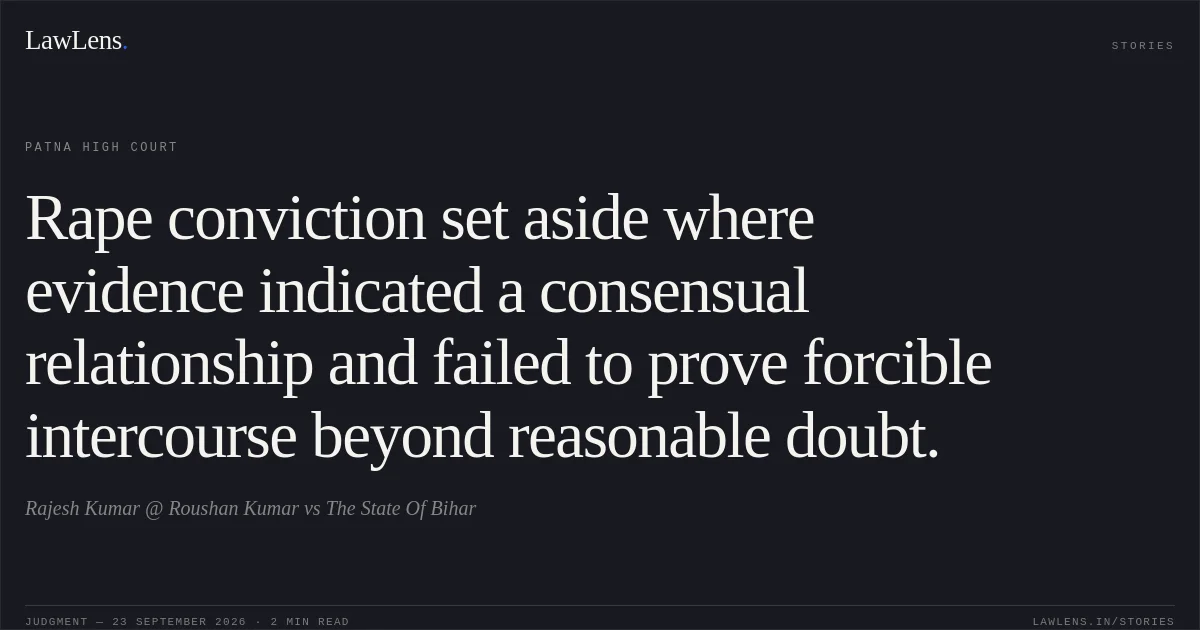
The appeal was allowed. The Court set aside the judgment of conviction dated 10 January 2018 and the order of sentence dated 12 January 2018 passed by the Fast Track Court-I, Purnea
The appellant was acquitted of the charge under Section 376 IPC and discharged from the liability of his bail bond
Source reference: p.4–5, paras. 12–13Acts & Sections Cited
1 provisions across 1 statute referred to in this judgment. Each provision opens on LawLens.
Indian Penal Code, 18601
Original Court PDF
Rajesh Kumar @ Roushan KumarvsThe State Of Bihar
Click to open original judgment
Original judgment, available to read, download and summarize on LawLens.in