Facts
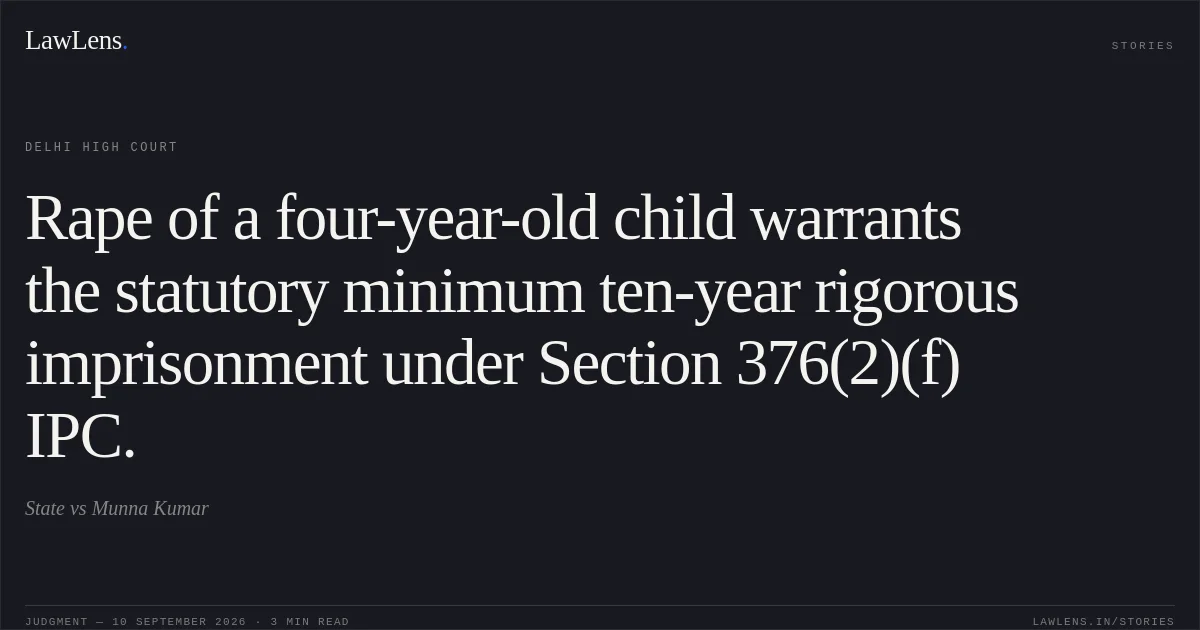
The State’s appeal was allowed by judgment dated 2 September 2026, whereby the Trial Court’s judgment dated 29 April 2010 was set aside and Munna Kumar was convicted under Section 376(2)(f) of the Indian Penal Code, 1860 (“IPC”) for the rape of a child survivor who was approximately four and a half years old at the time of the offence in 2008.
Source reference: p.1, para.1; p.3, para.5On the question of sentence, the respondent submitted that he was approximately 21 years old at the time of the offence, had undergone about one year and eight months in custody, was a first-time offender and the sole breadwinner of his family.
Source reference: p.1, para.3; p.3, para.8The State opposed leniency, relying on the survivor’s tender age, the breach of trust involved, the gravity of the offence, and the respondent’s subsequent declaration as a proclaimed offender during the appeal.
Source reference: p.2, paras.4–5The Nominal Roll recorded approximately one year and eight months of custody and no previous criminal antecedents.
Source reference: p.3, para.8Issues
Whether, having regard to the survivor’s age, the gravity of the offence, the respondent’s mitigating circumstances and subsequent conduct, the appropriate sentence under Section 376(2)(f) IPC should be the statutory minimum of ten years’ rigorous imprisonment or a higher sentence, including life imprisonment?
Source reference: pp.2–4, paras.5–9Whether the survivor was entitled to compensation for the physical and mental trauma caused by the offence, and, if so, what amount should be awarded?
Source reference: p.4, paras.11–12Whether the respondent was entitled to set-off for the period already spent in custody?
Source reference: p.4, para.10Law Applied
The Court applied Section 376(2)(f) IPC, as it stood in 2008 before the 2013 amendment, which prescribed rigorous imprisonment of not less than ten years, extendable to imprisonment for life, along with liability to fine.
Source reference: p.3, para.6The Court held that sentencing must be proportionate to the gravity and circumstances of the offence and must serve the ends of justice.
Source reference: p.3, para.6It treated the survivor’s tender age and vulnerability as significant aggravating circumstances, while recognising the absence of previous criminal antecedents as a mitigating circumstance that could not outweigh the seriousness of the offence.
Source reference: p.3, paras.7–8Section 428 of the Code of Criminal Procedure, 1973 (“CrPC”) required set-off of the period spent in custody during investigation and trial.
Source reference: p.4, para.10For compensation, the Court invoked Section 396 of the Bharatiya Nagarik Suraksha Sanhita (“BNSS”), corresponding to Section 357 CrPC, and the Compensation Scheme for Women Victims/Survivors of Sexual Assault/Other Crimes, 2018, under which the prescribed maximum compensation for rape was Rs. 7 lakhs, with a 50% enhancement where the victim was below 18 years of age.
Source reference: p.4, paras.11–12Reasoning
The Court balanced the respondent’s age at the time of the offence, prior custody, family responsibilities and clean antecedents against the highly aggravating circumstances: the survivor was only about four and a half years old, was particularly vulnerable, and had suffered serious physical and emotional trauma.
Source reference: pp.2–4, paras.5–8Although the statutory range permitted imprisonment up to life, the Court concluded that the statutory minimum of ten years’ rigorous imprisonment was proportionate to the totality of the circumstances and adequately served the ends of justice.
Source reference: p.4, para.9The Court further held that the survivor’s minority justified enhancement of the scheme-based compensation by 50%, resulting in an award of Rs. 10.50 lakhs.
Source reference: p.4, paras.11–12The period already undergone was directed to be credited under Section 428 CrPC.
Source reference: p.4, para.10Holding
The Court sentenced Munna Kumar to ten years’ rigorous imprisonment and a fine of Rs. 5,000, with six months’ simple imprisonment in default of payment of fine.
He was granted set-off for the period already undergone in custody under Section 428 CrPC.
Source reference: p.4, para.10The child survivor was awarded Rs. 10.50 lakhs as compensation, subject to adjustment of any amount already disbursed.
Source reference: p.4, para.12A copy of the order was directed to be sent to the Member Secretary, DSLSA, and the Deputy Registrar was directed to prepare the custody warrant and commit the convict to prison for serving the remaining sentence.
Source reference: p.5, paras.13–15The appeal was accordingly disposed of.
Source reference: p.5, para.16Acts & Sections Cited
5 provisions across 3 statutes referred to in this judgment. Each provision opens on LawLens.
Indian Penal Code, 18602
Code of Criminal Procedure, 19732
Bharatiya Nagarik Suraksha Sanhita, 20231
Original Court PDF
StatevsMunna Kumar
Click to open original judgment
Original judgment, available to read, download and summarize on LawLens.in