Facts
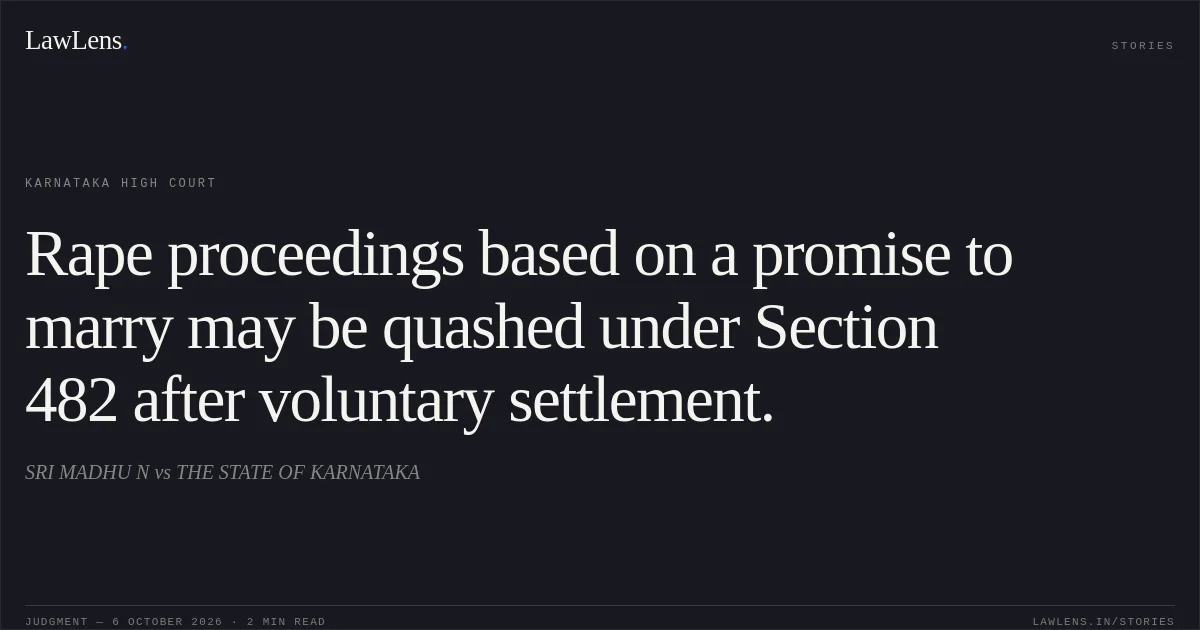
Respondent No. 2 lodged a complaint alleging that the petitioner had promised to marry her and that she had consented to a sexual relationship on that basis.
Source reference: para. 2–3The complaint was registered as Crime No. 124/2022 for offences under Sections 376(1) and 420 IPC; proceedings in S.C. No. 315/2025 were stated to concern Sections 376(2)(n) and 420 IPC.
Source reference: para. 2–3During the petition, the parties filed a joint application and affidavit stating that they had settled their dispute voluntarily.
Source reference: para. 4–10Respondent No. 2 appeared in person, confirmed the settlement, and stated that they had decided to separate and that she did not wish to pursue the prosecution.
Source reference: para. 4–10Issues
1. Whether the parties could compound the alleged offences under Section 320(2) CrPC.
Source reference: para. 112. Whether the proceedings for the non-compoundable offences could nevertheless be quashed under the High Court’s inherent jurisdiction in light of the settlement and complainant’s stated position.
Source reference: para. 12–18Law Applied
Section 320 CrPC permits compounding only of specified offences; the offences under Sections 376(2)(n) and 420 IPC were not compoundable under that provision.
Source reference: para. 11The Court treated Section 482 CrPC as conferring a distinct inherent power to quash proceedings, notwithstanding non-compoundability, where the circumstances of the case support that relief and it would secure the ends of justice.
Source reference: para. 12–13In considering an allegation under Section 376 IPC, the Court stated that settlement alone does not ordinarily justify quashing; the nature of the allegations and the facts and circumstances of the individual case must be examined.
Source reference: para. 16Reasoning
The Court declined to allow compounding under Section 320(2), but considered the settlement and respondent No. 2’s personal statement as relevant to its separate Section 482 inquiry.
Source reference: para. 11–13, 20It noted that the allegation arose from the petitioner’s alleged promise to marry, and that respondent No. 2 had voluntarily stated that she no longer wished to marry him, had no subsisting grievance, and did not wish to pursue the case.
Source reference: para. 14–18Finding no indication of force, threat, coercion, or undue influence, the Court concluded that, in the circumstances presented, continuing the prosecution would serve no useful purpose.
Source reference: para. 18–22Holding
The Court held that the offences could not be compounded under Section 320(2) CrPC, but that the proceedings could be quashed in exercise of its inherent jurisdiction under Section 482 CrPC.
It allowed the petition and quashed the proceedings in S.C. No. 315/2025 arising from Crime No. 124/2022, insofar as they concerned the petitioner.
Source reference: para. 24Acts & Sections Cited
5 provisions across 3 statutes referred to in this judgment. Each provision opens on LawLens.
Indian Penal Code, 18602
Code of Criminal Procedure, 19732
Bharatiya Nagarik Suraksha Sanhita, 20231
Original Court PDF
SRI MADHU NvsTHE STATE OF KARNATAKA
Click to open original judgment
Original judgment, available to read, download and summarize on LawLens.in