Facts
The petitioner invoked Section 528 of the Bharatiya Nagarik Suraksha Sanhita, 2023, seeking quashing of FIR Crime No. 51/2026 registered at Police Station Khaniyadhana, District Shivpuri, for offences under Sections 64(1), 87, 127(2) and 351(3) of the Bharatiya Nyaya Sanhita, 2023, along with consequential proceedings, on the basis of a compromise.
Source reference: para. 1The prosecution alleged that the 23-year-old complainant’s daughter went missing on 15 February 2026 and subsequently stated that the petitioner, allegedly armed with a pistol, abducted her, confined her in an isolated room, committed non-consensual sexual assault, and threatened her and her parents against disclosing the incident.
Source reference: para. 2The parties subsequently filed compromise applications supported by affidavits. The Principal Registrar verified their identities, signatures and the voluntariness of the compromise. The complainants supported the petitioner’s prayer, while the State opposed quashing of the FIR.
Source reference: paras. 3–8Issues
1. Whether the High Court should exercise its inherent jurisdiction under Section 528 of the BNSS to quash the FIR and consequential criminal proceedings on the basis of a compromise between the accused and the complainant in a prosecution involving alleged rape, abduction, wrongful confinement and criminal intimidation.
Source reference: paras. 1, 9–112. Whether the alleged compromise rendered the possibility of conviction remote or justified termination of the prosecution in the interests of justice.
Source reference: para. 11Law Applied
The Court applied Section 528 of the BNSS, which preserves the High Court’s inherent power to prevent abuse of process and secure the ends of justice.
Source reference: para. 1Relying on Gian Singh v. State of Punjab, (2012) 10 SCC 303, it held that inherent quashing jurisdiction is distinct from statutory compounding under Section 320 of the CrPC, but must be exercised having regard to the nature and gravity of the offence; heinous offences such as rape ordinarily cannot be quashed merely because the parties have compromised, as they are offences against society and not purely private disputes.
Source reference: para. 9The Court also relied on Narinder Singh v. State of Punjab, (2014) 6 SCC 466, and State of M.P. v. Madanlal, (2015) 7 SCC 681, which, following Shimbhu v. State of Haryana, (2014) 13 SCC 318, affirmed that rape is a non-compoundable offence and that compromise cannot ordinarily form the basis for terminating or reducing the consequences of such prosecution.
Source reference: para. 10Reasoning
Although the compromise was verified as voluntary, the allegations in the FIR and the material collected during investigation indicated a prima facie case of rape accompanied by abduction, confinement and threats.
Source reference: paras. 2, 11Applying the principles in Gian Singh, the Court treated the alleged offence as heinous and having a serious social impact, rather than as a private or predominantly civil dispute amenable to settlement.
Source reference: paras. 9, 11It further held that the possibility of compulsion, inducement or force behind the compromise could not be excluded, particularly in the context of an alleged sexual offence. Since the prosecution material did not demonstrate that the chances of conviction were remote or bleak, continuation of the criminal proceedings would not constitute an abuse of process.
Source reference: para. 11Holding
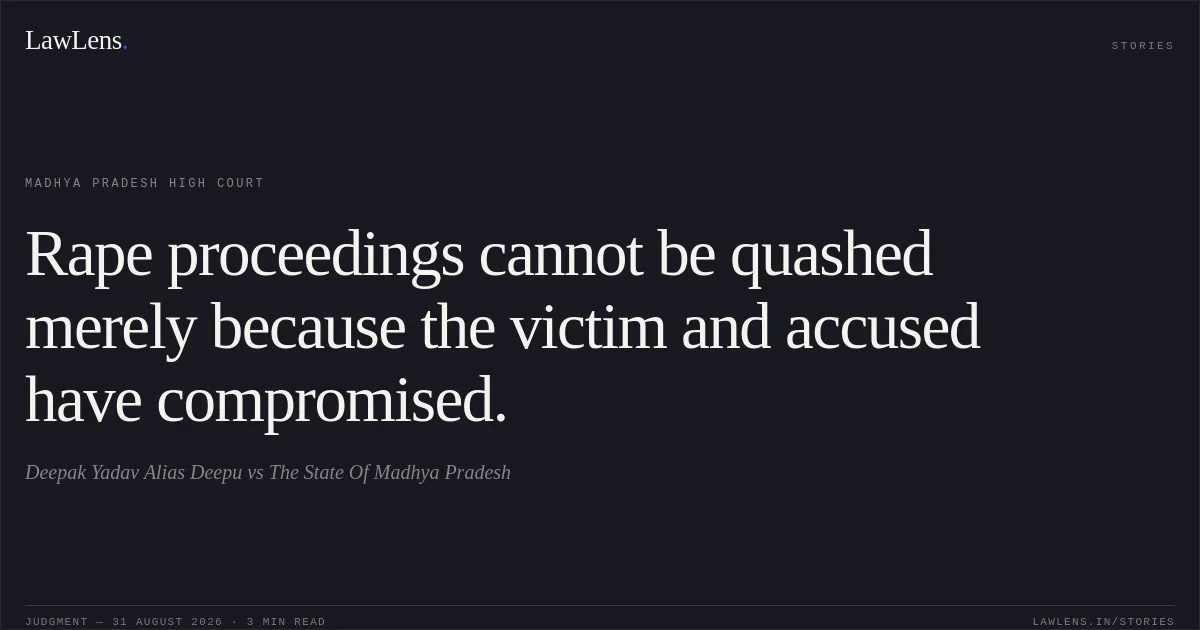
The Court answered the issues against the petitioner. It held that the alleged rape and allied offences could not be quashed under the High Court’s inherent jurisdiction merely on the basis of compromise, and that no case was made out for terminating the prosecution.
The petition was accordingly dismissed, and all pending interlocutory applications were disposed of.
Source reference: paras. 12–13Acts & Sections Cited
7 provisions across 4 statutes referred to in this judgment. Each provision opens on LawLens.
Bharatiya Nagarik Suraksha Sanhita, 20231
Bharatiya Nyaya Sanhita, 20234
Code of Criminal Procedure, 19731
Indian Penal Code, 18601
Original Court PDF
Deepak Yadav Alias DeepuvsThe State Of Madhya Pradesh
Click to open original judgment
Original judgment, available to read, download and summarize on LawLens.in