Facts
On April 24, 2017, the complainant/victim (PW-1) was waiting for a bus when the appellant and an accomplice offered her a lift on a motorcycle under false pretenses.
Source reference: para 2Instead of her destination, they took her to the Gahanadand forest, where the appellant threatened to hang her with her veil (odhni), robbed her of her mobile phone and belongings, and forcibly raped her.
Source reference: para 2The victim eventually sought help from villagers in Siyansarai.
Source reference: para 2Following a trial involving 18 prosecution witnesses, the First Additional Sessions Judge, Ramanujganj, convicted the appellant on August 4, 2025, for offenses under Sections 376, 392, and 506(B) of the IPC, sentencing him to a maximum of 10 years of rigorous imprisonment (RI).
Source reference: para 1The appellant challenged the sentence, but not the conviction, in the present appeal under Section 415(2) of the BNSS.
Source reference: para 1, 4Issues
1. Whether the conviction of the appellant under Sections 376, 392, and 506(B) of the IPC is sustainable based on the evidence on record.
Source reference: para 72. Whether the sentence of 10 years RI for the offense of rape should be reduced based on the reformative theory of punishment and the period of incarceration already served.
Source reference: para 8-9Law Applied
Sections 376 (rape), 392 (robbery), and 506(B) (criminal intimidation) of the Indian Penal Code (IPC).
Source reference: no citationThe reformative theory of penology as articulated in Mohammad Giasuddin v. State of Andhra Pradesh (1977) 3 SCC 287, which emphasizes that the objective of sentencing is to rehabilitate and "salvage" the offender for society rather than to satisfy a purely retributive impulse.
Source reference: para 8Reasoning
The High Court upheld the conviction, finding no illegality in the Trial Court's findings; the testimonies of the victim (PW-1), medical expert (PW-9), and other witnesses (PW-2 to PW-18) conclusively established the appellant's involvement in the crime.
Source reference: para 7On the matter of sentencing, the court balanced the "heinous" nature of the crime against the reformative approach.
Source reference: para 5, 8The court noted that the appellant, a farmer, had already served 6 years, 6 months, and 4 days of his sentence since his arrest in 2019.
Source reference: para 9-10Referencing the principle that "men are not improved by injuries," the court determined that reducing the 10-year RI sentence to 7 years RI was just and proper under the circumstances, while maintaining the fines and the sentences for the other offenses.
Source reference: para 8-9Holding
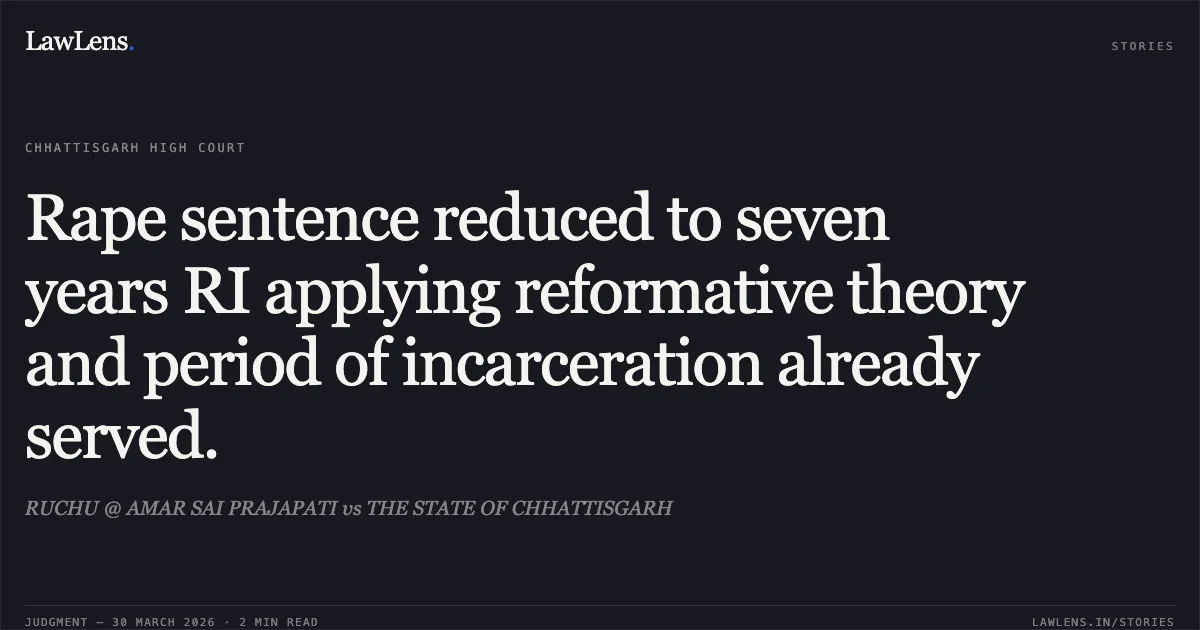
The High Court partly allowed the appeal.
It maintained the conviction for all offenses under Sections 376, 392, and 506(B) of the IPC.
Source reference: para 9It modified the sentence for the conviction under Section 376 IPC, reducing it from 10 years RI to 7 years RI.
Source reference: para 9The sentences for Sections 392 and 506(B) IPC, as well as all fine amounts and default sentences, were upheld.
Source reference: para 9The court ordered that the appellant’s period of custody be set off against the modified 7-year sentence.
Source reference: para 10Acts & Sections Cited
4 provisions across 2 statutes referred to in this judgment. Each provision opens on LawLens.
Bharatiya Nagarik Suraksha Sanhita, 20231
Indian Penal Code, 18603
Original Court PDF
RUCHU @ AMAR SAI PRAJAPATIvsTHE STATE OF CHHATTISGARH
Click to open original judgment
Original judgment, available to read, download and summarize on LawLens.in


