Facts
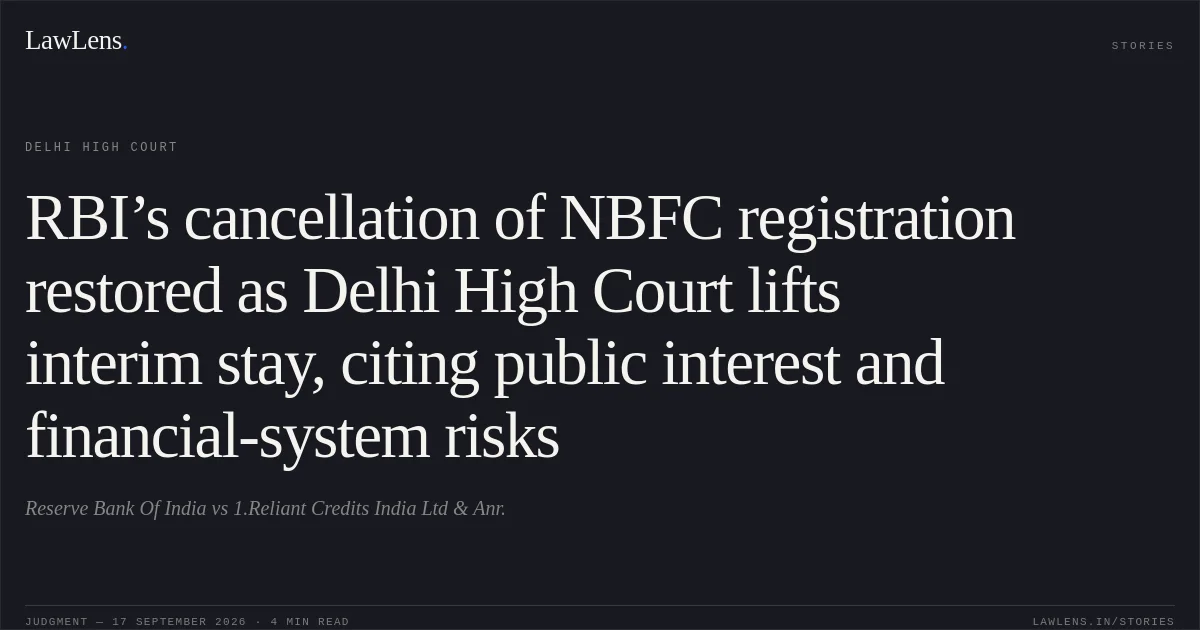
Respondent No. 1, a non-deposit-taking NBFC, held a Certificate of Registration (“CoR”) issued by the Reserve Bank of India (“RBI”) under the RBI Act, 1934.
Source reference: para. 4.1Following an inspection under Section 45-N of the RBI Act, RBI identified various statutory and regulatory violations, communicated its concerns, and afforded the company opportunities to submit compliance reports and respond to a show-cause notice proposing cancellation of its CoR under Section 45-IA(6).
Source reference: paras. 4.2–4.6After a personal hearing, the Executive Director of RBI cancelled the CoR on 11 September 2025. The statutory appeal filed by Respondent No. 1 under Section 45-IA(7) was dismissed on 8 June 2026.
Source reference: paras. 4.7–4.12Respondent No. 1 thereafter filed a writ petition challenging the cancellation and appellate orders. The learned Single Judge granted ad-interim protection by staying those orders insofar as they restrained Respondent No. 1 from carrying on NBFI business.
Source reference: paras. 4.12–4.15RBI challenged that interlocutory order through the present Letters Patent Appeal. Respondent No. 1 was permitted to continue day-to-day banking transactions and recover existing loans, but sought to resume fresh NBFI lending. During the appeal, it declined to furnish an undertaking that it would refrain from disbursing fresh loans pending determination of its interim-relief application.
Source reference: paras. 4.17, 16Issues
1. Whether the ad-interim order staying the cancellation of Respondent No. 1’s CoR and permitting it to resume NBFI business was appealable under Clause 10 of the Letters Patent.
Source reference: paras. 22–232. Whether the learned Single Judge correctly applied the principles governing interim relief, including strong prima facie case, balance of convenience, and irreparable injury.
Source reference: paras. 8–9, 13–173. Whether the larger public interest and RBI’s regulatory findings justified maintaining the restraint on Respondent No. 1’s fresh NBFI business pending adjudication of the writ petition.
Source reference: paras. 14, 17–21Law Applied
The Court applied Sections 45-N, 45-IA(6) and 45-IA(7) of the RBI Act, 1934, under which RBI may inspect an NBFC, cancel its CoR for statutory or regulatory violations, and provide a statutory appellate remedy.
Source reference: paras. 4.2, 4.5, 4.10Interim relief is an equitable and discretionary remedy requiring consideration of a strong prima facie case, balance of convenience, and likely irreparable injury, together with the competing interests and broader consequences of granting or refusing relief.
Source reference: paras. 8–9Courts should accord due deference to specialised sectoral regulators such as RBI, whose determinations should not be displaced absent manifest arbitrariness, perversity, ultra vires action, procedural impropriety, or violation of natural justice.
Source reference: paras. 18–20Under Clause 10 of the Letters Patent, an interlocutory order possessing the “trappings of finality,” particularly one granting substantially the final relief sought in the writ petition, is appealable; the Court relied on Union of India v. Delhi Race Club (1940) Ltd. & Ors., 2026 SCC OnLine Del 4127.
Source reference: paras. 22–23Reasoning
The Court held that the learned Single Judge had granted protection without adequately examining RBI’s findings that Respondent No. 1’s management was prejudicial to public interest and that permitting it to continue NBFI business would serve no public interest.
Source reference: paras. 13–14The alleged rectification of violations constituted disputed factual matters that could not properly be determined before RBI filed its counter-affidavit.
Source reference: paras. 10, 15Respondent No. 1 had also acknowledged the existence of the defaults by asserting that they had subsequently been rectified.
Source reference: para. 17Since Respondent No. 1 remained permitted to conduct day-to-day banking transactions and recover existing loans, refusal to permit fresh lending did not result in irreparable injury or bring its entire business to a standstill.
Source reference: paras. 15, 21In contrast, allowing fresh NBFI operations despite RBI’s cancellation and the appellate affirmation could prejudice customers and the financial system.
Source reference: paras. 17, 21The ad-interim order therefore failed to satisfy the requirements of a strong prima facie case, balance of convenience, and irreparable injury.
Source reference: paras. 17, 21The Court further found the appeal maintainable because the order effectively granted the final relief sought in the writ petition by permitting Respondent No. 1 to resume NBFI business.
Source reference: paras. 22–23Holding
The appeal was allowed.
The ad-interim order was set aside insofar as it stayed the operation and effect of the Cancellation Order and Appellate Order restraining Respondent No. 1 from carrying on NBFI business.
Source reference: para. 24Respondent No. 1 consequently remained restrained from disbursing fresh loans or otherwise carrying on fresh NBFI business, while continuing to undertake day-to-day banking transactions and recover existing loans.
Source reference: para. 21The Court expressed no final opinion on the merits, including alleged rectification, proportionality, natural justice, or territorial jurisdiction, and left all issues open for determination by the learned Single Judge.
Source reference: para. 25The learned Single Judge was requested to decide the pending interim-relief application at the earliest.
Source reference: paras. 25–26Acts & Sections Cited
2 provisions across 1 statute referred to in this judgment. Linked provisions open on LawLens.
Reserve Bank of India Act, 19342
Original Court PDF
Reserve Bank Of Indiavs1.Reliant Credits India Ltd & Anr.
Click to open original judgment
Original judgment, available to read, download and summarize on LawLens.in