Facts
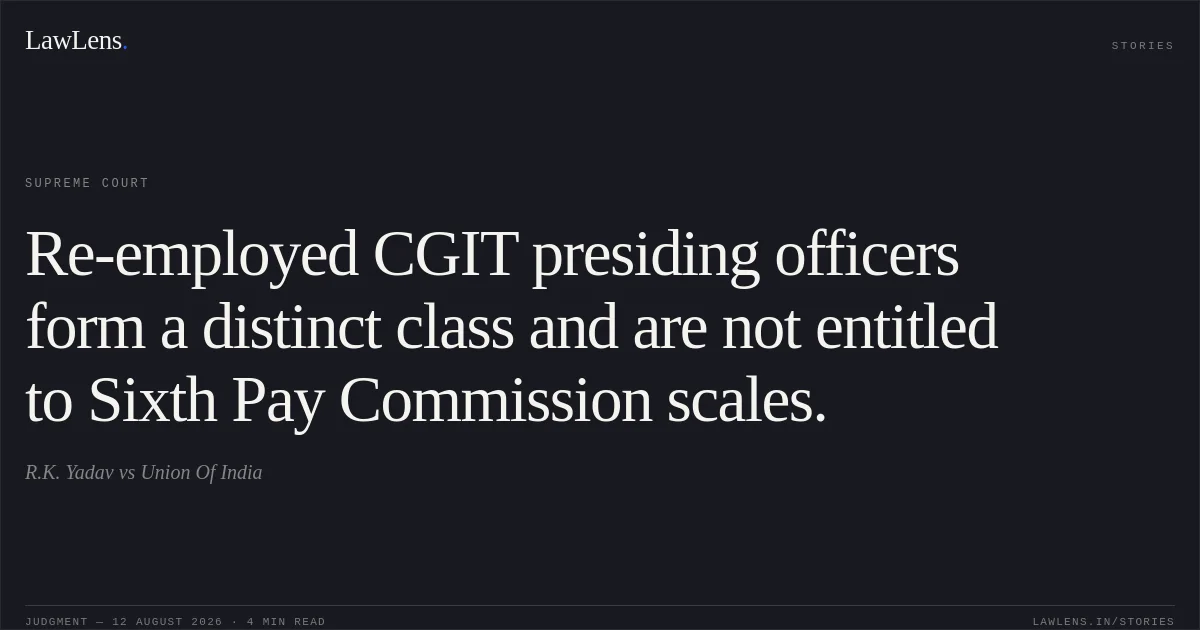
The petitioners were appointed as Presiding Officers of Central Government Industrial Tribunals-cum-Labour Courts (“CGIT-cum-LCs”) at New Delhi and Hyderabad. They invoked Article 32, alleging violation of Articles 14 and 16 on the ground that the Union Government had granted the Sixth Central Pay Commission scales to officers of certain other Central tribunals, but had fixed their pay according to the scales recommended for the State District Judiciary by the Shetty Commission and Justice E. Padmanabhan Committee.
Source reference: p.2–5Petitioner No. 1, formerly a judicial officer of the Delhi Judicial Service, joined as Presiding Officer on deputation and was thereafter re-employed from 1 July 2009 after superannuation. The petitioners’ pay was fixed in the scale applicable to a District Judge in the super-time scale.
Source reference: p.5–7The Union Government contended that the petitioners were re-employed pensioners and that their pay was governed by the Central Civil Services (Fixation of Pay of Re-employed Pensioners) Orders, 1986, as revised from time to time.
Source reference: p.8–11, 18–21The pay scales of CGIT-cum-LC Presiding Officers were subsequently revised under the recommendations of Justice E. Padmanabhan Committee with effect from 1 January 2006. Later statutory rules, including the 2015, 2017, 2020 and 2021 Tribunal Rules, prescribed further revised salaries and allowances.
Source reference: p.12–15The petitioners sought implementation of Sixth Pay Commission scales and quashing of the Government’s order dated 16 January 2012.
Source reference: p.2Issues
1. Whether the petitioners, as Presiding Officers of CGIT-cum-LCs, were entitled to the Sixth Central Pay Commission pay scales on parity with Presiding Officers of other Central tribunals?
Source reference: p.2–5, 21–242. Whether extending to the petitioners the pay scales applicable to the District Judiciary amounted to hostile discrimination or arbitrary classification in violation of Articles 14 and 16 of the Constitution?
Source reference: p.21–283. Whether the petitioners’ status as re-employed retired officers justified separate treatment for pay fixation under the applicable re-employment rules?
Source reference: p.18–22, 25–28Law Applied
The Court applied Articles 14 and 16 of the Constitution, holding that equality does not prohibit reasonable classification based on an intelligible differentia having a rational nexus with the object sought to be achieved.
Source reference: p.24–26It relied on the principle that fixation and classification of pay scales are primarily executive functions requiring expert evaluation, and that judicial review is limited unless mala fides, patent arbitrariness or an apparent anomaly is established. This principle was drawn from State of U.P. v. J.P. Chaurasia, (1989) 1 SCC 121, Union of India v. Dineshan K.K., (2008) 1 SCC 586, Union of India v. Indian Navy Civilian Design Officers Association, (2023) 19 SCC 482, and Union of India v. T.V.L.N. Mallikarjuna Rao, (2015) 3 SCC 653.
Source reference: p.22–24The Court also applied Sections 7, 7A and 7B of the Industrial Disputes Act, 1947 concerning Labour Courts, Industrial Tribunals and National Tribunals.
Source reference: p.15–17The Court also applied the Central Civil Services (Fixation of Pay of Re-employed Pensioners) Orders, 1986, under which re-employed pensioners receive pay in the prescribed scale of the re-employed post and do not retain the pay structure of their pre-retirement post.
Source reference: p.18–21The classification principle was further supported by Charanjit Lal Chowdhury v. Union of India, 1950 SCC 833.
Source reference: p.25–26Reasoning
The Court held that the petitioners’ claim was substantially affected by their status as re-employed retired officers. Under the 1986 Re-employment Orders, they constituted a distinct class from regularly serving government officers and were entitled only to the prescribed pay structure of the re-employed post.
Source reference: p.18–22The Court found that the pay scales applicable to CGIT-cum-LC Presiding Officers had been determined on the basis of expert recommendations of the Shetty Commission and Justice E. Padmanabhan Committee, which had deliberately aligned them with the District Judiciary.
Source reference: p.17–18, 26–27The distinction between CGIT-cum-LCs and other tribunals, including the separate treatment of National Tribunals at Mumbai and Kolkata, was not shown to be irrational or mala fide.
Source reference: p.7–11, 26–27Since pay fixation lies primarily within the executive and expert domain, and no patent anomaly or unconstitutional discrimination was established, the Court declined to substitute the Sixth Pay Commission structure for the existing framework.
Source reference: p.22–24, 26–28Holding
The Court answered the issues against the petitioners. It held that re-employed Presiding Officers of CGIT-cum-LCs could be separately classified for pay fixation and that their alignment with the District Judiciary, pursuant to expert recommendations, did not violate Articles 14 or 16.
The petitioners had no enforceable right to claim Sixth Central Pay Commission scales merely because different scales had been granted to officers of other tribunals.
Source reference: p.25–28The writ petition was accordingly dismissed as devoid of merit, with no relief granted.
Source reference: p.28Acts & Sections Cited
3 provisions across 1 statute referred to in this judgment. Linked provisions open on LawLens.
Industrial Disputes Act, 19473
Original Court PDF
R.K. YadavvsUnion Of India
Click to open original judgment
Original judgment, available to read, download and summarize on LawLens.in