Facts
The respondent/plaintiff instituted a suit for recovery of possession of medical equipment valued at approximately ₹17,36,738, allegedly given to the petitioner/defendant on rent at ₹5,000 per day.
Source reference: p.2, para. 3Seven issues were framed on 6 March 2019, and a Local Commissioner was appointed to record evidence.
Source reference: p.2, para. 3Although PW-1 and PW-2 had not had their examination-in-chief recorded, they were partially cross-examined on 30 May and 3 June 2019.
Source reference: p.2, para. 4The second Local Commissioner confirmed that the examination-in-chief of PW-1 and PW-2 had not been recorded and that documents had not been tendered before cross-examination.
Source reference: p.2, para. 5The trial court allowed an application under Section 151 CPC for re-tendering PW-1’s evidence on 26 September 2024.
Source reference: p.2–3, para. 7In December 2025, the respondent filed another application under Section 151 CPC seeking re-tendering and re-recording of the examination-in-chief of PW-1 and PW-2.
Source reference: p.3, para. 10The trial court allowed the application on 9 January 2026 and appointed another Local Commissioner for recording the evidence.
Source reference: p.3, para. 11The petitioner challenged that order under Article 227 of the Constitution, contending that the application was barred by constructive res judicata and constituted a dilatory tactic.
Source reference: p.3–4, paras. 12–13Issues
1. Whether the respondent’s application under Section 151 CPC for re-tendering and re-recording the examination-in-chief of PW-1 and PW-2 was barred by constructive res judicata because an earlier application seeking similar relief had been allowed on 26 September 2024?
Source reference: p.4–5, paras. 16, 18–192. Whether permitting the respondent to record the examination-in-chief after cross-examination had already taken place amounted to an impermissible or dilatory reopening of evidence?
Source reference: p.4–6, paras. 16, 203. Whether the trial court was justified in exercising its inherent powers under Section 151 CPC to cure the procedural irregularity in the recording of evidence?
Source reference: p.5–6, paras. 17–21Law Applied
The Court applied Section 143(1) of the Bharatiya Sakshya Adhiniyam, 2023, corresponding to Section 138 of the Indian Evidence Act, which mandates that a witness must first be examined in chief and thereafter subjected to cross-examination.
Source reference: p.5, para. 17Consequently, cross-examination cannot properly exist in law where examination-in-chief has not been recorded.
Source reference: p.5, para. 17The Court also considered the inherent jurisdiction of the civil court under Section 151 CPC to correct procedural irregularities in the interests of justice, particularly where the irregularity affects the substantive rights of the parties.
Source reference: p.5, paras. 17–19Although the petitioner relied on Satyadhyan Ghosal v. Sm. Deorajin Debi, Hope Plantations Ltd. v. Taluk Land Board and Shanmughasundram v. Diravia Nadar on res judicata and constructive res judicata, the Court held that the doctrine did not bar correction of an unresolved procedural defect where the earlier order had not resulted in the defect being cured.
Source reference: p.4, para. 12; p.5, para. 19Reasoning
The Court found that it was undisputed that the examination-in-chief of PW-1 and PW-2 had never been recorded, even though their cross-examination had been partially conducted.
Source reference: p.5, para. 18This sequence violated the statutory order of examination prescribed by Section 143(1) BSA, under which examination-in-chief must precede cross-examination.
Source reference: p.5, para. 17The later application was therefore directed only at curing the continuing procedural irregularity and not at introducing an entirely new or previously adjudicated claim.
Source reference: p.5, para. 19Since the defect remained uncured even after the order dated 26 September 2024, the issue had not attained finality and the subsequent order permitting its correction could not be treated as barred by res judicata.
Source reference: p.5, para. 19The Court further held that adherence to the statutory procedure could not be rejected merely because correction would prolong the proceedings; permitting cross-examination to stand without a recorded examination-in-chief could prejudice the parties’ substantive rights.
Source reference: p.6, para. 20Holding
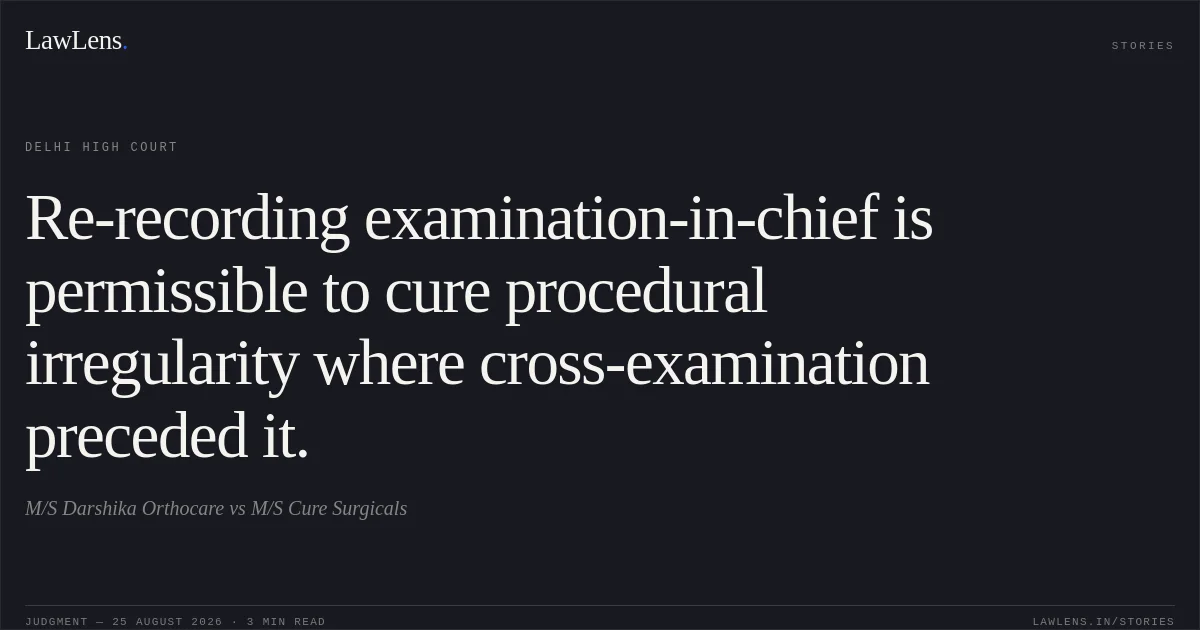
The High Court held that the second application for recording the examination-in-chief of PW-1 and PW-2 was not barred by constructive res judicata and did not amount to a dilatory tactic.
The trial court had properly exercised its inherent powers under Section 151 CPC to cure a material procedural irregularity and ensure compliance with Section 143(1) BSA.
Source reference: p.5–6, paras. 17, 19–20The petition under Article 227 was accordingly dismissed, the order dated 9 January 2026 was upheld, and all pending applications were disposed of.
Source reference: p.6, para. 21Acts & Sections Cited
3 provisions across 3 statutes referred to in this judgment. Each provision opens on LawLens.
Code of Civil Procedure, 19081
Commercial Courts Act, 20151
Bharatiya Sakshya Adhiniyam, 20231
Original Court PDF
M/S Darshika OrthocarevsM/S Cure Surgicals
Click to open original judgment
Original judgment, available to read, download and summarize on LawLens.in