Facts
The petitioner filed his return for A.Y. 2016–17 declaring income of ₹14,90,27,890.
Source reference: p. 2; paras 2.1–2.2The return was scrutinised under Section 143(3), and, during that assessment, the petitioner responded to queries concerning short-term capital loss relating to J.M. Balance Fund.
Source reference: p. 2, p. 4; paras 2.1–2.2, 5The assessment was completed on 14 November 2018.
Source reference: p. 2, p. 4; paras 2.1–2.2, 5In 2023, the Revenue issued notices under Section 148A concerning losses allegedly connected with equity or derivative trading involving J.M. Financial Asset Management Ltd.
Source reference: p. 2–4; paras 2.3–2.5, 6The petitioner replied, but the Assessing Officer passed an order under Section 148A(d) and issued a notice under Section 148, both dated 22 March 2023, proposing reassessment for A.Y. 2016–17.
Source reference: p. 2–4; paras 2.3–2.5, 6The Revenue’s case relied on information arising from survey action concerning the fund’s alleged manipulation of its accounting methodology to inflate distributable surplus.
Source reference: p. 4; para 6Issues
Whether the information concerning alleged manipulation by J.M. Financial Asset Management Ltd. provided a sufficient nexus to the petitioner’s income to justify reopening the assessment under Sections 148A and 148.
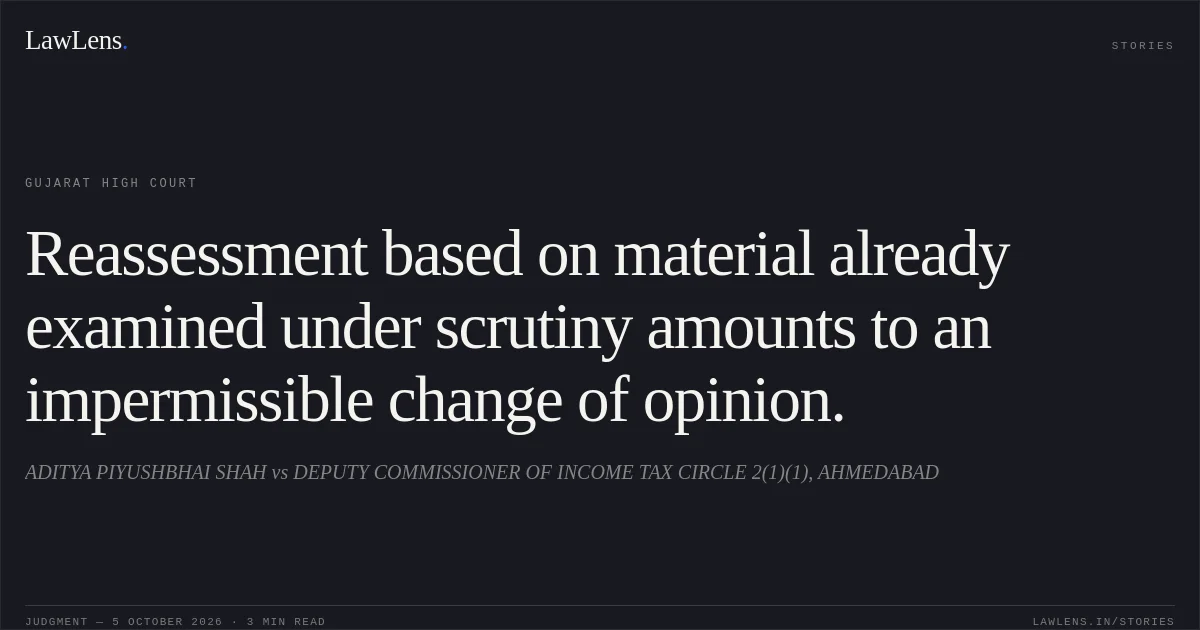
Source reference: p. 4–5, p. 9–11; paras 6, 7.19Whether reopening the assessment was impermissible as a change of opinion where the petitioner’s short-term capital loss relating to J.M. Balance Fund had already been examined in the scrutiny assessment and no fresh tangible material was shown.
Source reference: p. 11–12; para 8Law Applied
Sections 148A and 148 of the Income Tax Act, 1961 require a legally sustainable basis for initiating reassessment; information relied upon must have a rational connection or live link to the belief that the particular assessee’s income escaped assessment.
Source reference: p. 8–10; para 7.18Under the principles stated in Income Tax Officer v. Lakhmani Mewal Das, vague, remote or unconnected material is insufficient, although the court does not assess the adequacy of the material where it is relevant.
Source reference: p. 8–10; para 7.18The Court also relied on Commissioner of Income Tax v. Walfort Share & Stock Brokers (P) Ltd. for the principle that a transaction is not rendered sham merely because it is tax-motivated or results in a loss, absent material impeaching its genuineness.
Source reference: p. 7–8; para 7.17It followed Pranav Ramesh Parikh v. Deputy Commissioner of Income Tax and the Bombay High Court’s decision in Karan Maheshwari, which addressed similar allegations concerning J.M. Financial and found reassessment unsustainable where the allegations did not implicate the assessee and relevant information was withheld.
Source reference: p. 5–11; paras 7.12–7.20Further, reassessment cannot rest on a change of opinion where the same issue was examined in the original scrutiny and no fresh tangible material is established.
Source reference: p. 11–12; para 8Reasoning
The Court found that the petitioner’s return had been scrutinised and that the petitioner had answered queries about the short-term capital loss relating to J.M. Balance Fund before the assessment was completed.
Source reference: p. 2, p. 4; paras 2.2, 5The later reassessment was based on survey information alleging that J.M. Financial had manipulated its accounting methodology.
Source reference: p. 4–5; paras 6, 7.13–7.20Applying the live-link requirement and the reasoning in Pranav Ramesh Parikh and Karan Maheshwari, the Court concluded that allegations against the fund did not, without material connecting the petitioner to a sham transaction, justify reopening the petitioner’s assessment.
Source reference: p. 4–5, p. 10–11; paras 6, 7.13–7.20The Court also held that the same loss issue had already been examined in the scrutiny assessment and that the Revenue had not shown any fresh tangible material; reopening therefore also amounted to a change of opinion.
Source reference: p. 11–12; para 8Holding
The Court held that the reassessment proceedings were unsustainable both because the Revenue had not demonstrated a sufficient basis connecting the alleged fund-level manipulation to the petitioner and because the same issue had already been examined without any demonstrated fresh tangible material.
It quashed and set aside the order dated 22 March 2023 under Section 148A(d) and the notice dated 22 March 2023 under Section 148 for A.Y. 2016–17, and made the rule absolute to that extent.
Source reference: p. 12; para 8Acts & Sections Cited
9 provisions across 2 statutes referred to in this judgment. Linked provisions open on LawLens.
Income Tax Act, 19618
Indian Income-tax Act, 19221
Original Court PDF
ADITYA PIYUSHBHAI SHAHvsDEPUTY COMMISSIONER OF INCOME TAX CIRCLE 2(1)(1), AHMEDABAD
Click to open original judgment
Original judgment, available to read, download and summarize on LawLens.in