Facts
The petitioner filed his return of income for A.Y. 2022-23 on 17.12.2022
Source reference: p. 2On 28.09.2021, a search action under Section 132 of the IT Act was conducted at the premises of City Estate Management India, a real estate broker
Source reference: p. 2An inquiry register was seized containing a notation dated 29.11.2018 regarding Survey No. 31, Village Kaneti, quoting a rate of ₹1.20 Crore per vigha under the name "Sanjay Thakor"
Source reference: p. 3, 7The petitioner, with co-purchasers, had purchased a portion of the same survey number via a registered deed dated 03.04.2021 for ₹73,82,700
Source reference: p. 2Based solely on the register entry, the Respondent issued a notice dated 20.06.2025 under Section 148 of the IT Act, alleging "on-money" payments of ₹4,88,97,300
Source reference: p. 2-3The petitioner challenged this notice as being based on conjectures and lacking a live nexus
Source reference: p. 3Issues
1. Whether the Assessing Officer (AO) had "information suggesting escapement of income" sufficient to invoke jurisdiction under Section 148 based on a third-party inquiry register entry that predates the actual transaction by 28 months
Source reference: p. 7-82. Whether there exists a live and direct nexus between the seized material and the petitioner to satisfy the "pertains to" or "relates to" requirement under Explanation 2(iv) to Section 148
Source reference: p. 4, 10-11Law Applied
Section 148 of the Income Tax Act, 1961, regarding the issuance of notice for reassessment where income has escaped assessment
Source reference: p. 1Explanation 2(iv) to Section 148, which deems the AO to have information if seized documents "pertain to" or "relate to" the assessee
Source reference: p. 6-7The evidentiary standards of Sections 132(4A) and 292C regarding the presumption of truthfulness of seized documents, but noted these are rebuttable
Source reference: p. 5-6, 9Naliniben Jagdishkumar Gandhi v. ITO [2025] 183 taxmann.com 126 (Gujarat), which held that a survey number match alone without a live link is insufficient to reopen assessment
Source reference: p. 10-11Reasoning
The court reasoned that the reopening was based on "conjectures and surmises" rather than tangible material
Source reference: p. 12It highlighted that the notation in the seized register (dated 29.11.2018) predated the petitioner’s purchase (03.04.2021) by 28 months, falling into a completely different Assessment Year (A.Y. 2019-20 vs. A.Y. 2022-23), making it a mere "market survey" or "asking rate" rather than a concluded transaction
Source reference: p. 8The court found major discrepancies: the register mentioned "Sanjay Thakor" (an unknown third party) and covered a larger land area (4.69 vigha) than what the petitioner actually purchased
Source reference: p. 9-10The broker’s own statement under Section 131 clarified that the registers merely listed "available" plots and that documents often belonged to clients, thereby weakening the statutory presumption under Section 292C
Source reference: p. 9The court concluded that a mere match of the survey number, without any mention of the petitioner’s name or corroborative evidence of cash exchange, fails to establish the "live nexus" required for jurisdictional facts
Source reference: p. 10-11Holding
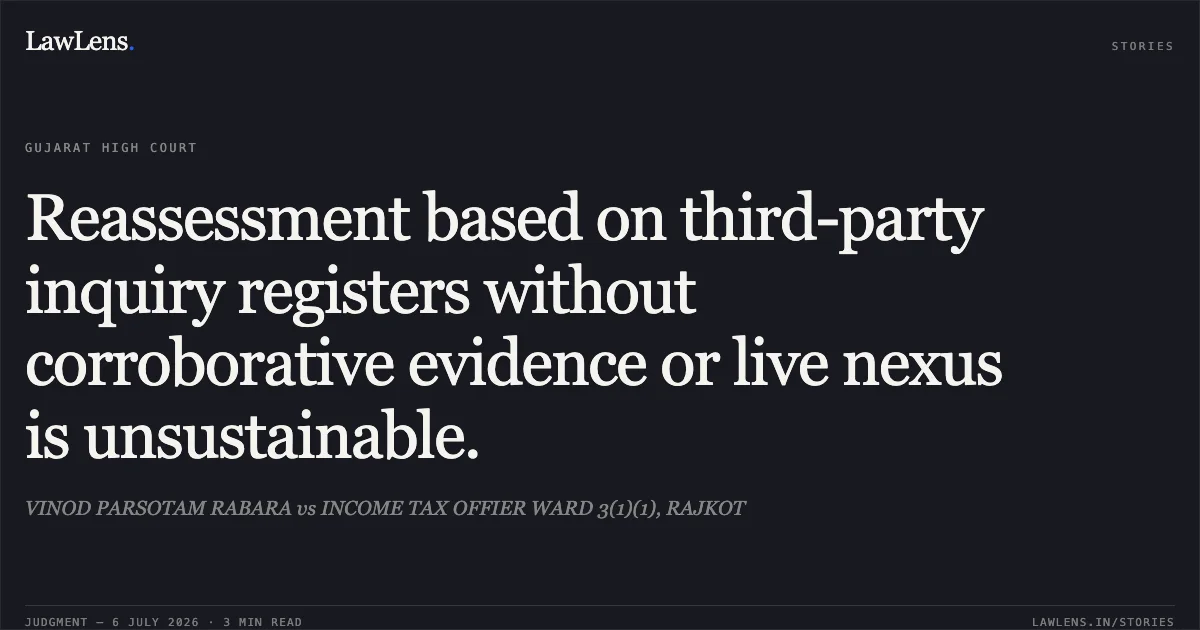
The court answered the issues in the negative, holding that the reopening was ill-conceived as the seized document did not establish a direct or indirect link to the petitioner
The court ruled that assessment cannot be reopened in a "vacuum" based on vague third-party notations
Source reference: p. 11The High Court allowed the writ petition and quashed the impugned Notice dated 20.06.2025 issued under Section 148 of the IT Act
Source reference: p. 12Acts & Sections Cited
6 provisions across 1 statute referred to in this judgment. Linked provisions open on LawLens.
Income Tax Act, 19616
Original Court PDF
VINOD PARSOTAM RABARAvsINCOME TAX OFFIER WARD 3(1)(1), RAJKOT
Click to open original judgment
Original judgment, available to read, download and summarize on LawLens.in