Facts
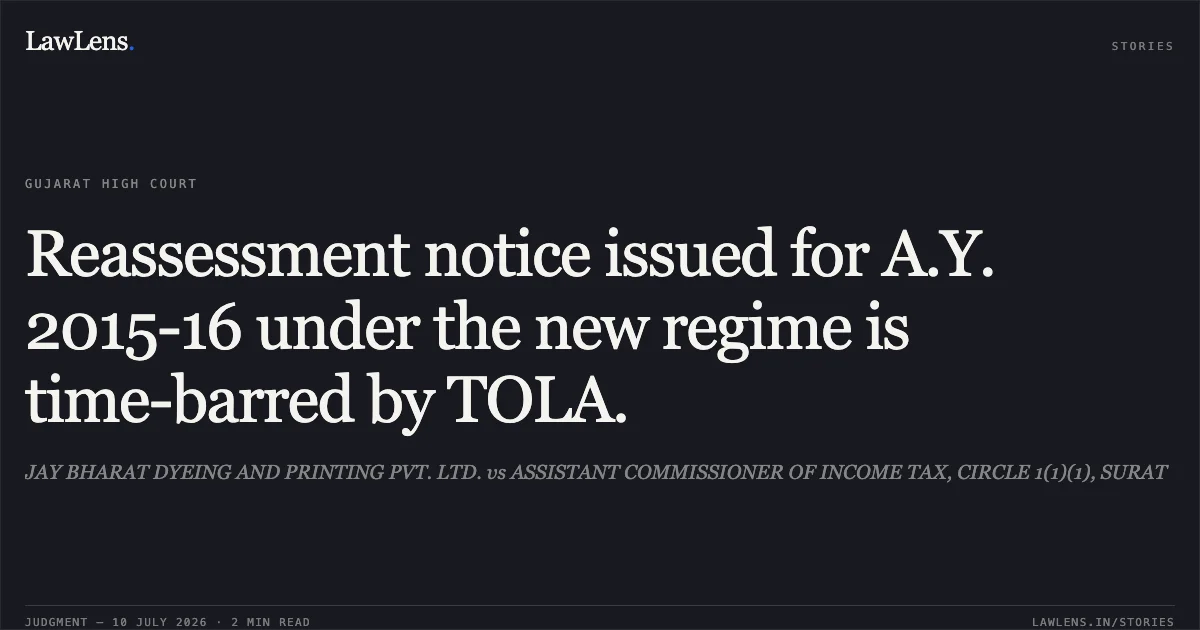
The petitioner, a company incorporated under the Companies Act, 1956, challenged a reassessment notice and order dated 27.07.2022 issued under Sections 148 and 148A(d) of the Income Tax Act, 1961, for Assessment Year (A.Y.) 2015-16.
Source reference: p. 1Originally, assessment for A.Y. 2015-16 was completed under Section 143(3) on 22.12.2017.
Source reference: p. 2Between 01.04.2021 and 30.06.2021, the Department issued reopening notices under the old regime, despite the new regime taking effect on 01.04.2021.
Source reference: p. 1-2Following the Supreme Court’s decision in Ashish Agarwal, the Revenue initiated fresh proceedings under the new regime, resulting in the impugned order alleging escaped income of Rs. 1,05,00,000/-.
Source reference: p. 2The petitioner contended the notices were time-barred under the amended provisions and the Taxation and Other Laws (Relaxation and Amendment of Certain Provisions) Act, 2020 (TOLA).
Source reference: p. 3Issues
1. Whether the reassessment notice issued for A.Y. 2015-16 under the new regime was barred by limitation as per the provisions of the Income Tax Act read with TOLA.
Source reference: p. 32. Whether the proceedings initiated pursuant to the Supreme Court's directions in Ashish Agarwal were valid given the specific timeline of the transition period.
Source reference: p. 3Law Applied
The court primarily applied the legal framework established by the Supreme Court in Union of India v. Rajeev Bansal (2024), which clarified the validity and limitation periods for reassessment notices issued during the transition from the old to the new regime under the Finance Act, 2021.
Source reference: p. 3-4It considered Section 148A and Section 148 of the Income Tax Act, 1961, in conjunction with Section 3(1) of the Taxation and Other Laws (Relaxation and Amendment of Certain Provisions) Act, 2020 (TOLA), which governed the extension of time limits during the Covid-19 pandemic.
Source reference: p. 3The court also referenced the procedural directions regarding "deemed notices" set out in Union of India v. Ashish Agarwal (2022).
Source reference: p. 2Reasoning
The court examined whether the impugned notice survived the limitation test based on the "surviving time" principle established in Rajeev Bansal.
Source reference: p. 3This principle calculates the validity of a notice based on the time remaining between the date the notice was issued under TOLA (up to 30.06.2021) and the issuance of the subsequent notice under the new Section 148 pursuant to Ashish Agarwal.
Source reference: p. 3The Court noted that for A.Y. 2015-16, the Revenue had previously conceded before the Apex Court that notices issued on or after 01.04.2021, which do not fall within the prescribed TOLA period, must be dropped as they are time-barred under the new regime.
Source reference: p. 2-3Applying the Rajeev Bansal precedent to the facts, the court found the proceedings for A.Y. 2015-16 to be outside the permissible limitation period.
Source reference: p. 4Holding
The court allowed the writ petition, holding that the issue was squarely covered by the Supreme Court’s decision in Union of India v. Rajeev Bansal.
The court quashed and set aside the impugned Notice and Order dated 27.07.2022, along with all consequential reassessment proceedings, on the grounds of being time-barred.
Source reference: p. 4Rule was made absolute.
Source reference: p. 4Acts & Sections Cited
4 provisions across 2 statutes referred to in this judgment. Linked provisions open on LawLens.
Income Tax Act, 19613
Companies Act, 19561
Original Court PDF
JAY BHARAT DYEING AND PRINTING PVT. LTD.vsASSISTANT COMMISSIONER OF INCOME TAX, CIRCLE 1(1)(1), SURAT
Click to open original judgment
Original judgment, available to read, download and summarize on LawLens.in