Facts
The petitioner’s husband, Shri Sanjay Dubey, passed away on January 7, 2024
Source reference: p. 4Following his death, the petitioner instructed her Chartered Accountant to file his Income Tax Return (ITR) for AY 2024-25, which was verified via Aadhaar OTP in the name of the deceased
Source reference: p. 4-5On March 28, 2025, the Revenue issued a notice under Section 148 of the Income Tax Act, 1961 ('the Act') for AY 2021-22 in the name of the deceased husband, alleging unaccounted cash transactions discovered during a search on the Omaxe Group
Source reference: p. 5Despite being informed of the death via preliminary objections in February 2026, the Department substituted the petitioner's name, rejected her objections, and passed an assessment order on March 24, 2026, creating a tax demand of Rs. 39,67,330/-
Source reference: p. 6, 7-8Issues
1. Whether the revenue can invoke Section 159 to validate proceedings initiated against a person already deceased on the date of initiation?
Source reference: p. 33 / Issue I2. Whether issuing a Section 148 notice to a deceased assessee is a curable "mistake" under Section 292B or a substantive jurisdictional defect?
Source reference: p. 33 / Issue II3. Whether the legal representative waived jurisdictional objections under Section 292BB by participating or filing returns?
Source reference: p. 34 / Issue III4. Whether reassessment proceedings against a deceased person can be justified on equitable grounds to protect public revenue?
Source reference: p. 34 / Issue IV5. Whether the High Court’s quashing of the notice constitutes a ‘finding’ or ‘direction’ under Section 150(1) to allow a fresh notice beyond limitation?
Source reference: p. 34 / Issue VLaw Applied
The Court applied Section 148 regarding the jurisdictional requirement of notice and Section 159 regarding the liability of legal representatives, noting that Section 159(2)(a) applies to pending proceedings while 159(2)(b) requires new proceedings to be initiated directly against the legal representative
Source reference: p. 38, 42, 78It relied on CIT v. Amarchand N. Shroff, establishing that there can be no assessment on a dead person, and PCIT v. Maruti Suzuki India Ltd., holding that participation does not create estoppel against the law regarding non-existent entities.
Source reference: p. 97, 84-86The Court further applied the principle from Cape Brandy Syndicate v. IRC that there is no equity in tax law and Section 292B, which only cures procedural—not jurisdictional—defects.
Source reference: p. 90, 43, 81Reasoning
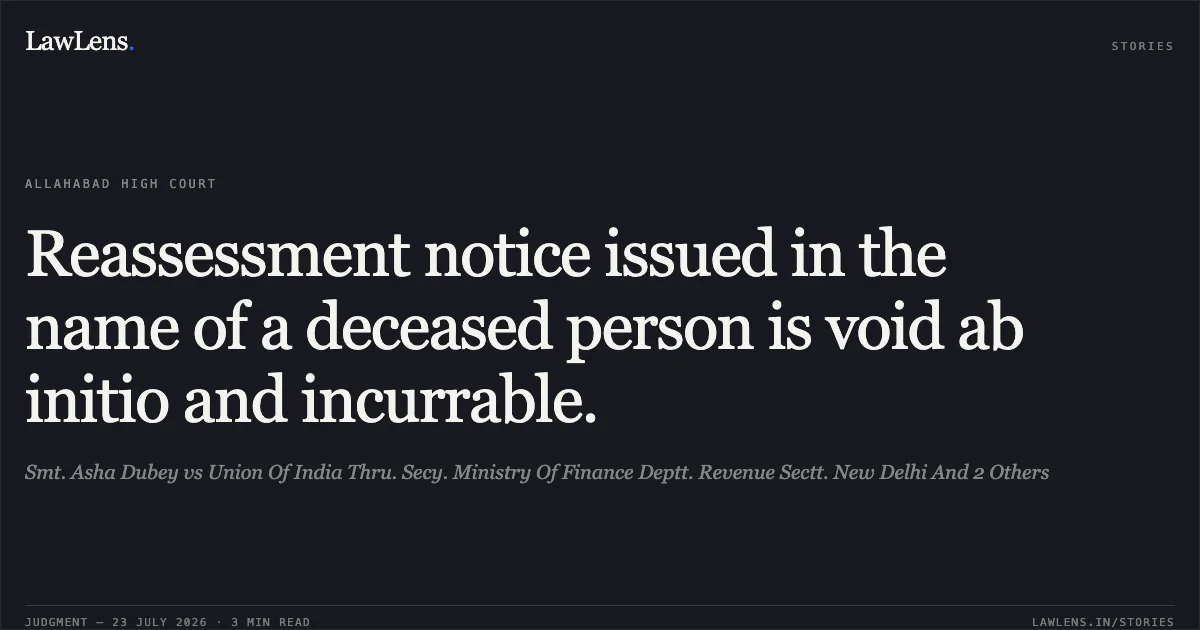
The Court reasoned that a valid notice under Section 148 is the "sine qua non" for acquiring jurisdiction; since a dead person has no legal personality, a notice issued in their name is a nullity and void ab initio.
Source reference: p. 53-54, 79The Court rejected the Revenue's reliance on Section 159, clarifying that this provision does not authorize the initiation of proceedings against a dead person, but rather the continuation of validly initiated ones or the initiation of fresh ones against the legal representative.
Source reference: p. 78-79It held that Section 292B cannot save the notice because the error was not clerical but went to the root of the jurisdiction.
Source reference: p. 81Regarding the petitioner's conduct (filing a return in the deceased's name), the Court held that while this might attract penalties under Section 277, it cannot confer jurisdiction where none exists, as there is no estoppel against the statute and equity cannot override strict legal requirements in fiscal matters.
Source reference: p. 91, 103The Court determined that quashing a void notice does not qualify as a "finding or direction" under Section 150(1) because no valid proceedings were ever legally in existence to be "given effect to".
Source reference: p. 119-120Holding
The Court answered all five issues in the negative.
It held that the notice issued to the deceased husband was void ab initio and the subsequent assessment was without jurisdiction. The Court quashed the Section 148 notice dated March 28, 2025, and all consequential orders and demands.
Source reference: p. 121, 125It further directed the judgment be sent to the Ministry of Finance to address the legislative "loophole" regarding proceedings against the estates of deceased persons. Writ petition allowed.
Source reference: p. 127, 125Acts & Sections Cited
41 provisions across 3 statutes referred to in this judgment. Linked provisions open on LawLens.
Excess Profits Tax Act, 19402
Income Tax Act, 1961
Indian Income Tax Act, 19227
Original Court PDF
Smt. Asha DubeyvsUnion Of India Thru. Secy. Ministry Of Finance Deptt. Revenue Sectt. New Delhi And 2 Others
Click to open original judgment
Original judgment, available to read, download and summarize on LawLens.in