Facts
The petitioner, a manufacturer of Metallurgical Coke, cleared specific quantities of goods from its factory for export to Singapore between April and May 2011
Source reference: p. 2Central Excise duty was paid on the total weight recorded at the factory gate
Source reference: p. 3Upon arrival at Mundra Port and subsequent loading into the vessel, a discrepancy was noted between the quantity cleared from the factory and the quantity actually exported—the exported weight was significantly lower due to alleged moisture loss
Source reference: p. 3, 9The petitioner applied for a rebate of the full duty paid under Rule 18 of the Central Excise Rules, 2002. However, the Department sanctioned the rebate only for the quantity actually exported as per the shipping bills, rejecting the claim for the "shortfall" quantity (approximately 1794.806 MT in the lead case)
Source reference: p. 4The petitioner challenged the orders of the lower authorities and the Revisional Authority
Source reference: p. 5Issues
1. Whether the petitioner is entitled to a rebate of duty under Rule 18 of the Central Excise Rules, 2002, on the entire quantity of goods cleared from the factory, or if such rebate is restricted to the quantity actually exported out of India
Source reference: p. 5 / para. 5.42. Whether the loss of weight attributed to moisture evaporation during transit can be considered for the purpose of processing a rebate claim in the absence of a prior declaration
Source reference: p. 11 / para. 7.5Law Applied
The court applied Rule 18 of the Central Excise Rules, 2002, which permits the Central Government to grant a rebate of duty paid on "excisable goods" provided they are "exported"
Source reference: p. 10The 'Explanation' to Rule 18 defines "export" as taking goods out of India to a place outside India
Source reference: p. 10-11The court further relied on Notification No. 19/2004-CE (N.T.), which mandates that goods must be exported after payment of duty directly from the factory
Source reference: p. 14Crucially, the court followed the precedent in Union of India v. Rajindra Dyeing and Printing Mills Limited (2004) 10 SCC 187, which established that "export" is only complete when goods are taken out of the territorial waters of India; thus, duty benefits are linked to actual export
Source reference: p. 12-13Reasoning
The court reasoned that Rule 18 and its Explanation make the act of "taking goods out of India" a quintessential condition for claiming a rebate
Source reference: p. 10While the petitioner paid duty on the higher weight at the factory gate under Rule 4, the rebate under Rule 18 is intrinsically tied to the quantity actually leaving the country
Source reference: p. 11The court observed a substantial discrepancy (up to 9% weight loss) between the cleared and exported goods
Source reference: p. 9It noted that the petitioner failed to declare the potential moisture content in the statutory ARE-1 forms or invoices at the time of removal from the factory
Source reference: p. 11Without such a declaration, the Customs authorities could not verify if the shortage was truly due to moisture or other causes. Following the Rajindra Dyeing principle, the court held that since the deficient quantity never left Indian territory, it did not qualify as an "export," and therefore, no rebate could be granted on the duty paid for that missing portion
Source reference: p. 13, 15Holding
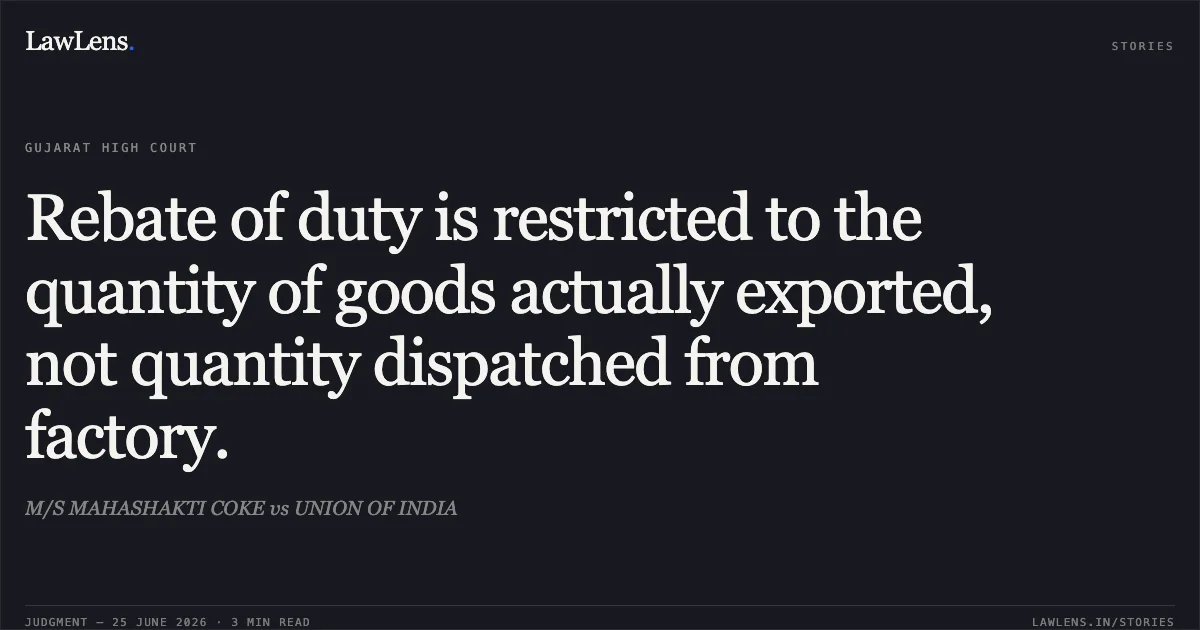
The Court answered the issues in the negative, holding that the rebate of duty is restricted to the actual quantity of goods exported as evidenced by the shipping bills
The court found no infirmity in the orders passed by the respondent authorities. Consequently, all Special Civil Applications were dismissed, and the Rule was discharged
Source reference: p. 16Acts & Sections Cited
3 provisions across 2 statutes referred to in this judgment. Each provision opens on LawLens.
Central Excise Act, 19442
Customs Act,19621
Original Court PDF
M/S MAHASHAKTI COKEvsUNION OF INDIA
Click to open original judgment
Original judgment, available to read, download and summarize on LawLens.in


