Facts
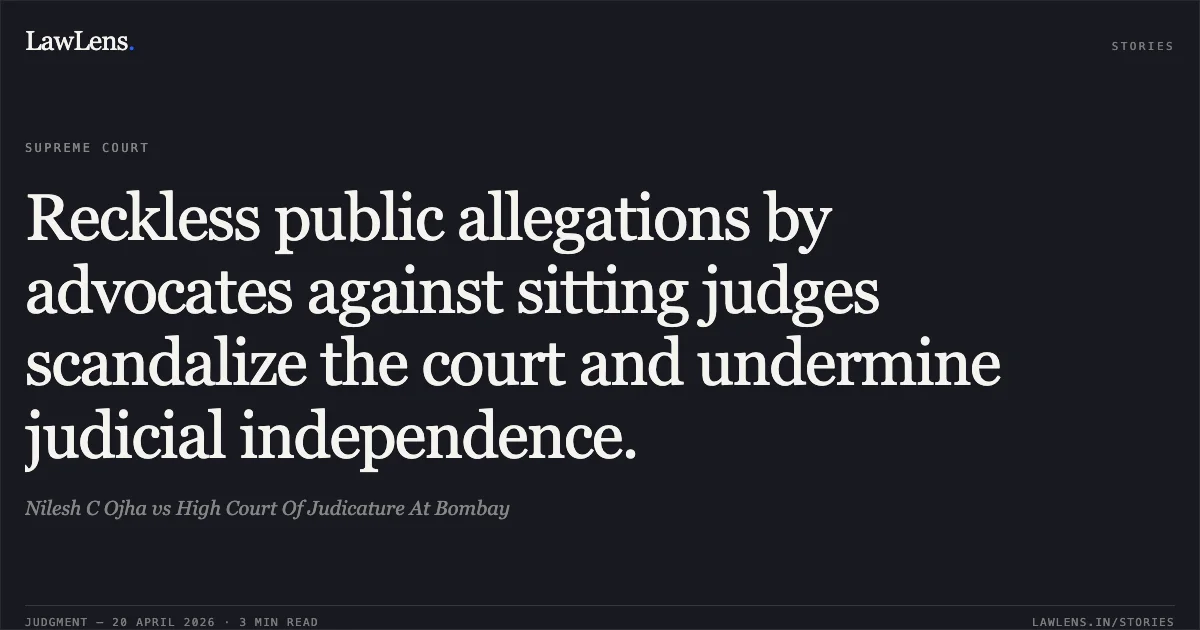
The Appellant, an advocate, held a press conference on April 1, 2025, alleging that a sitting judge of the Bombay High Court ("Justice X") was disqualified from hearing a Writ Petition filed by his client due to a personal conflict of interest involving the judge’s sister.
Source reference: para. 7Justice X reported the matter to the Chief Justice, who initiated suo motu criminal contempt proceedings (Petition No. 1/2025).
Source reference: para. 8-9During the proceedings, the Appellant filed an application (IA 3297/2025) to implead Justice X as a respondent.
Source reference: para. 12On September 17, 2025, a Full Bench of the High Court rejected the impleadment, holding that an informant is not a necessary party, and initiated a second suo motu contempt case (Petition No. 4/2025) based on scandalous imputations within the impleadment application.
Source reference: para. 13The High Court also recorded observations regarding professional misconduct by the Appellant and sixteen associated advocates.
Source reference: para. 14A subsequent recall application (IA 3843/2025) was dismissed on October 16, 2025.
Source reference: para. 16The Appellant challenged these orders before the Supreme Court under Section 19 of the Contempt of Courts Act, 1971.
Source reference: para. 2Issues
1. Whether a sitting judge who provides information regarding contemptuous conduct to the Chief Justice is a necessary or proper party to be impleaded in the resulting contempt proceedings.
Source reference: para. 132. Whether the High Court was justified in initiating fresh suo motu contempt proceedings based on the contents of interlocutory applications filed by the contemnor.
Source reference: para. 13, 163. Whether the conduct of an advocate addressing a press conference to cast aspersions on a sitting judge regarding a pending matter constitutes prima facie contempt.
Source reference: para. 32-34Law Applied
The Court emphasized that judicial independence and public confidence are the bedrocks of the constitutional scheme, citing Shanti Bhushan v. Supreme Court of India.
Source reference: para. 27The Court applied the Contempt of Courts Act, 1971, and the Contempt of Courts (Bombay High Court) Rules, 1994, to evaluate the procedure of suo motu cognizance.
Source reference: para. 9-10The Court distinguished between bona fide legal defense and scandalous imputations, noting that while Section 19 provides a right of appeal, the protection of the "majesty of the rule of law" remains paramount.
Source reference: para. 27-28Regarding professional ethics, the Court referenced the heightened duty of advocates as officers of the court to maintain sobriety and restraint both within and outside the courtroom.
Source reference: para. 31-32Reasoning
The Court reasoned that the High Court’s refusal to implead Justice X was correct because a judge who furnishes information to the Chief Justice for administrative action does not become a "complainant" or a party to the lis.
Source reference: para. 13The Court found that the Appellant’s act of carrying a pending judicial controversy into the public domain via a press conference was "wholly inconsistent" with professional discipline and had the potential to scandalize the institution.
Source reference: para. 32While a litigant may challenge the correctness of an order, they cannot personalize grievances by attributing improper motives to the judge.
Source reference: para. 29The Court observed that the allegations traversed the boundary of fair criticism and appeared calculated to diminish the credibility of the justice delivery system.
Source reference: para. 33-34It further noted that the High Court was within its rights to take additional cognizance of disparaging statements made in subsequent court filings, as these constitute fresh acts of prima facie contempt.
Source reference: para. 13, 35Holding
The Supreme Court dismissed the appeals, holding that no case for interference with the High Court’s interim orders was made out.
The Court declined to interdict the ongoing contempt proceedings and requested the High Court to adjudicate all issues independently and expeditiously on their merits.
Source reference: para. 36It clarified that its observations were limited to a prima facie consideration and should not influence the final outcome of the contempt petitions before the High Court.
Source reference: para. 37Acts & Sections Cited
1 provisions across 1 statute referred to in this judgment. Each provision opens on LawLens.
Contempt of Courts Act, 19711
Original Court PDF
Nilesh C OjhavsHigh Court Of Judicature At Bombay
Click to open original judgment
Original judgment, available to read, download and summarize on LawLens.in