Facts
The Appellant, a trust representing private schools in J&K, challenged notifications issued by the J&K Board of School Education (JKBOSE) in 2022 and 2023. These notifications directed all private schools to exclusively adopt and teach textbooks published by the Board for Classes VI to VIII.
Source reference: p. 2-3Further circulars were issued by education authorities to enforce compliance and investigate schools allegedly compelling students to use unapproved private publications.
Source reference: p. 3The Appellant filed a writ petition (WP (C) No. 702/2023) arguing these directives were arbitrary and lacked jurisdiction.
Source reference: p. 4The learned Single Judge dismissed the petition on 08.09.2023, ruling that the Board had statutory authority to prescribe such books.
Source reference: p. 4Issues
Whether the J&K Board of School Education has the legal authority and jurisdiction to compel private affiliated schools to exclusively use textbooks published by the Board.
Source reference: p. 4 / para. 7Whether the restriction on using private publishers' books constitutes an unreasonable restriction on the right to establish and administer educational institutions under Article 19(1)(g) of the Constitution.
Source reference: p. 5 / para. 9Law Applied
Section 10 of the J&K State Board of School Education Act, 1975, which empowers the Board to prescribe courses of instruction and textbooks for elementary and secondary levels.
Source reference: p. 5Section 29 of the J&K School Education Act, 2002, which grants the Government and Board power to regulate standards of education and courses of study in all schools.
Source reference: p. 6The principle from P.A. Inamdar v. State of Maharashtra [2005 (6) SCC 537], establishing that the right to run educational institutions is subject to reasonable restrictions in the interest of the general public.
Source reference: p. 8The doctrine from Union of India v. International Trading Co. [(2003) 5 SCC 437] regarding the limits of judicial review over executive policy decisions under Article 14.
Source reference: p. 9-10Reasoning
The Court reasoned that once an educational institution voluntarily seeks and obtains affiliation with the Board, it is contractually and legally bound by the Board’s terms, including the prescription of curricula and textbooks.
Source reference: p. 6The Court rejected the Appellant’s argument that "prescribing" textbooks does not include the power to "publish" them exclusively, holding that the statutory mandate under Section 10 of the 1975 Act explicitly encompasses the authority to designate specific books to maintain academic standards and uniformity.
Source reference: p. 6-7Applying the "reasonableness" test from P.A. Inamdar and Indian Medical Association, the Court found that the regulations were not arbitrary but were valid attempts to ensure social justice and quality education across the Union Territory.
Source reference: p. 8, 11The Court emphasized that judicial interference in educational policy is limited; since the Board acted within its statutory competence to achieve educational uniformity, the policy satisfied the test of fairness under Article 14.
Source reference: p. 9-10Holding
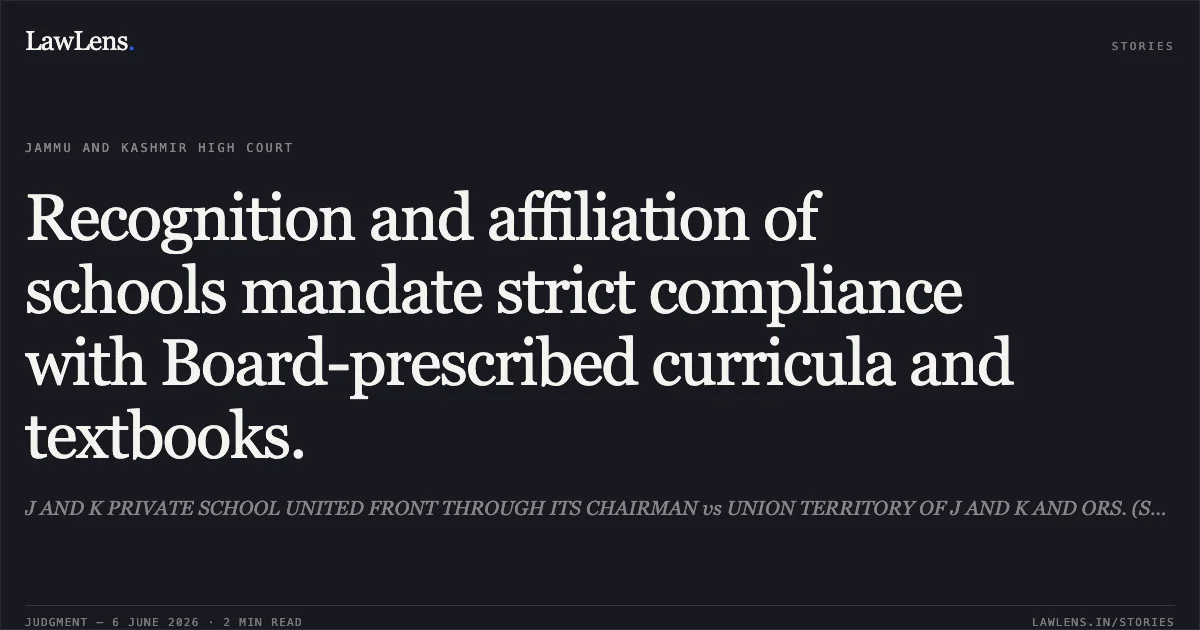
The Court answered the issues in the affirmative, holding that the J&K Board of School Education possesses the statutory jurisdiction to mandate the use of its published textbooks in affiliated schools.
The Letters Patent Appeal was dismissed, and the judgment of the Single Judge dated 08.09.2023 was affirmed, upholding the Board's directive to use only JKBOSE-published textbooks for Classes VI to VIII.
Source reference: p. 12Acts & Sections Cited
3 provisions across 2 statutes referred to in this judgment. Linked provisions open on LawLens.
Jammu and Kashmir State Board of School Education Act, 19752
Jammu and Kashmir School Education Act, 20021
Original Court PDF
J AND K PRIVATE SCHOOL UNITED FRONT THROUGH ITS CHAIRMANvsUNION TERRITORY OF J AND K AND ORS. (SCHOOL EDUCATION)
Click to open original judgment
Original judgment, available to read, download and summarize on LawLens.in