Facts
The petitioner relied on the Supreme Court’s judgment in Dhananjay Rathi v. Ruchika Rathi, 2026 SCC OnLine SC 587, and sought compliance by the respondent with specified terms of the parties’ Memorandum of Understanding dated 16 May 2024 and the directions recorded in the Supreme Court judgment.
Source reference: pp. 1–4, paras. 1–4The respondent agreed to cooperate in executing the gift deed and relinquishment deed, without prejudice to her proposed right to file a curative petition.
Source reference: p. 4, para. 5The respondent further agreed to transfer ₹27,82,500, received upon maturity of an LIC policy bearing No. 117410693, to the petitioner within one week.
Source reference: pp. 4–5, paras. 11–14The Court also recorded that ₹89,00,000 deposited by the respondent before the Court was to be returned to her with accrued interest, and granted her liberty to approach the Registry for that purpose.
Source reference: p. 5, paras. 15–18Finally, the petitioner undertook to return the respondent’s personal articles lying in his house within two weeks.
Source reference: p. 5, paras. 19–21Issues
Whether the respondent was required to comply with the relevant terms of the Supreme Court judgment and the parties’ MoU, including cooperation in executing the gift deed and relinquishment deed.
Source reference: pp. 1–4, paras. 1–5Whether the parties could be directed to cooperate in changing the nominee under the respondent’s Aditya Birla Capital life-insurance policy from the petitioner to the children.
Source reference: p. 4, paras. 6–10Whether the respondent was required to transfer ₹27,82,500 received on maturity of the LIC policy to the petitioner.
Source reference: pp. 4–5, paras. 11–14Whether ₹89,00,000 deposited by the respondent before the Court was liable to be returned to her with accrued interest.
Source reference: p. 5, paras. 15–18Whether the respondent’s personal articles lying with the petitioner were required to be returned.
Source reference: p. 5, paras. 19–21Law Applied
The Court applied the binding effect of the Supreme Court’s directions in Dhananjay Rathi v. Ruchika Rathi, 2026 SCC OnLine SC 587, together with the parties’ contractual obligations under the MoU dated 16 May 2024.
Source reference: pp. 1–4, paras. 1–4It further applied the principle that clear statements and undertakings made by parties through counsel and recorded by the Court are binding upon them.
Source reference: pp. 4–6, paras. 9, 14, 22The Court also gave effect to the Supreme Court’s direction that the ₹89,00,000 deposited before it be returned to the respondent with accrued interest.
Source reference: p. 5, paras. 15–18Reasoning
The Court treated the Supreme Court judgment and the MoU as governing the parties’ outstanding obligations.
Source reference: no citationSince the respondent expressly agreed to cooperate in executing the gift deed and relinquishment deed, that undertaking was recorded and made binding, without affecting her stated right to pursue a curative petition.
Source reference: p. 4, paras. 5, 22The petitioner’s consent to changing the insurance nominee to the children enabled the Court to direct mutual cooperation on that issue.
Source reference: p. 4, paras. 6–10The respondent’s agreement to transfer the LIC maturity amount justified a time-bound direction for payment of ₹27,82,500 to the petitioner.
Source reference: pp. 4–5, paras. 11–14Conversely, by following the Supreme Court’s direction, the Court permitted return of the ₹89,00,000 deposit with accrued interest.
Source reference: p. 5, paras. 15–18The petitioner’s undertaking regarding the respondent’s personal articles was likewise recorded and converted into a two-week direction.
Source reference: p. 5, paras. 19–21Holding
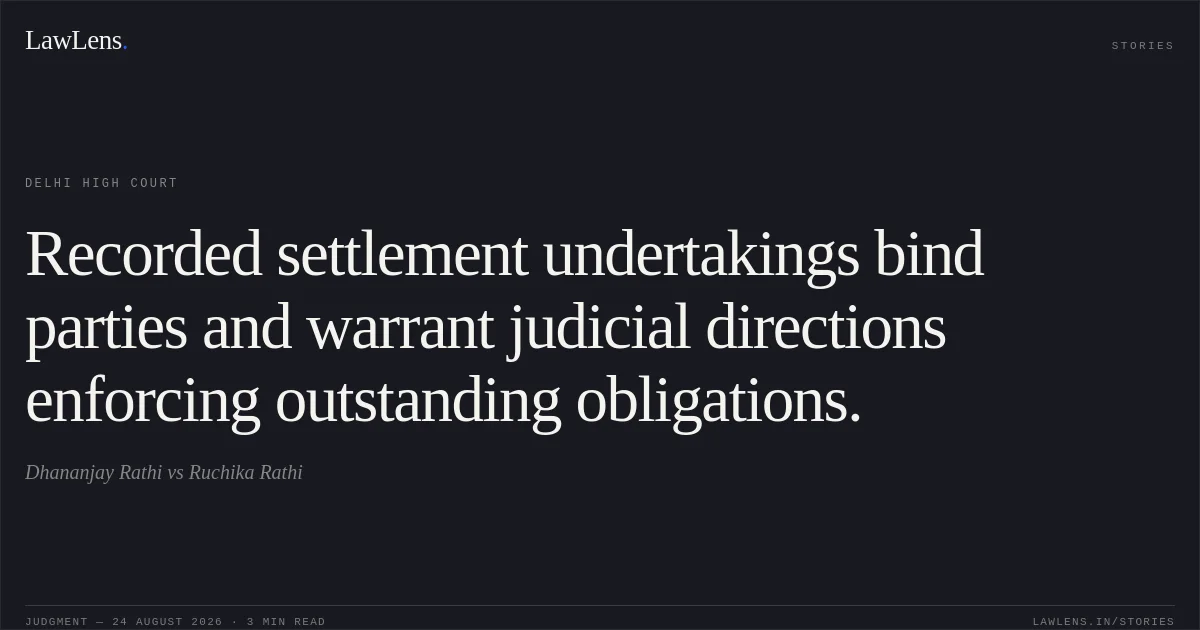
The Court recorded and enforced the parties’ statements and directions arising from the Supreme Court judgment and the MoU.
The parties were directed to cooperate in changing the insurance-policy nominee to the children; the respondent was directed to transfer ₹27,82,500 to the petitioner within one week; and the respondent was permitted to obtain return of the ₹89,00,000 deposit with accrued interest from the Registry.
Source reference: pp. 4–6, paras. 10, 14, 17–18The petitioner was directed to return the respondent’s personal articles within two weeks.
Source reference: p. 5, paras. 19–21Both parties were held bound by the recorded statements and directions, and the contempt petition together with the pending application was disposed of.
Source reference: pp. 4–6, paras. 21–23Original Court PDF
Dhananjay RathivsRuchika Rathi
Click to open original judgment
Original judgment, available to read, download and summarize on LawLens.in