Facts
The applicant, Shabir Ahmed Batt, retired as a Foreman from the Public Works (R&B) Department on 30-04-2022 after reaching the age of 63.
Source reference: p. 1Following his retirement, the respondents issued impugned Check Point Orders (CPOs) dated 27-12-2021 and 20-08-2024, which did not calculate his pension based on his last pay drawn and sought to adjust/recover benefits previously granted under SRO 149 and SRO 59.
Source reference: p. 2, 8The applicant approached the Tribunal seeking the quashing of these orders and a direction to fix his pensionary benefits based on his last pay drawn without recoveries.
Source reference: p. 2Issues
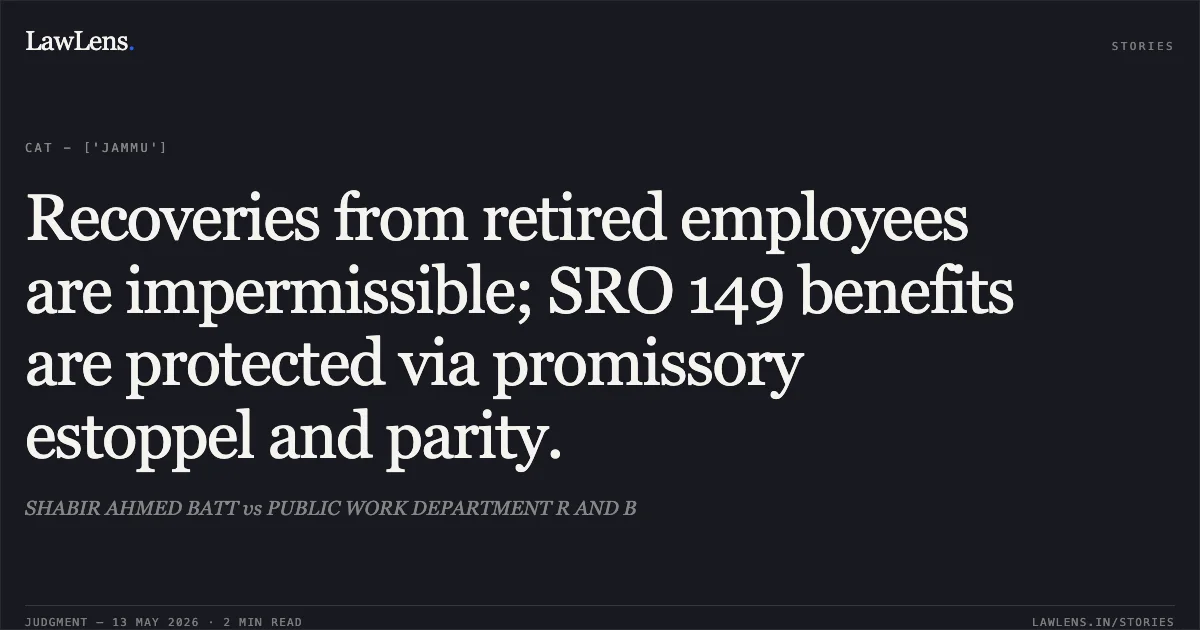
1. Whether the respondents can legally effect recovery of excess payments made to a retired Class-III employee under SRO 149 or SRO 59.
Source reference: p. 8 / para. 82. Whether the benefits granted under SRO 149 of 1973 can be arbitrarily withdrawn or excluded during the fixation of pensionary benefits.
Source reference: p. 8 / para. 83. Whether the respondents are permitted to re-fix pay/pension regarding benefits erroneously granted under SRO 59.
Source reference: p. 9 / para. 10Law Applied
The Tribunal applied the principle of estoppel and the prohibition against recovery from retired/Class-III employees established in State of Punjab v. Rafiq Masih (White Washer).
Source reference: p. 5, para. 21It relied on the Hon’ble High Court of J&K's ruling in UT of J&K & Ors. vs. Maqbool Sheikh & Ors. (WP I No. 936/2025), which prohibits recovery of excess payments but allows re-fixation of pay by excluding benefits wrongly granted under SRO 59.
Source reference: p. 3, para. 4Furthermore, it followed Provincial Power Employees Union v. State of J&K, upheld by the Supreme Court in Civil Appeal No. 7992/2022, which established that benefits under SRO 149 cannot be withdrawn if they cause irrational discrimination under Article 14 of the Constitution.
Source reference: p. 4-8Reasoning
The Tribunal noted that the legal controversy regarding SRO 149 and SRO 59 is res integra (already settled) by superior courts.
Source reference: p. 2, para. 3Applying the Maqbool Sheikh precedent, the Tribunal reasoned that while the administration maintains the liberty to re-fix pay by excluding erroneous SRO 59 benefits, it is strictly prohibited from recovering any past excess payments from a retired employee.
Source reference: p. 3, para 4; p. 9, para 10Regarding SRO 149, the Tribunal found that the State is estopped from withdrawing such benefits because the same have been widely extended across various departments and upheld by Division Benches to ensure parity under Article 14.
Source reference: p. 6, para. 21; p. 8, para. 7Since the applicant was a retired Foreman (Class-III category), the attempted recovery was deemed impermissible in law as per the Rafiq Masih doctrine.
Source reference: p. 5, para. 21Holding
The Tribunal disposed of the O.A. by directing the respondents to refrain from effecting any recovery from the applicant and to refund any amount already recovered.
It held that re-fixation of pay/pension is permissible only regarding SRO 59 benefits, whereas benefits under SRO 149 must be fully accounted for in the settlement of pensionary dues.
Source reference: p. 9, para. 10The respondents were ordered to forward a revised Last Pay Certificate (LPC) to the Accountant General for the final settlement of retiral benefits in accordance with the cited High Court and Supreme Court judgments.
Source reference: p. 9, para 10No costs were awarded.
Source reference: p. 9, para. 11Acts & Sections Cited
1 provisions across 1 statute referred to in this judgment. Each provision opens on LawLens.
Administrative Tribunals Act, 19851
Original Court PDF
SHABIR AHMED BATTvsPUBLIC WORK DEPARTMENT R AND B
Click to open original judgment
Original judgment, available to read, download and summarize on LawLens.in