Facts
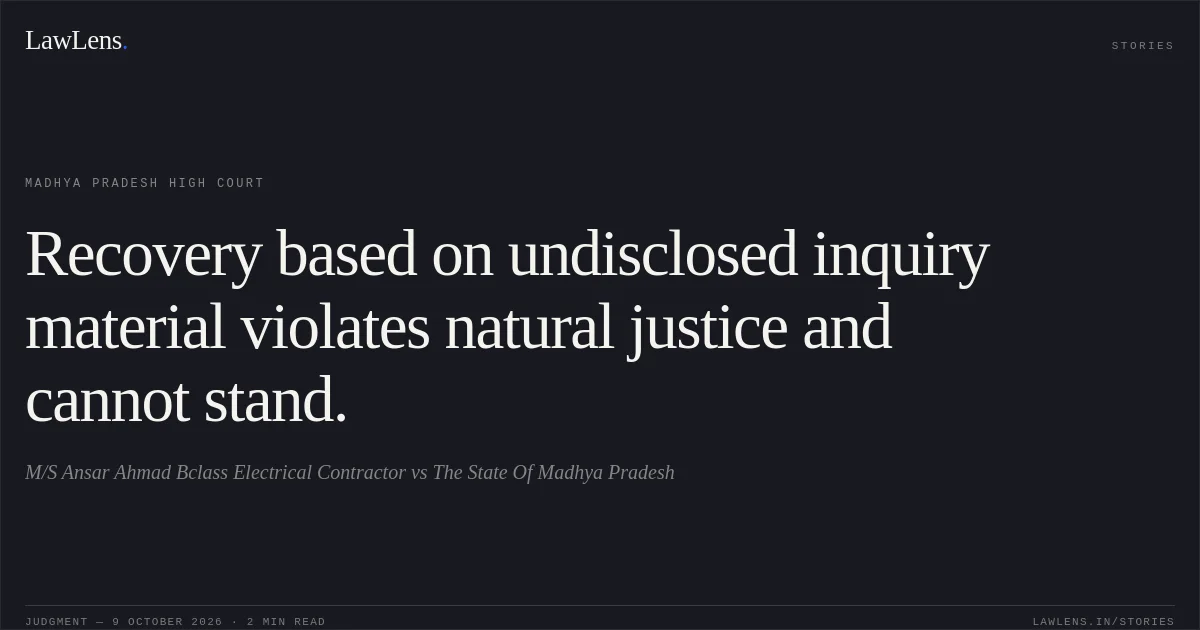
The petitioner challenged a recovery order dated 10 December 2021 relating to electrical work performed under the Saubhagya Scheme.
Source reference: paras. 1–6The respondents alleged irregularities including billing for connections not established, use of non-prescribed or substandard materials, and duplicate billing.
Source reference: paras. 1–6The petitioner maintained that the work had been completed, inspected, and handed over, and that the recovery was based on an inquiry conducted without giving it an opportunity to participate or supplying the material relied upon.
Source reference: paras. 1–6, 9, 11The respondents did not establish that the inquiry material or report had been provided to the petitioner and stated that they were willing to reconsider the matter after hearing it.
Source reference: paras. 1–6, 9, 11Issues
1. Whether the recovery order could stand when it was made without supplying the petitioner with the inquiry material and without affording an opportunity to respond.
Source reference: paras. 9, 11–122. Whether the matter should be remitted to the respondents for reconsideration after disclosure of the relied-upon material and a hearing.
Source reference: paras. 5–6, 13–14Law Applied
In Kranti Associates (P) Ltd. v. Masood Ahmed Khan, (2010) 9 SCC 496, the Supreme Court held that decisions affecting a person prejudicially must be supported by reasons, and that quasi-judicial authorities must consider relevant grounds and provide reasoned decisions.
Source reference: para. 8In Techno Prints v. Chhattisgarh Textbook Corporation, 2025 SCC OnLine SC 343, the Supreme Court discussed the importance of a meaningful opportunity to answer allegations, cautioning that a hearing process may be an empty formality where the authority has already made up its mind.
Source reference: para. 10The judgment applied the principles of natural justice and fair play, requiring disclosure of the material relied upon and a genuine opportunity to respond before an adverse decision is made.
Source reference: paras. 7, 9, 11Reasoning
The recovery order was based on an inquiry whose complaint, supporting material, and report had not been shown to have been supplied to the petitioner.
Source reference: paras. 5–6, 9, 11–12The petitioner therefore had no meaningful opportunity to address the allegations before the order was made.
Source reference: paras. 5–6, 9, 11–12The respondents’ willingness to reconsider the matter after disclosure and a hearing reinforced the need for a fresh decision through a fair process.
Source reference: paras. 5–6, 9, 11–12In these circumstances, the order was contrary to natural justice and fair play.
Source reference: paras. 5–6, 9, 11–12Holding
The Court quashed the recovery order dated 10 December 2021 and remitted the matter to respondents 2 and 3 for reconsideration.
The respondents were directed to provide the complaint and relied-upon material within seven days; the petitioner was to submit a detailed representation within seven days of receipt; and the respondents were then to provide a personal hearing and issue and communicate a fresh order within 30 days thereafter.
Source reference: para. 14Any existing interim order was to continue until the authorities made their decision.
Source reference: para. 15Original Court PDF
M/S Ansar Ahmad Bclass Electrical ContractorvsThe State Of Madhya Pradesh
Click to open original judgment
Original judgment, available to read, download and summarize on LawLens.in