Facts
The Appellant-Bank extended credit facilities to a company where the original respondent (Kishore K. Mehta) was a director and personal guarantor
Source reference: para. 4Upon default, the Bank approached the Debt Recovery Tribunal (DRT), Mumbai, which issued a recovery certificate for approx. Rs. 14.74 crores
Source reference: para. 4Based on this certificate, the Insolvency Registrar issued an insolvency notice under Section 9(2) of the Presidency Towns Insolvency Act, 1909
Source reference: para. 4The respondent challenged this notice via a Notice of Motion in the Bombay High Court
Source reference: para. 4Both a Single Judge and a Division Bench of the High Court held that a DRT recovery certificate cannot form the basis of an insolvency notice, relying on the precedent in Paramjeet Singh Patheja v. ICDS Ltd.
Source reference: para. 4, 6During pendency, the respondent died and was substituted by his legal representatives
Source reference: para. 5Issues
1. Whether an insolvency notice under Section 9(2) of the Presidency Towns Insolvency Act, 1909 can be issued on the basis of a recovery certificate issued by a Debts Recovery Tribunal (DRT)
Source reference: para. 1, 3Law Applied
Section 9(2) of the Presidency Towns Insolvency Act, 1909, which requires a "decree or order" for payment of money to trigger an act of insolvency
Source reference: para. 2Sections 2(2) and 2(14) of the Code of Civil Procedure (CPC), 1908, defining "decree" and "order" as adjudications by a "Court"
Source reference: para. 11Paramjeet Singh Patheja v. ICDS Ltd. (2006), which held that insolvency statutes must be strictly construed and that "decree or order" excludes awards or certificates from non-court tribunals
Source reference: para. 6, 11Section 19(22A) of the Recovery of Debts and Bankruptcy (RDB) Act, 1993 (inserted in 2016), which creates a legal fiction deeming a recovery certificate to be a decree for insolvency purposes
Source reference: para. 13-14Reasoning
The Court reasoned that since insolvency leads to "civil death," Section 9(2) must be strictly interpreted
Source reference: para. 11Applying Paramjeet Singh Patheja, the Court held that a recovery certificate is not a "decree" because it does not originate from a suit in a civil court
Source reference: para. 11The Court rejected the Bank’s argument that the DRT steps into the shoes of a civil court, noting that insolvency notices are not mere execution tools but status-altering proceedings
Source reference: para. 11Regarding the 2016 amendment (Section 19(22A) of the RDB Act), the Court observed that the express introduction of a "deeming fiction" by Parliament in 2016 proves that such certificates were not considered decrees prior to the amendment
Source reference: para. 14Furthermore, the Court maintained that the rights of the parties must be determined as they existed on the date the litigation commenced (2006), and since the 2016 amendment was not retrospective, it could not validate a notice that was untenable when issued
Source reference: para. 16-19Holding
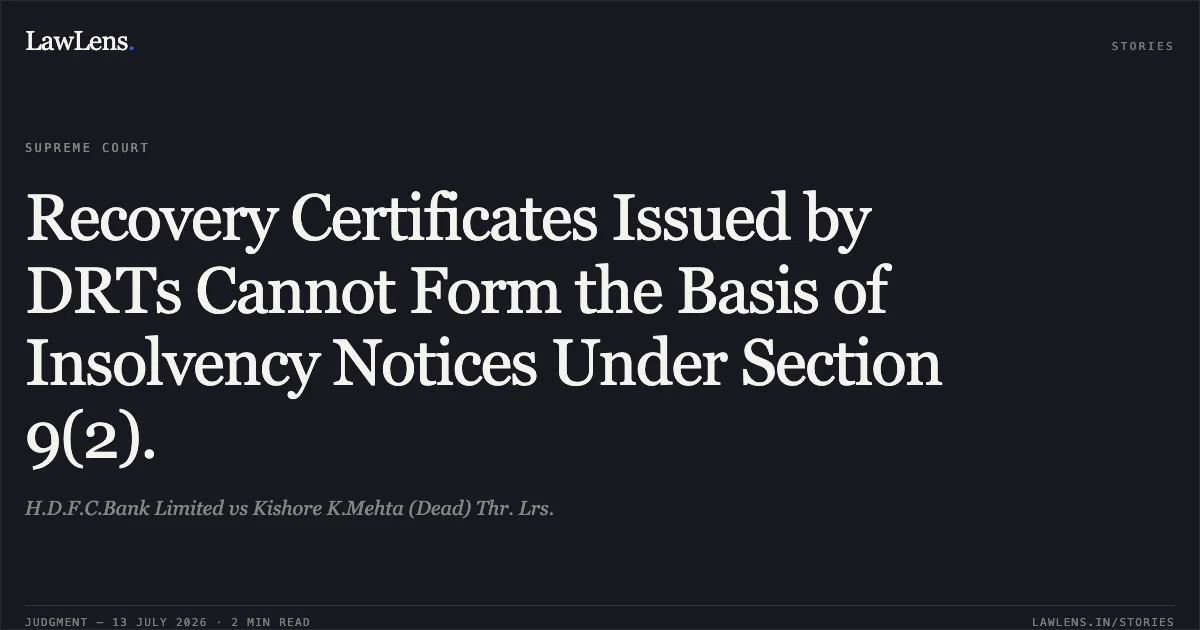
The Court answered the issue in the negative, holding that a recovery certificate issued by a DRT (prior to the 2016 amendment) cannot form the basis of an insolvency notice under Section 9(2) of the Insolvency Act
The judgment of the High Court was upheld, and the appeal was dismissed
Source reference: para. 23While the proceeding against the deceased respondent was closed, the Court clarified that the Bank may pursue remedies against other surviving certificate debtors (the sons) if permissible by law
Source reference: para. 24Acts & Sections Cited
5 provisions across 3 statutes referred to in this judgment. Each provision opens on LawLens.
Recovery Of Debts And Bankruptcy Act, 19931
Code of Civil Procedure, 19082
Original Court PDF
H.D.F.C.Bank LimitedvsKishore K.Mehta (Dead) Thr. Lrs.
Click to open original judgment
Original judgment, available to read, download and summarize on LawLens.in