Facts
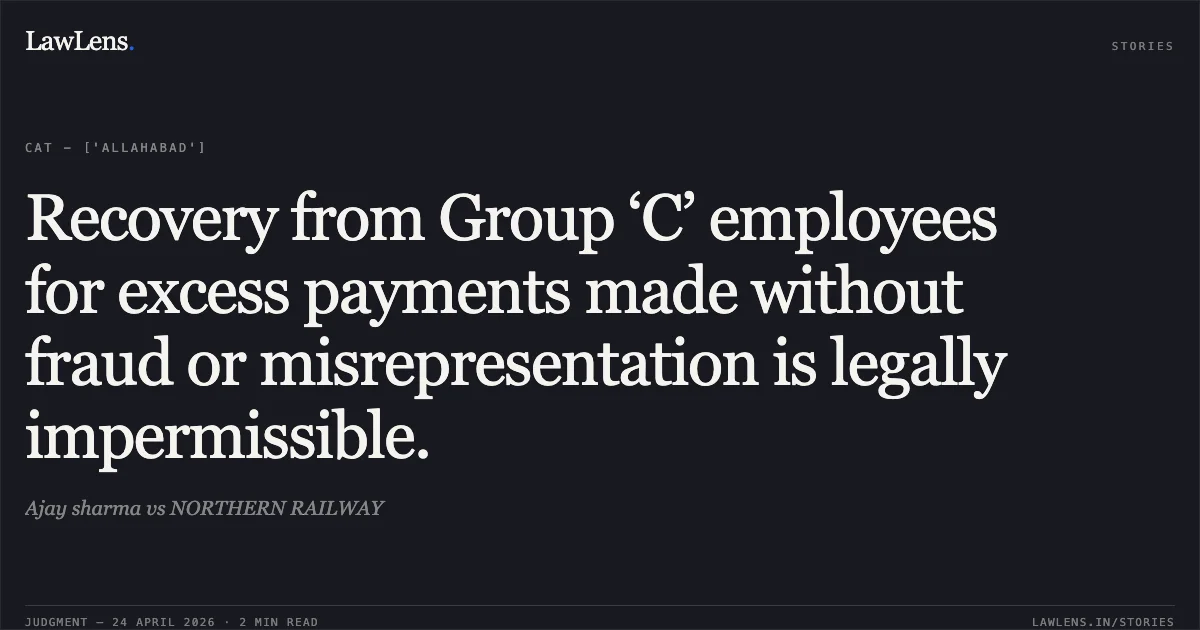
The applicant, a Group ‘C’ employee (T.T.E.) appointed in 2007, challenged the recovery of alleged excess salary payments initiated by the respondents in July 2025.
Source reference: p. 1-2The respondents claimed that due to an audit inspection, a pay fixation error dating back to 2008 was discovered, necessitating the recovery of overpayments.
Source reference: p. 2The applicant contended that the recovery was initiated without a show-cause notice, hearing, or any formal order, and that as a Group ‘C’ employee who committed no fraud, such recovery was impermissible.
Source reference: p. 2Issues
1. Whether the recovery of excess salary from a Group ‘C’ employee, occurring more than five years after the initial payment and without proof of fraud/misrepresentation, is legally sustainable.
Source reference: p. 32. Whether the respondents complied with the principles of natural justice before initiating the recovery process.
Source reference: p. 2Law Applied
State of Punjab Ors vs. Rafiq Masih (White Washer) [AIR 2015 SC 696], which identified specific situations where recovery of excess payment by employers is impermissible, including: (i) recovery from Group ‘C’ and ‘D’ employees; and (iii) recovery of payments made for a period in excess of five years before the recovery order.
Source reference: p. 3Section 19 of the Administrative Tribunals Act, 1985, regarding the adjudication of service matters.
Source reference: p. 1Reasoning
The Tribunal found that the applicant is undisputedly a Group ‘C’ employee and that the excess payments were not the result of any fraud or misrepresentation on his part.
Source reference: p. 3Applying the Rafiq Masih guidelines, the Tribunal reasoned that recovering payments made nearly 17 years prior (dating back to 2008) from a Group ‘C’ official is "de hors the law" as it constitutes a situation of hardship that outweighs the employer's right to recover.
Source reference: p. 3The Tribunal noted the respondents' failure to issue a show-cause notice or afford the applicant an opportunity to be heard, rendering the recovery procedure arbitrary and inconsistent with the principles of natural justice.
Source reference: p. 2-3Holding
The Tribunal allowed the O.A., declaring the recovery illegal.
It directed the respondents to refund the recovered amount with 6% simple interest per annum within three months.
Source reference: p. 3While the respondents were granted liberty to rectify the applicant's pay fixation moving forward—subject to issuing a show-cause notice and passing a reasoned order—the Tribunal explicitly ordered that no recovery shall be made for the excess amounts already paid to the applicant.
Source reference: p. 3-4Acts & Sections Cited
1 provisions across 1 statute referred to in this judgment. Each provision opens on LawLens.
Administrative Tribunals Act, 19851
Original Court PDF
Ajay sharmavsNORTHERN RAILWAY
Click to open original judgment
Original judgment, available to read, download and summarize on LawLens.in