Facts
The petitioner was appointed as an Assistant Teacher in 1984 and retired from the post (a Class-III position) on 31.08.2016.
Source reference: para. 4Following her retirement, the District Pension Officer objected to certain pay fixations and wage increments in her service book. Consequently, the respondent department recalculated her benefits and determined an excess payment of ₹1,40,429/- had been made.
Source reference: para. 4A Pension Payment Order (P.P.O.) dated 30.09.2016 was issued directing the recovery of this amount without providing the petitioner a show-cause notice or an opportunity for a hearing.
Source reference: para. 5The petitioner challenged this recovery, asserting it was due to a departmental error in salary fixation for which she was not responsible.
Source reference: para. 5Issues
1. Whether the recovery of excess payments made due to erroneous pay fixation is permissible from a retired Class-III employee.
Source reference: para. 5, 92. Whether an undertaking given by an employee regarding the refund of excess payments can be enforced if it was obtained at the time of retirement or under coercion.
Source reference: para. 8, 11Law Applied
The Court applied the principles established by the Hon'ble Supreme Court in State of Punjab v. Rafiq Masih (White Washer), (2015) 4 SCC 334, which prohibits recovery from Class-III/IV employees and retired employees where the recovery would be iniquitous or harsh.
Source reference: para. 9The Court relied on the Full Bench decision of the Madhya Pradesh High Court in State of Madhya Pradesh v. Jagdish Prasad Dubey, (2024) 2 M.P.L.J. 198, which held that "forced undertakings" given at the time of retirement are unenforceable.
Source reference: para. 5, 8The Court cited Jogeswar Sahoo v. District Judge, Cuttack, 2025 (3) M.P.L.J. (S.C.) 25, emphasizing that recovery without a hearing from superannuated ministerial staff is unsustainable.
Source reference: para. 10Reasoning
The Court observed that the respondents failed to file a reply despite being given a "last indulgence," leading the Court to decide the matter on the available record.
Source reference: para. 1-2Applying the Rafiq Masih dictum, the Court noted that the petitioner was a Class-III employee and the recovery was initiated after her retirement, placing her squarely within the categories exempt from recovery.
Source reference: para. 9, 12Regarding judicial precedents on undertakings, the Court analyzed that unless the State proves an undertaking was given voluntarily at the time of pay fixation—rather than being a "forced" requirement at the time of retirement—it serves as no basis for recovery.
Source reference: para. 8, 11The Court found no evidence of fraud or misrepresentation by the petitioner; rather, the excess payment resulted solely from the department's erroneous fixation.
Source reference: para. 10, 12The violation of natural justice (failure to provide a show-cause notice) rendered the recovery order procedurally infirm.
Source reference: para. 5, 12Holding
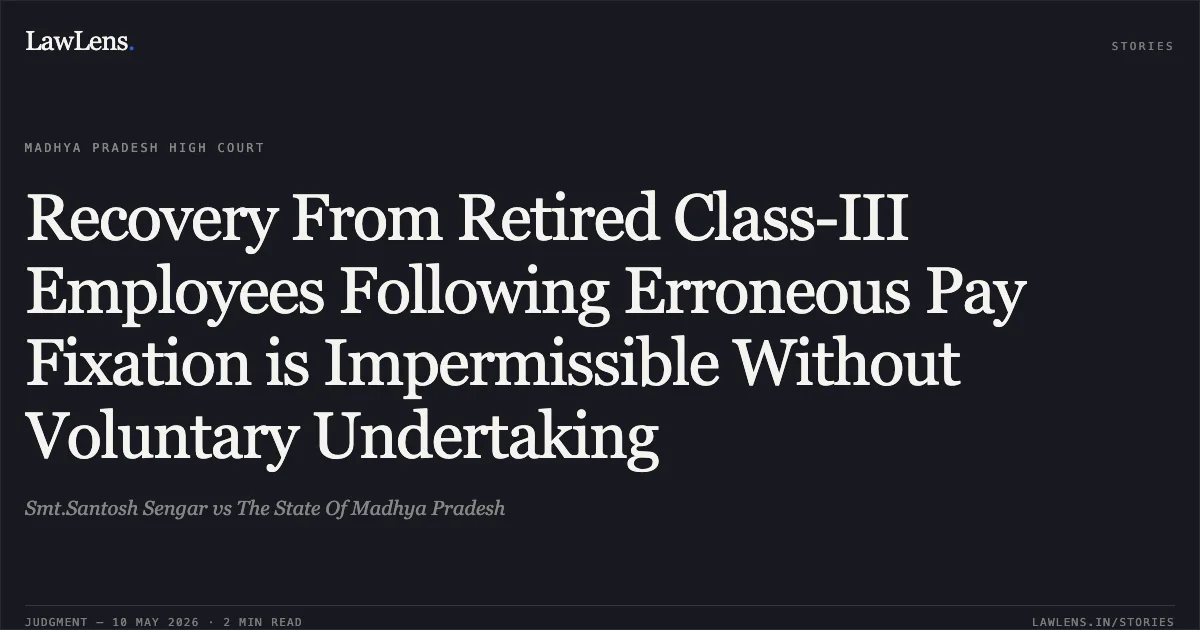
The Court held that the impugned recovery was impermissible in law.
The Court set aside the recovery and directed the respondents to refund the sum of ₹1,40,429/- to the petitioner with interest at 6% per annum from the date of retirement until the actual payment, with a default interest rate of 12% per annum if not paid within 90 days of the order.
Source reference: para. 13-14Acts & Sections Cited
2 provisions across 1 statute referred to in this judgment. Linked provisions open on LawLens.
M.P. Civil Services (Pension) Rules, 19762
Original Court PDF
Smt.Santosh SengarvsThe State Of Madhya Pradesh
Click to open original judgment
Original judgment, available to read, download and summarize on LawLens.in