Facts
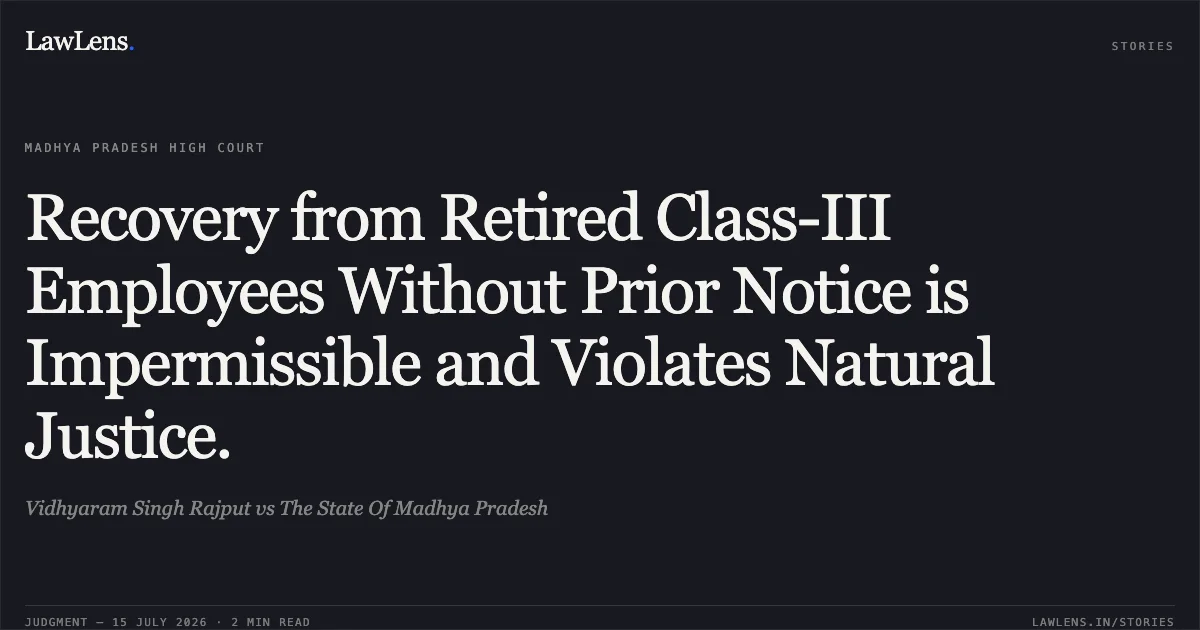
The petitioners, retired Class-III employees of the State of Madhya Pradesh, challenged the recovery of alleged excess payments of Dearness Allowance deducted from their gratuity after retirement.
Source reference: para. 4Petitioner No. 3 withdrew from the petition during proceedings.
Source reference: para. 2-3The respondents contended that the excess payments resulted from erroneous salary fixation and were recoverable.
Source reference: para. 5The petitioners argued that the recovery was made without a show-cause notice, violated principles of natural justice, and was legally barred as they were Class-III employees.
Source reference: para. 4, 11Issues
1. Whether the recovery of excess Dearness Allowance from the gratuity of retired Class-III employees is permissible in law.
Source reference: para. 4, 112. Whether the recovery made without issuing a show-cause notice or affording an opportunity of hearing violates the principles of natural justice.
Source reference: para. 11Law Applied
The court primarily applied the principles established by the Supreme Court in State of Punjab v. Rafiq Masih (White Washer) (2015) 4 SCC 334, which prohibits recovery from Class-III/Group 'C' employees and retired employees when the recovery would be iniquitous.
Source reference: para. 8State of Madhya Pradesh v. Jagdish Prasad Dubey (2024) 2 M.P.L.J. 198, which held that undertakings for recovery obtained at the time of refixation are often "forced" and unenforceable unless proven voluntary.
Source reference: para. 7Jogeswar Sahoo v. District Judge, Cuttack (2025) 3 M.P.L.J. (S.C.) 25 regarding the necessity of an opportunity of hearing before recovery.
Source reference: para. 9Reasoning
The Court observed that the petitioners were indisputably retired Class-III employees and that the state failed to issue any show-cause notice before deducting amounts from their gratuity.
Source reference: para. 11Applying Rafiq Masih, the Court reasoned that recovery from retired Class-III employees is inherently unsustainable.
Source reference: para. 11Regarding the validity of undertakings, the Court followed the logic in Ravindra Kumar Joshi v. State of M.P., noting that the State failed to prove the petitioners gave their undertakings voluntarily; thus, such undertakings are treated as "forcefully obtained" and cannot justify recovery.
Source reference: para. 10Since the recovery violated both substantive protections for low-tier employees and procedural natural justice, it was deemed legally flawed.
Source reference: para. 11-12Holding
The Court answered the issues in favor of the petitioners, holding that the impugned recovery from their gratuity was not sustainable in law.
The petition was disposed of with a direction to the respondents to refund the recovered amount to the petitioners with 6% interest per annum from the date of entitlement within three months.
Source reference: para. 12-13Acts & Sections Cited
1 provisions across 1 statute referred to in this judgment. Linked provisions open on LawLens.
M.P. Civil Services (Pension) Rules, 19761
Original Court PDF
Vidhyaram Singh RajputvsThe State Of Madhya Pradesh
Click to open original judgment
Original judgment, available to read, download and summarize on LawLens.in