Facts
The applicant was initially appointed as a teacher on an ad-hoc basis in 1987. His services were regularized via an order dated 11.07.1994 following litigation that reached the Supreme Court
Source reference: p.2The regularization order included a condition that he must acquire essential professional qualifications within two years, failing which future increments and promotions would be barred
Source reference: p.2-3Although the applicant never acquired these qualifications, the respondents continued to grant him annual increments, senior pay scales, and financial upgrades under the ACP and MACP schemes for over 25 years
Source reference: p.5-6In 2019, on the verge of the applicant’s retirement, the respondents issued memoranda seeking clarification on his qualifications
Source reference: p.6Subsequently, in 2020 and 2021, the respondents re-fixed his pay by withdrawing all increments granted since 01.01.1996 and ordered a recovery of ₹53,15,822
Source reference: p.7-8Issues
1. Whether the re-fixation of the applicant’s pay in the year 2020, disallowing increments for failing to meet a 1994 qualification condition, is sustainable.
Source reference: p.11 / para. 62. Whether the recovery of ₹53,15,822 arising out of such re-fixation can be legally effected from the applicant at the time of his retirement.
Source reference: p.11 / para. 6Law Applied
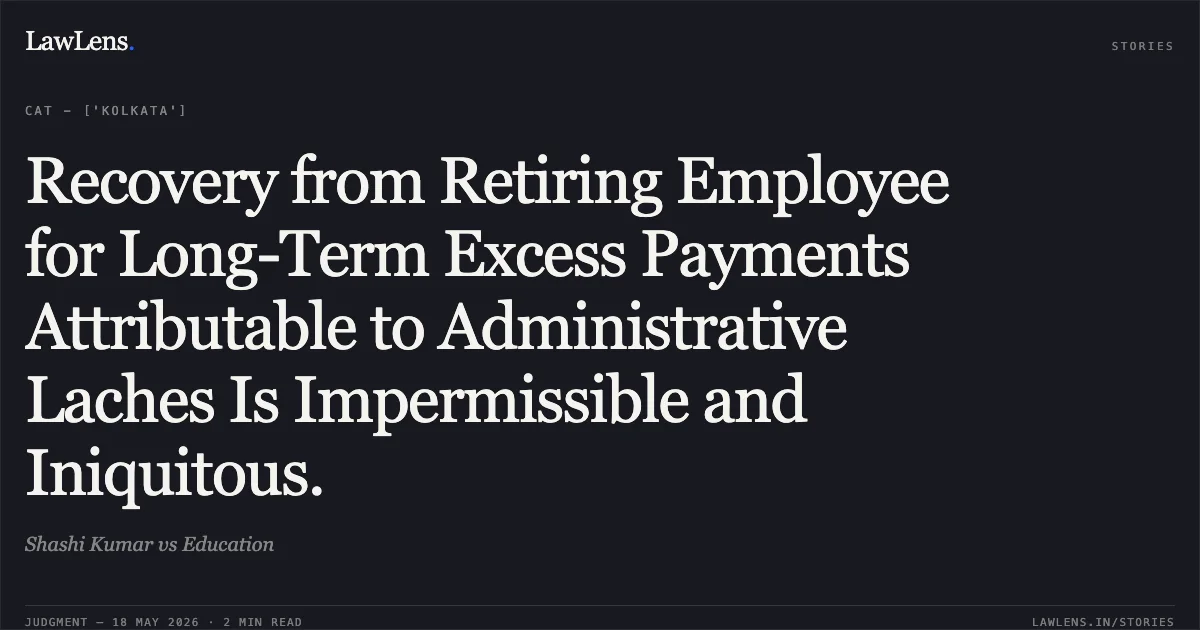
The court primarily applied the equitable principles governing the recovery of excess payments from employees as settled in State of Punjab & Ors. v. Rafiq Masih (White Washer), which prohibits recovery from retiring employees or when payments were made for over five years
Source reference: p.10, 14It further relied on Thomas Daniel v. State of Kerala, which reiterated that recovery is impermissible if the excess payment was not due to any misrepresentation by the employee
Source reference: p.10, 14While the respondents cited Chandi Prasad Uniyal v. State of Uttarakhand and High Court of Punjab & Haryana v. Jagdev Singh regarding the recovery of public money and conditional benefits, the court distinguished these based on the specific hardships and timelines involved
Source reference: p.10-11, 13-14Reasoning
The Tribunal observed that while the respondents were within their rights to impose a qualification condition in 1994, they failed to enforce it for 25 years, thereby creating a legitimate expectation of entitlement in the applicant
Source reference: p.12-13The court reasoned that in the interest of equity, the applicant’s 32 years of service and professional experience should be treated as a substitute for the missing qualification
Source reference: p.13Regarding recovery, the Tribunal found that the applicant was not at fault for the "mistaken" payments. Applying the criteria from Rafiq Masih, the court noted that the recovery was ordered after a gap of 25 years and on the eve of retirement, making it iniquitous and harsh
Source reference: para. 11-12The court emphasized that the respondents' action of granting three successive financial upgrades (ACP/MACP) indicated total satisfaction with the applicant's service record until the abrupt reversal
Source reference: p.14Holding
The Tribunal answered both issues in the negative. It held that the re-fixation and subsequent recovery were legally unsustainable and "impermissible as per law laid down by the Hon’ble Supreme Court"
The Tribunal quashed the impugned orders dated 19.09.2019, 28.11.2019, 16.06.2020, 01.10.2020, and 25.01.2021. The respondents were directed to grant the applicant his full pension and retiral dues, ignoring the lack of professional qualification and without any recovery, within 60 days
Source reference: para. 13Acts & Sections Cited
1 provisions across 1 statute referred to in this judgment. Each provision opens on LawLens.
Administrative Tribunals Act, 19851
Original Court PDF
Shashi KumarvsEducation
Click to open original judgment
Original judgment, available to read, download and summarize on LawLens.in