Facts
The petitioner, Constable No. 476, had been serving in the Police Department since 19 October 1993.
Source reference: paras. 1–2His pay was purportedly refixed by an order dated 16 October 2019, a copy of which was neither supplied to him nor otherwise communicated.
Source reference: paras. 1–2On the basis of a subsequent calculation, the respondents determined that excess salary had been paid and initially directed recovery of ₹1,81,878, later revising it to ₹1,34,510.
Source reference: paras. 6–8The recovery related to the period beginning in 2011–2012, with interest also applied, although the respondents had recalculated the petitioner’s salary from 2006 onwards.
Source reference: paras. 6–8The petitioner contended that the excess payment was not caused by fraud, misrepresentation, or any act attributable to him, and that the recovery had been ordered without notice or hearing.
Source reference: paras. 1–2, 6–8He sought quashing of the recovery, stating that the amount had already been recovered from his salary.
Source reference: paras. 1–2, 6–8Issues
Whether recovery of alleged excess salary paid to a Class III employee, without any allegation of fraud or misrepresentation and without prior notice or hearing, was legally sustainable.
Source reference: paras. 1–3, 8Whether the principle permitting recovery pursuant to an undertaking, as recognised in High Court of Punjab and Haryana v. Jagdev Singh, applied to the petitioner’s case.
Source reference: paras. 4, 8Whether the amount already recovered from the petitioner was liable to be refunded.
Source reference: paras. 7–9Law Applied
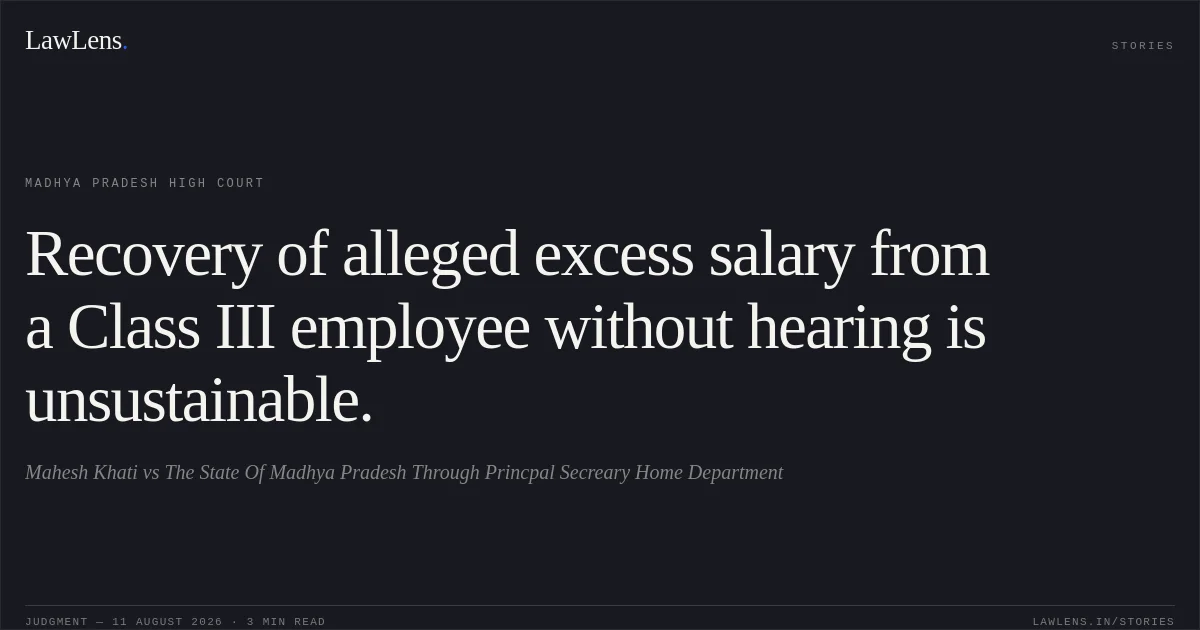
The Court relied on the principle in State of Punjab v. Rafiq Masih (Whitewasher), (2015) 4 SCC 334, that recovery of excess payments is generally impermissible in cases involving employees in lower service categories, including Class III employees, particularly where the excess payment was not obtained through fraud or misrepresentation.
Source reference: paras. 3, 8It also applied the principles of natural justice, holding that a unilateral refixation of pay and consequential recovery without notice or an opportunity of hearing is unsustainable.
Source reference: paras. 3, 8The Court considered High Court of Punjab and Haryana v. Jagdev Singh, AIR 2016 SC 3523, but distinguished it on the ground that recovery in that case was supported by an undertaking given at the time of pay revision, whereas no such undertaking or comparable pay-revision circumstance was shown here.
Source reference: paras. 4, 8Reasoning
The Court found that the respondents’ tabulation did not establish that the alleged excess payment resulted from a pay revision or incorrect fixation supported by an undertaking.
Source reference: paras. 6–8It also found no allegation that the petitioner had secured the excess payment through fraud or misrepresentation.
Source reference: paras. 6–8Since the petitioner was a Class III employee and the recovery was imposed after unilateral recalculation, without supplying the refixation order or providing an opportunity to contest the determination, the action violated natural justice and fell within the protective principle in Rafiq Masih.
Source reference: paras. 6–8The Court further noted that the petitioner was nearing retirement and that the recovery related to payments allegedly made over several years, making it appropriate to resolve the matter finally rather than remit it for further proceedings.
Source reference: para. 9Holding
The Court held that the recovery of ₹1,34,510 from the petitioner was unsustainable and quashed it.
As the amount had already been recovered, the respondents were directed to refund the entire recovered sum within three months from the date of communication of the order.
Source reference: paras. 8–10The writ petition was accordingly disposed of.
Source reference: paras. 8–10Original Court PDF
Mahesh KhativsThe State Of Madhya Pradesh Through Princpal Secreary Home Department
Click to open original judgment
Original judgment, available to read, download and summarize on LawLens.in