Facts
The petitioner was appointed as Technician Grade-1 at Jamalpur Workshop in 1980
Source reference: p. 2In 2000, he was declared surplus and opted for redeployment to the Howrah Division, where he joined in July 2001
Source reference: p. 2Despite moving to Howrah and drawing House Rent Allowance (HRA) there, the petitioner retained his official Railway accommodation at Jamalpur until January 20, 2010
Source reference: p. 3, 6On March 30, 2010, the Railway Authority issued a memo seeking to recover ₹5,86,920/- for damage rent, electricity, and water charges for the period of unauthorized occupation (2001–2010)
Source reference: p. 3, 7The petitioner’s representation for waiver was rejected via a reasoned order dated June 6, 2013
Source reference: p. 3The Central Administrative Tribunal (CAT), Calcutta Bench, dismissed his challenge (OA No. 1551 of 2013) on October 6, 2016
Source reference: p. 1-2Issues
1. Whether the Railway Authority was justified in recovering damage rent and utility charges from a transferred employee who retained previous accommodation while drawing HRA at the new station
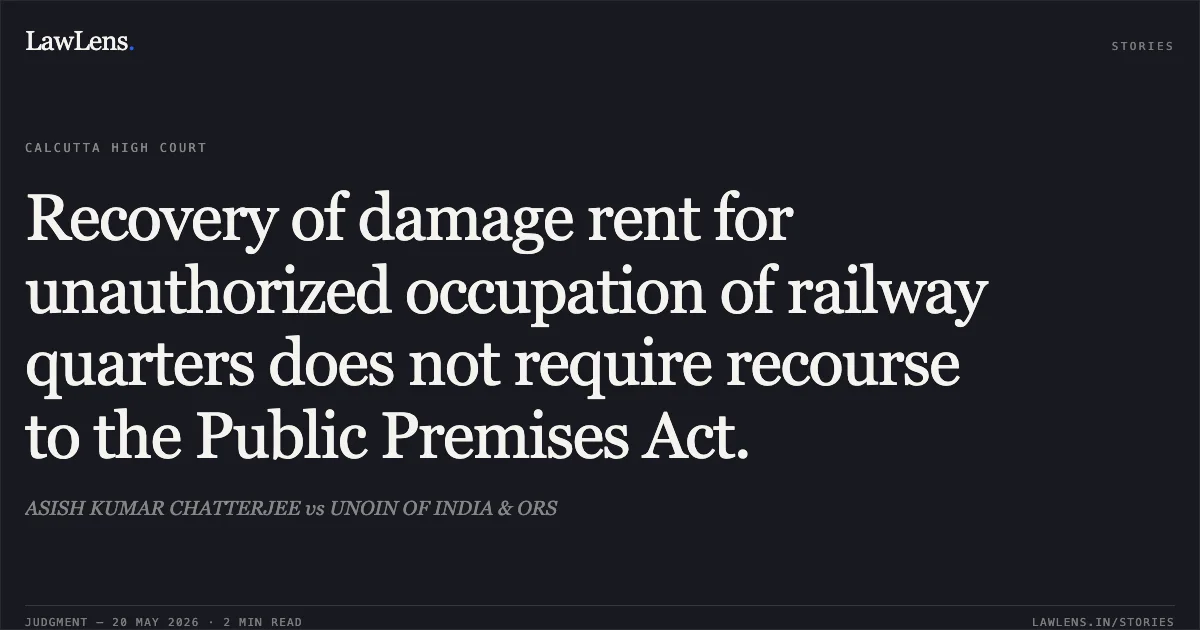
Source reference: p. 8-92. Whether the recovery of damage rent from an employee's salary requires the prior initiation of proceedings under the Public Premises (Eviction of Unauthorised Occupants) Act, 1971
Source reference: p. 5, 9Law Applied
The Court applied the principle that a transferred employee cannot simultaneously draw HRA at a new station and retain official accommodation at a previous station
Source reference: p. 9recourse to the Public Premises (Eviction of Unauthorised Occupants) Act, 1971, is not a prerequisite for recovering damage rent from a serving employee [P.R. Subramaniyam v. Union of India (1978 SCC (L&S) 35)]
Source reference: para. 18the "cardinal principles" of certiorari jurisdiction restrict High Courts from acting as an appellate court or re-weighing evidence when reviewing tribunal orders [Central Council for Research in Ayurvedic Sciences v. Bikartan Das (2023 16 SCC 462)]
Source reference: para. 19Reasoning
The Court found that the petitioner’s retention of the Jamalpur quarter for nearly nine years after his transfer to Howrah was legally indefensible, particularly as he was drawing monthly HRA at the new posting
Source reference: p. 9The petitioner's reliance on a 2004 Railway Board circular regarding the retention of accommodation was rejected because he failed to produce or argue this before the lower tribunal or the respondent authorities
Source reference: para. 16Addressing the procedural challenge, the Court affirmed the CAT’s finding that the authorities are not mandated to follow the 1971 Act's eviction procedures simply to calculate and recover damage rent from a current employee’s salary
Source reference: para. 18Under its supervisory jurisdiction under Article 226, the Court concluded that there was no "error of law apparent on the face of the record" nor any jurisdictional excess in the tribunal's judgment
Source reference: para. 19, 20Holding
The Court answered both issues in the affirmative for the respondents, holding that the recovery of ₹5,86,920/- was justified and legally proceded
The High Court dismissed the writ petition, vacated any interim orders, and upheld the CAT’s judgment, ruling that it had taken a "plausible view" that did not warrant interference in writ jurisdiction
Source reference: para. 20, 21Acts & Sections Cited
1 provisions across 1 statute referred to in this judgment. Each provision opens on LawLens.
Administrative Tribunals Act, 19851
Original Court PDF
ASISH KUMAR CHATTERJEEvsUNOIN OF INDIA & ORS
Click to open original judgment
Original judgment, available to read, download and summarize on LawLens.in


