Facts
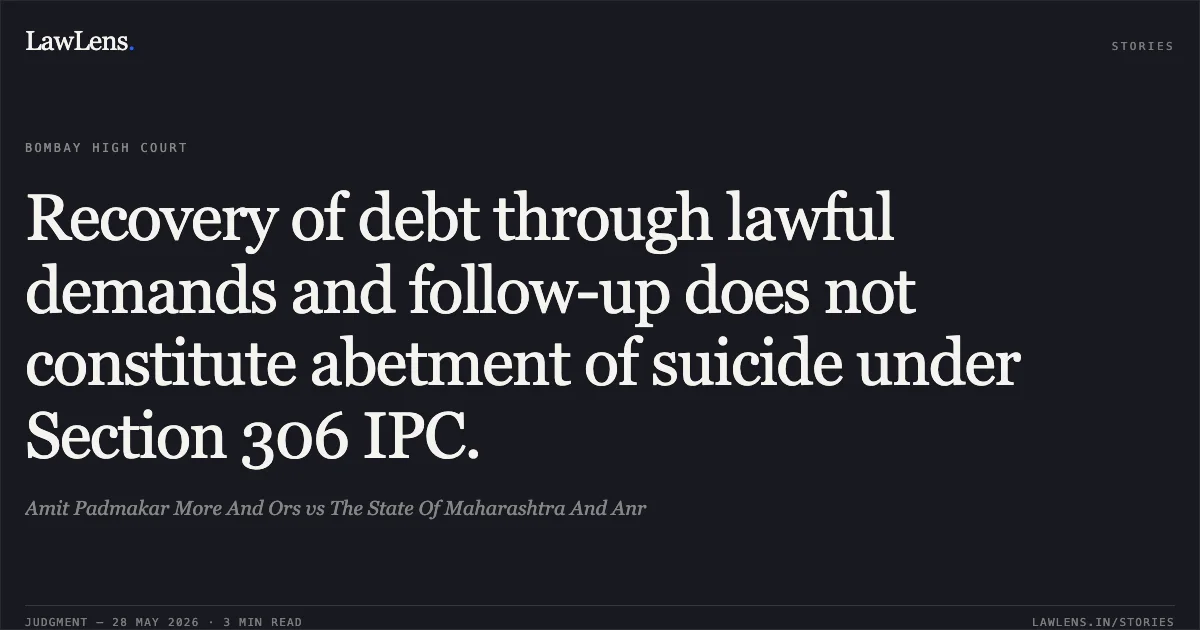
The Applicants sought quashing of FIR No. 396 of 2022 and subsequent proceedings in R.C.C. No. 423 of 2024 for offences under Section 306 read with Section 34 of the IPC.
Source reference: para 1The Respondent No. 2 (informant) alleged that her husband, a retired teacher, committed suicide by consuming poison on September 10, 2022, due to persistent harassment and loan recovery demands by the Applicants.
Source reference: paras 3.1, 5.1The Post-Mortem Report dated August 10, 2022, cited the cause of death as "auto myocardial infraction leading to cardiorespiratory arrest" (heart attack).
Source reference: para 4.2A Chemical Analysis Report from May 26, 2023, confirmed that no traces of poison were found in the viscera.
Source reference: para 4.9The Medical Officer confirmed the final cause of death was natural.
Source reference: para 4.11Despite this medical evidence, the police filed a chargesheet alleging the mental pressure of the debt caused the fatal heart attack.
Source reference: para 4.12Issues
1. Whether the mere demand for repayment of a loan constitutes "abetment" under Section 107 of the IPC so as to attract criminal liability under Section 306.
Source reference: paras 9, 122. Whether criminal proceedings can be sustained for abetment of suicide when medical evidence establishes the cause of death as natural/cardiac arrest rather than suicide.
Source reference: paras 10, 16Law Applied
The Court applied Sections 306 and 107 of the Indian Penal Code, emphasizing that abetment requires a mental process of instigating or intentionally aiding the commission of suicide.
Source reference: paras 6.1, 6.2It relied on the landmark precedent State of Haryana v. Bhajan Lal, which permits quashing where allegations do not disclose an offence or are inherently improbable.
Source reference: para 6.3It further integrated principles from Amalendu Pal v. State of West Bengal and M. Arjunan v. State, holding that harassment without a positive act proximate to the time of occurrence does not constitute abetment.
Source reference: paras 6.5, 6.6The Court relied on Rajiv Thapar v. Madan Lal Kapoor, which establishes that criminal proceedings must be quashed when unimpeachable medical/forensic evidence (like PM and CA reports) contradicts the prosecution's theory of unnatural death.
Source reference: para 6.10, 10Reasoning
The Court observed that the entire foundation of the FIR—death by poisoning—was categorically belied by the Post-Mortem and Chemical Analysis reports, which proved the deceased died of a natural heart attack.
Source reference: para 10, 12The Court reasoned that to attract Section 306, there must be a "suicide" and a "positive intentional act" of instigation that leaves the victim with no alternative.
Source reference: para 8A creditor’s pursuit of a debt is a lawful act and does not amount to abetment unless accompanied by a conscious deliberate intention to drive the person to suicide.
Source reference: paras 9, 12The Court found the allegations to be vague, general, and lacking any proximity or link between the Applicants' actions and the death.
Source reference: para 13, 16It noted that the deceased might have been under stress from other factors, such as a separate loan of Rs. 4,00,000/- or being cheated in a land transaction.
Source reference: para 14Holding
The Court concluded that the invocation of Section 306 was untenable as there was no evidence of suicide or abetment.
The application was allowed, and the FIR No. 396 of 2022 and R.C.C. No. 423 of 2024 were quashed qua the Applicants. The Court held that continuing the proceedings would be an abuse of the process of law, particularly when the allegations were contrary to the medical records. The proceedings shall continue against other co-accused not part of this application.
Source reference: para 16, 17, 17(ii)Acts & Sections Cited
2 provisions across 2 statutes referred to in this judgment. Each provision opens on LawLens.
Bharatiya Nagarik Suraksha Sanhita, 20231
Code of Criminal Procedure, 19731
Original Court PDF
Amit Padmakar More And OrsvsThe State Of Maharashtra And Anr
Click to open original judgment
Original judgment, available to read, download and summarize on LawLens.in